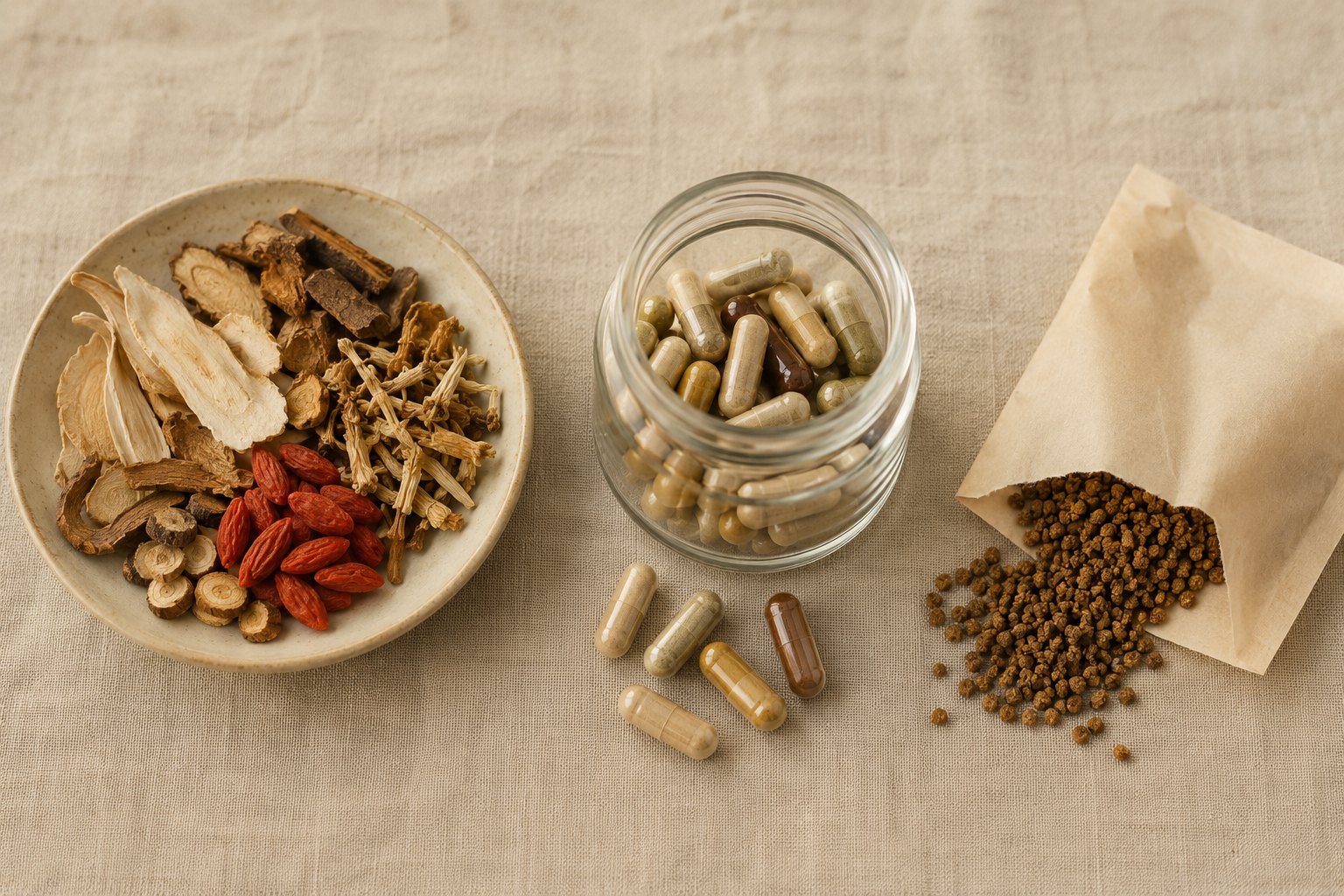
"Doctor, I have a pile of tonics and supplements at home — some brought back from overseas by relatives, some I bought myself, plus the Chinese medicine you prescribed. Can these all be taken together?"
This question comes up often in Malaysia. Many households keep several bottles of supplements alongside traditional tonics and prescribed Chinese medicine, without being clear on how these differ or whether mixing them is safe. This article breaks it down into 5 key points: the differences between "tonics," "supplements," and "Chinese medicine," how each is meant to be used, and what to watch out for before combining them.
I. The Basic Layer — What Each of These Really Is
Tonics (补品) in everyday Malaysian Chinese usage refers to foods or ingredients believed to be nourishing or strengthening. Examples include chicken essence, bird's nest, Cordyceps, Pao Shen (American ginseng) and Korean ginseng. They come from traditional food culture and are usually seen as part of daily nourishment rather than something taken only when unwell.
Supplements are products positioned as "health-supporting" and come in forms like capsules, tablets, powders, or liquids. They typically contain specific ingredients such as vitamins, minerals, fish oil, or probiotics. These products are standardised — each pill or sachet has a fixed amount of the ingredient, clearly labelled for consumers.
Chinese medicine refers to formulas prescribed by a TCM practitioner after a consultation. In Malaysia, forms include traditional decocted herbs, concentrated scientific Chinese medicine (granules or powders extracted and concentrated from herbs), and registered Chinese proprietary medicines (such as pills or capsules). Chinese medicine is individualised — the formula is built around the person's condition, not the same for everyone.
The fundamental difference: tonics and supplements are products you choose yourself, while Chinese medicine is a prescription issued by a practitioner based on assessment.
⚠️ A safety note: TCM and Western medicine complement each other; it is not a choice between them. If you are under medical treatment, TCM care is a layer added on top — not a layer swapped in — and never stop a prescription on your own.
II. The Common Confusion — "Chinese Medicine" Is Not the Same as "Chinese Herbal Materials"
Many people assume that "Chinese medicine" refers to the dried herbs on the shelves of a medical hall. This is one of the most common mix-ups.
In fact, "Chinese herbal materials" (中药材) are the raw ingredients — dried plants, animal parts, or minerals, such as dang gui, wolfberry, or astragalus. These materials are indeed the basis of Chinese medicine, but in TCM theory, the use of a single herb and the formulation of a compound prescription are two very different things.
When a TCM practitioner writes a prescription, they are not stacking "useful herbs" together. They select specific herbs and determine each one's dosage to create a coherent formula that matches the person's condition. This is why two people with the same cold may receive completely different prescriptions.
So treating "herbal materials" as equivalent to "Chinese medicine" is like treating flour as equivalent to a cake — flour is an ingredient, while a cake is the finished product, and between them lies a recipe, proportions, and a process.
💡 Keep this in mind: herbal materials are raw ingredients; Chinese medicine is a combination prescribed by a practitioner. They are not the same thing.
III. A Table to Make It Clear — Comparing Tonics, Supplements and Chinese Medicine
| Comparison | Tonics | Supplements | Chinese Medicine |
|---|---|---|---|
| Origin | Ingredients or prepared foods from traditional food culture | Standardised manufactured products | Formulas prescribed by a registered TCM practitioner |
| How to obtain | Buy yourself | Buy yourself | Requires assessment by a registered TCM practitioner |
| Common forms | Chicken essence, bird's nest, Pao Shen, soup ingredients | Capsules, tablets, powders, liquids | Decoction herbs, concentrated scientific Chinese medicine, Chinese proprietary medicines |
| Purpose logic | Aimed at "supplementary nourishment" | Aimed at "supplying specific ingredients" | Individualised: built on pattern differentiation (辨证), matched to the person's condition |
| Category | Generally treated as food | A registered product (registration number on the packaging) | Part of registered TCM practice under the T&CM Act |
This table deliberately does not state how often to take these or for how long. Those factors depend on each individual, and should be explained by the practitioner assessing you. The point of the table is this: these are three different categories, with different purposes, ways of obtaining them, and logics of use.
IV. When to Be Extra Careful — Points to Note Before Combining
- List everything out: when you see a TCM practitioner or a doctor, list every tonic, supplement, and medication you are currently taking. Include items from overseas, bought online, and daily vitamins — everything.
- Pay attention to products of unclear origin: if the packaging lacks clear registration information, ingredient labels, or expiry dates, the level of uncertainty is higher, and extra caution is needed.
- The same ingredient may repeat: some supplements and Chinese medicines contain ingredients with similar functions. Taking both at the same time effectively increases the total intake of that component. If unsure, ask a professional.
- ⚠️ Safety reminder: do not self-combine tonics, supplements, and Chinese medicine from different sources before consulting a professional. If you experience any discomfort after taking them, stop and contact your practitioner or doctor.
- For emergencies: if you experience a severe allergic reaction (such as difficulty breathing or facial swelling) or loss of consciousness, call 999 now, or go to the nearest emergency department.
⚠️ If you are taking prescription medication from a doctor, make sure your doctor knows that you are also using Chinese medicine or supplements. Never stop or reduce your prescribed medication on your own — any adjustment should be done under professional guidance.
A note: this section is general information only. For conditions like these, follow your doctor's diagnosis and treatment, and seek medical attention when you need it.
V. How to Arrange It in Malaysian Life — Practical Scenarios
Scenario 1: Receiving a pile of tonic gift boxes during Chinese New Year Receiving bird's nest, Pao Shen, or chicken essence during the festive season is common. There is nothing right or wrong about the gift boxes themselves, but if you are already taking Chinese medicine or Western medication, it is worth bringing the gifts to your practitioner after the holidays to confirm whether they can be consumed alongside what you are taking.
Scenario 2: A friend recommends a supplement over teh tarik at the mamak "My fish oil is really good, why don't you try it?" — this sounds casual, but your friend's supplement was chosen based on their situation, not yours. A polite "let me check with my practitioner first" is not being difficult; it is being responsible.
Scenario 3: Taking a handful of supplements every day but forgetting to mention them Some people habitually take vitamin C, calcium, and probiotics every morning, yet say nothing during consultations. These products may be common, but they can still interact with Chinese medicine or Western drugs. Bring all your supplements to the consultation, or write them down on a piece of paper in advance — a simple and effective habit.
Scenario 4: Coming across a product online that is marketed for a particular purpose Before buying or consuming it, check whether the packaging carries a registration number, then ask yourself: "Do I actually need this?" — if the answer is unclear, ask a practitioner or a doctor.
💡 Keep this in mind: whether tonics, supplements, Chinese medicine, and Western medication can be combined is a matter for professionals to assess. Telling them everything you take is the first step in protecting yourself.
In closing
✅ Keep these in mind:
- Tonics are nourishing foods from food culture; supplements are standardised products; Chinese medicine is a practitioner's prescription.
- These three differ in purpose, how they are obtained, and how they are meant to be used.
- Herbal materials are raw ingredients, not the same as a prescribed Chinese medicine formula.
- Tell your practitioner and your doctor about every supplement and medication you are using.
- Before combining products from different sources, seek professional advice first.
❌ What not to do:
- Do not buy supplements just because a friend recommended them, especially if you already take other products.
- Do not self-combine tonics, supplements, and Chinese medicine — pause until you have professional assessment.
- Do not stop or reduce your medication on your own — whether Western medicine or Chinese medicine, any change should be discussed with your practitioner or doctor first.
👉 If you are unsure whether "all those tonics and supplements at home can be taken together," feel free to reach out to HansMed for an online consultation with a practitioner registered under the T&CM Act 2016.
Sit with a licensed TCM practitioner from wherever you are.
HansMed Modern TCM
For general wellness education only — not medical advice. Consult a registered TCM practitioner for personal guidance.


