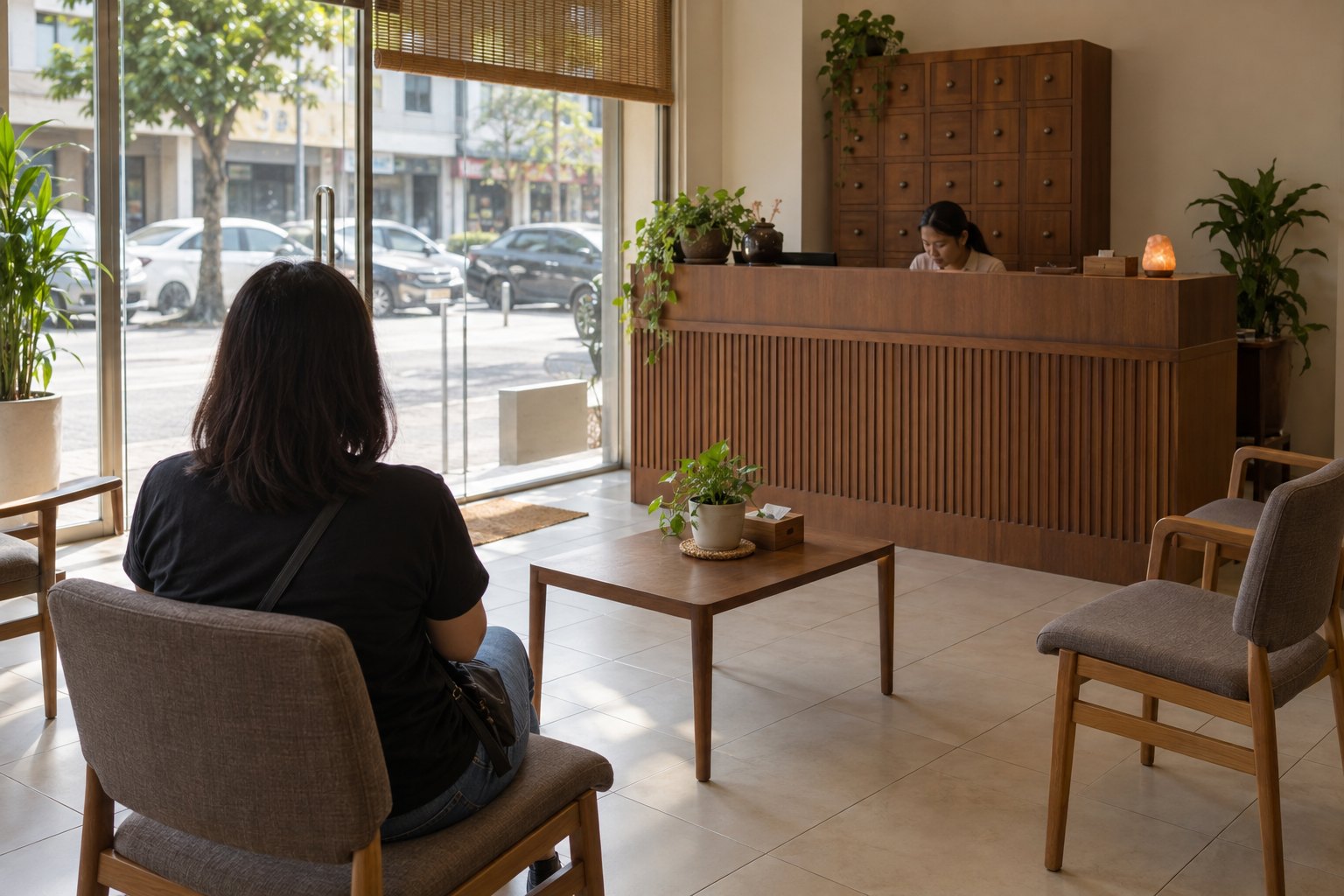
For many people, the first feeling about TCM is not scepticism. It is unfamiliarity.
You don't know what to bring, what you'll be asked, how long it takes, or what you'll be holding when you walk out. That unfamiliarity is enough on its own to put people off.
This article walks through the whole sequence. By the end, a first consultation should no longer be an unknown.
1. Before you book: prepare three things
First, a list of everything you currently take.
This is the most important item and the most commonly forgotten one. Include prescription medication, over-the-counter medicine, supplements, vitamins, and any tonics or herbal teas you drink regularly. Photographing the boxes is the easiest method.
Why it matters: a TCM practitioner needs to know what is already in the picture before suggesting anything. This is a safety step, not paperwork.
Second, write your questions down.
People get flustered in consultations, and flustered people forget. Written questions don't.
Third, notice your own routine.
Sleep, appetite, digestion, menstrual cycle where relevant — most of these will come up. You don't need a tracking chart. A rough sense of your own week is enough.
What you do *not* need to do: you don't need to fast, you don't need to stop any medication you are taking (any change to prescribed medication is decided by the practitioner who prescribed it), and you don't need to look up your own "constitution" beforehand. Working that out is the practitioner's job, not your homework.
2. The consultation: what you'll be asked
A first consultation usually runs longer than people expect.
TCM questioning traditionally covers a wide range — beyond the concern that brought you in, you can expect questions about sleep, appetite, digestion, whether you tend to feel cold or warm, sweating, and energy through the day.
Why so many questions that seem unrelated?
Because in the TCM framework the body is treated as an interconnected whole, and the practitioner is gathering enough information to form an overall assessment rather than responding to a single symptom. The classical texts organised this range of questioning into what is known as the "ten questions"; modern clinical practice extends from that tradition.
For you, the practical implication is simple: the more specific your answers, the more accurate the picture. "I don't sleep well sometimes" is much less useful than "three or four nights a week I wake around 3am and take an hour to fall back asleep."
3. The four examinations
You may have heard the term "four examinations" (四诊). It refers to the four channels through which TCM gathers information — looking, listening/smelling, asking and pulse taking. They are not four separate tests but four different sources, used to corroborate each other:
- Looking — observation, including complexion and posture, and the tongue, which TCM pays particular attention to: colour, and the thickness and distribution of the coating.
- Listening and smelling — a single term in Chinese covering observations of voice and odour.
- Asking — the questioning described above.
- Touching — pulse taking. The practitioner feels the quality of your pulse at the wrist.
Pulse taking is usually done on both wrists and takes a little time on each. It does not hurt. All you need to do is relax your arm and breathe normally.
Only once these four sources are taken together does the practitioner form an assessment — a process TCM calls pattern differentiation (辨证). This is the key thing to understand about TCM: the practitioner is working with an assessment of an overall state, not a disease label. Two people who both come in about poor sleep may be assessed quite differently, and what is suggested afterwards differs accordingly.
It is also why TCM advice travels badly on the internet. It was never meant to be general.
4. Explanation and recommendations
After the assessment, the practitioner will explain what they have concluded and what they suggest.
You are entitled to ask for clarity here. Reasonable and worthwhile questions include:
- What is the TCM assessment of my situation?
- What are you suggesting, and why that approach rather than another?
- Roughly how long, and how often would I come back?
- Is there anything I should be careful about or avoid?
- Could this affect the Western medication I'm on?
Please do ask that last one. TCM does not replace Western medicine. Where the two run alongside each other, the considerations should be raised by the practitioner and confirmed by you.
5. Dispensing: if herbs are prescribed
If the practitioner concludes that herbal medicine is appropriate, the next step is dispensing.
Several forms are common in Malaysia: traditional raw herbs that you decoct yourself, granules or concentrated powders that dissolve in hot water, and prepared forms such as pills and pastes. Which suits you is the practitioner's recommendation, and your routine is a legitimate part of that conversation — if you work until ten most nights, simmering herbs for an hour is not realistic, and that is worth saying out loud.
When you receive anything, confirm three things: how to take it, when to take it, and for how long. If you are given raw herbs, ask how to prepare them. This is usually printed on the packet, but confirming once in person is safer.
If the practitioner concludes that herbs are not needed, that is a legitimate outcome too. TCM is not only herbal medicine — acupuncture, tuina, moxibustion, cupping and adjustments to daily routine are all within scope. Not every consultation ends with a prescription.
6. After the consultation
Follow-up matters. TCM recommendations are usually given in stages, and the practitioner revises the approach based on how things stand when you return. The first set of recommendations is a starting point, not a fixed conclusion.
Note whether anything changes. Nothing elaborate — just whether sleep, energy and appetite are any different, in enough detail to describe at your next visit.
Contact your practitioner if anything feels off. Whether it is a reaction after taking something or a sensation after treatment, asking is always better than guessing.
7. How online consultations differ
If you book an online consultation, looking and asking proceed much as they would in person — the conversation is complete, and the tongue can be observed from a photograph. Pulse taking is the part that cannot be done remotely. There is no reason to be coy about that: it is a genuine limitation of online consultation.
At HansMed, the tongue photograph from an online consultation is processed by the system and then reviewed and decided on by a registered TCM practitioner. The judgement stays with the practitioner.
Online and in-person each suit different situations. We cover that in a separate article.
8. Common questions
How long does it take? A first consultation is usually longer, because the questioning is broad. Follow-ups are generally shorter.
Do I need to undress? Not for questioning alone. If acupuncture, cupping or tuina is done in the same session, a specific area may need to be exposed, and the practitioner will tell you beforehand. Loose clothing that rolls up easily makes it simpler.
Can I see a Western doctor at the same time? Yes — and both should know about the other. TCM is complementary care, not an alternative. Being clear with both sides is the safest approach.
What is TCM suitable for? TCM largely deals with non-emergency health concerns. For emergencies, injuries, or severe or sudden symptoms, seek immediate medical attention or go to an emergency department. That is outside TCM's scope, and any responsible practitioner will tell you the same.
In closing
The practical preparation for a first TCM consultation comes down to two things: bring a list of what you currently take, and write your questions down.
The practitioner will walk you through the rest.
👉 If you are unsure where to start with a first TCM visit, you are welcome to book an online consultation with HansMed, where a practitioner registered under the T&CM Act 2016 can assess it with you.
Sit with a licensed TCM practitioner from wherever you are.
HansMed Modern TCM
For general wellness education only — not medical advice. Consult a registered TCM practitioner for personal guidance.


