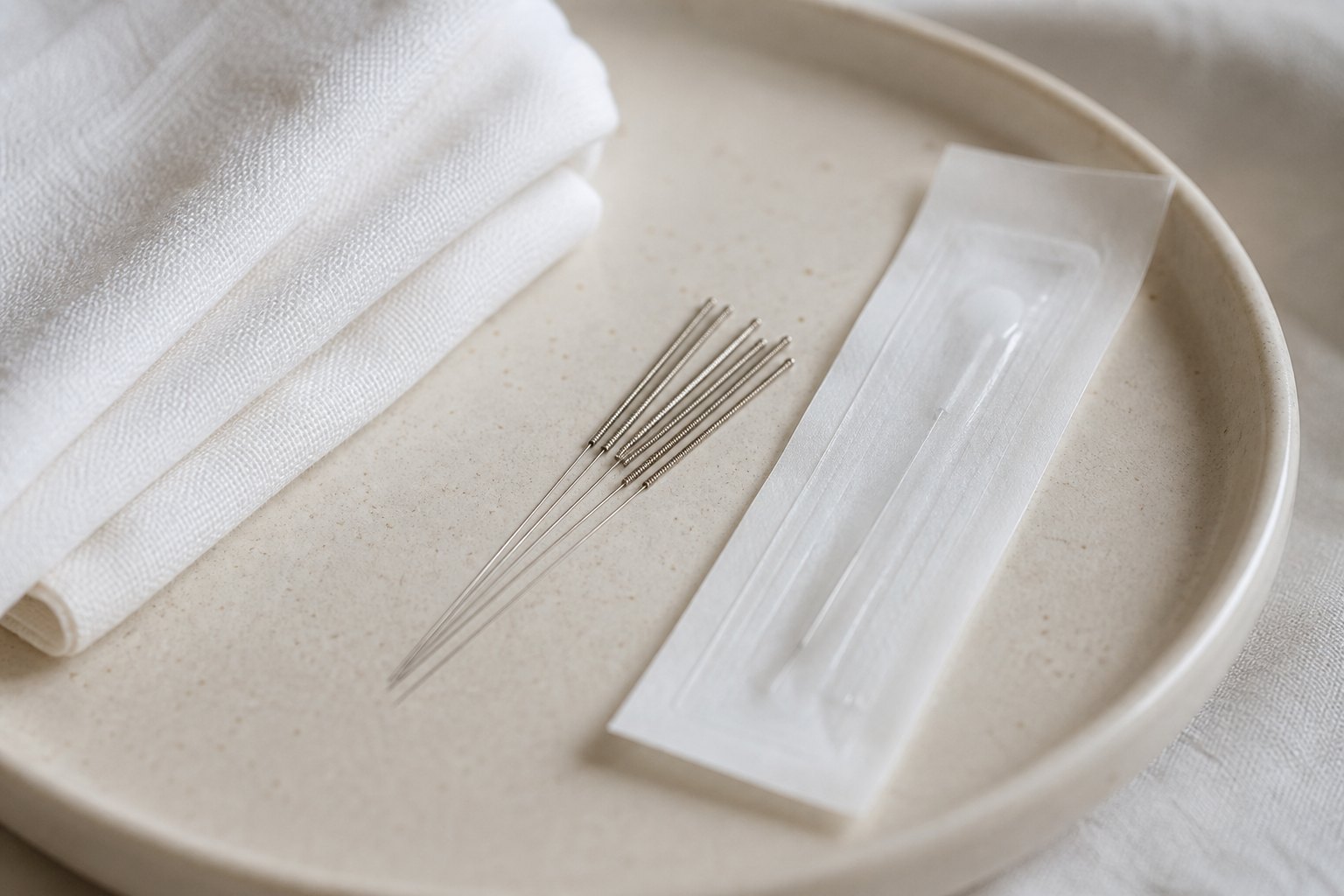
"Will it hurt?" is almost always the first question people ask when they are considering acupuncture for the first time.
This article will not tell you it's painless. That is a guarantee we cannot make on your behalf — people describe sensation differently.
What we can give you is concrete information: how thin the needles are, what the process involves, what reactions can occur, and what you should say. By the end you should know what you are dealing with.
1. How thin the needles are — start with the numbers
The needle most people picture is a hypodermic needle, the kind used to draw blood or give an injection. Those are hollow, because liquid has to pass through them, which sets a floor on how thick they can be.
Acupuncture needles are a different object. They are solid.
The needles we use are 0.12 to 0.25 mm in diameter. A common blood-draw needle (21G) is about 0.8 mm. That puts an acupuncture needle at roughly a sixth to a third of the diameter.
Another way to hold the scale: the finest acupuncture needles are comparable in thickness to a human hair.
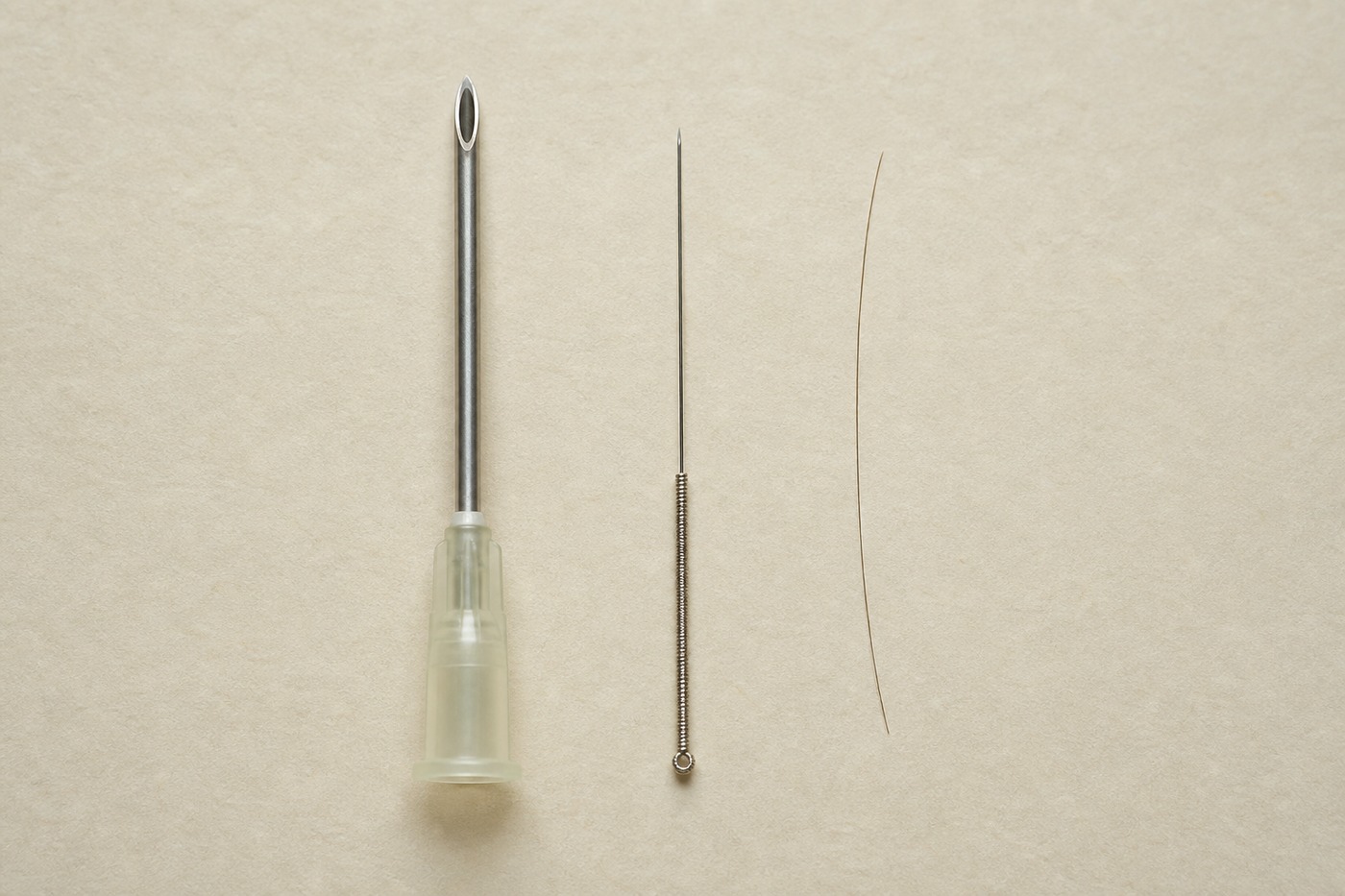
This is why insertion is a different experience from an injection — not a matter of tolerance, but of physics.
2. What the sensation is commonly like
Insertion is commonly described as a light tap or a brief prick, and at many points as barely detectable. Areas like the head, hands and feet are commonly described as more noticeable; areas with more muscle, less so.
Once the needle is in, TCM has a concept called deqi (得气).
Deqi refers to a particular sensation that arises when the needle reaches a certain depth and position. It is traditionally described as an ache, a tingle, distension, heaviness, or a spreading sensation travelling in some direction. In TCM theory it is regarded as one sign that the needling has produced a response.
This distinction matters: in the traditional descriptions, deqi and pain are not the same thing. In those descriptions the aching sensation is characterised as brief.
Needles are usually retained for 15 to 30 minutes, most of which people spend lying quietly.
3. If something feels wrong, say so immediately
This is the most practical section here.
If you experience sharp pain, burning, marked discomfort, or anything that unsettles you during a session, tell the practitioner straight away.
There is nothing to endure and nothing to "cooperate" with. The practitioner can adjust depth or angle, or remove the needle. That is standard practice, not an imposition.
Other moments to speak up:
- Feeling dizzy, nauseated, or lightheaded
- Vision darkening, breaking into a cold sweat
- Difficulty breathing
- Simply feeling that something is off, without being able to name it
Fainting during needling is among the reactions that can occur. The usual response is to remove the needles and have you lie flat and rest. Practice guidance is to eat something beforehand rather than have acupuncture on an empty stomach.
4. Needles and hygiene
There is no grey area on this one. The standard is explicit:
Acupuncture needles are single-use and sterile. They are disposed of after use and never reused.
Modern practice uses individually packaged sterile needles, opened at the point of use and discarded into a sharps container under clinical waste procedure.
What you can reasonably expect to see: the practitioner opening the packaging in front of you, cleaning their hands, and disinfecting the skin before needling. These are observable actions. If you don't see them, asking is entirely legitimate.
5. After a session
Reactions that can occur:
Small bruises at needle sites are among the reactions that can occur — a capillary catching the needle is enough to produce one. Local aching can also persist for a while.
Some people feel relaxed or sleepy afterwards; others report feeling more alert. Responses vary between individuals.
For the rest of the day:
- Avoid strenuous exercise
- Drink water
- Keep needle sites clean and avoid prolonged soaking (baths, swimming) that day
- Rest if you feel tired
Contact your practitioner if:
- Bruising keeps spreading, or pain increases
- A needle site becomes red, swollen, hot, or discharges
- You develop a fever
- Any reaction persists and unsettles you
6. What to tell your practitioner beforehand
None of the following means you cannot have acupuncture. They mean the practitioner needs to know in order to adapt:
- Taking anticoagulant medication, or any bleeding or clotting condition
- Pregnancy, or possible pregnancy — certain points carry specific considerations
- A pacemaker or other implanted electronic device — directly relevant to whether electroacupuncture is used
- Skin infection, open wounds, or any skin condition at the intended site
- Previous fainting during needling
- Any immune-related condition, or ongoing related treatment
- A fear of needles — saying so is useful; the practitioner can adjust placement and number
That last one is worth underlining: being afraid of needles is not something to be embarrassed about. It is useful information.
7. Common questions
How many needles? It varies — anywhere from a few to a dozen or more, at the practitioner's judgement.
Where do they go? Not necessarily where the discomfort is. Point selection follows meridian theory, and using points on the hands and feet for concerns elsewhere is common practice.
How many sessions? The practitioner will suggest a course and frequency when explaining their recommendation. Ask directly — including "roughly when can we assess whether to continue?"
Can I have acupuncture on an empty stomach? Not advised — practice guidance is to eat something beforehand.
What should I wear? Loose clothing that rolls or lifts easily. If a specific area needs to be exposed, the practitioner will tell you beforehand.
When is acupuncture not the right route? For emergencies, injuries, or severe or sudden symptoms, seek immediate medical attention or go to an emergency department. Acupuncture is not the route for an emergency.
In closing
"Does acupuncture hurt?" — the honest answer is that the sensation is not the same as an injection. Sensation differs between people, and we won't presume yours.
What you can control is three things: say what needs saying beforehand, speak up during the session if something feels wrong, and contact your practitioner afterwards if anything seems off.
Do those three, and the rest is the practitioner's job.
👉 If you are unsure whether acupuncture is suitable for your situation, you are welcome to book an online consultation with HansMed, where a practitioner registered under the T&CM Act 2016 can assess it with you.
Sit with a licensed TCM practitioner from wherever you are.
HansMed Modern TCM
For general wellness education only — not medical advice. Consult a registered TCM practitioner for personal guidance.


