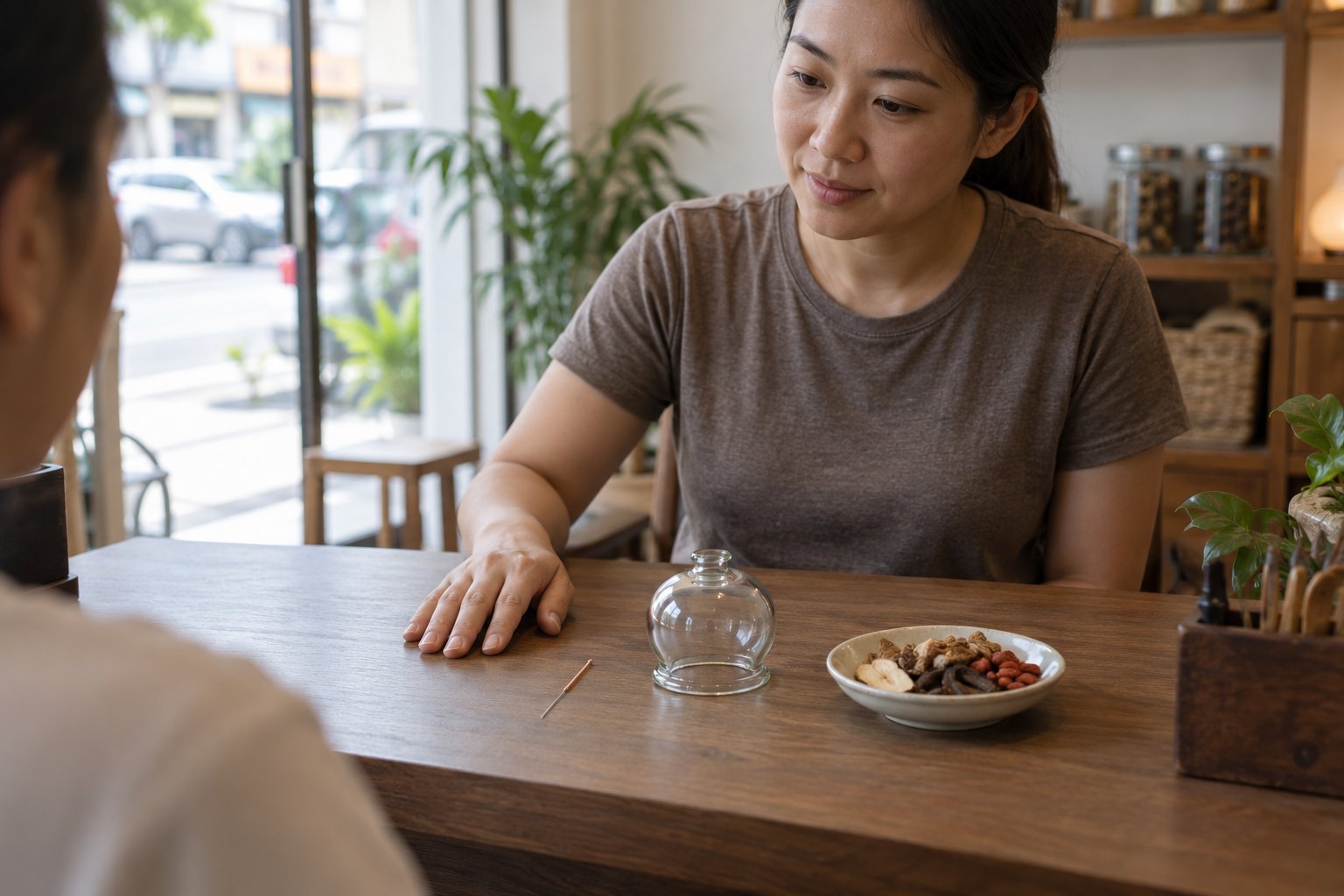
"My friend says acupuncture is the fastest, my mother says take herbs, and someone online swears by cupping — which one am I supposed to choose?" This is a question that comes up often. The options are all there, and everyone gives a different answer.
This article is not about which one is "better", because that question points in the wrong direction. Here are 5 things that show what a practitioner is actually looking at when making this decision.
I. First, these are not the same kind of thing
Lining up acupuncture, cupping and herbs to compare is a bit like comparing eating with walking — they were never options at the same level.
- Herbs are an internal method. The practitioner writes a formula; the medicine is absorbed and acts on the body as a whole.
- Acupuncture, cupping and tui na are external methods. The practitioner works directly on specific areas of the body surface.
Why those particular areas are chosen, and what the technique means within TCM, belongs to the theoretical framework of meridians and qi. That is a different kind of explanation from modern physiology.
💡 Remember: internal and external methods do not replace each other. A practitioner may use one, or more than one.
II. What a practitioner looks at before deciding
This is the heart of it, and the step most often skipped. A practitioner does not hear a complaint and match it to a technique — that would treat symptoms as signposts, and TCM does not work that way.
Before deciding, the practitioner will want to understand:
- Your situation as a whole — not only what troubles you most, but sleep, appetite, digestion and general state.
- How long, and how it changes — always like this, or recent; when it is more noticeable.
- Other care you are receiving — your doctor's diagnosis, medication you take, tests you have had.
- Your practical circumstances — whether you can attend regularly, how far you live, whether your working hours allow it.
That last one is easy to overlook, but it is a genuine consideration. A well-suited plan you have no time to complete is not, in the end, suited to you.
💡 Remember: the decision comes from assessing the whole picture, not from a lookup table of symptom to technique.
III. The basic differences at a glance
| How it is generally done | In person, or online | |
|---|---|---|
| Herbs (concentrated herbal granules) | The practitioner writes the formula; a licensed pharmacist at the partner pharmacy verifies it before it is sent to you | Can be done online |
| Acupuncture | The practitioner uses fine needles on specific areas of the body surface | In person |
| Cupping | A cup creates suction on the skin, lifting the surface gently | In person |
| Tui na | The practitioner uses pressing, kneading, pushing and grasping techniques on specific areas | In person |
This table deliberately does not say which is "faster" or how many sessions are needed. Those vary from person to person and should be explained by the practitioner who assesses you.
HansMed currently offers online consultations with herbal dispensing; in-person consultations are coming soon. So the in-person rows above describe general clinic practice, not a service we offer today. To read about individual methods: what cupping is, tui na compared with massage.
IV. Situations that need extra care
Whichever approach is chosen in the end, tell your practitioner before you decide if any of the following apply:
- You take prescribed medication, including long-term medication for a chronic condition. Make sure both your doctor and your TCM practitioner have the full picture, and never stop or adjust a prescription on your own.
- You take blood-thinning medication, or have a bleeding tendency — this affects whether external methods are appropriate.
- Pregnancy, confinement, or breastfeeding — both herbs and external methods need more caution.
- You have a pacemaker — say so before any external method.
- You have diabetes, heart disease or another chronic condition — follow your doctor's diagnosis and treatment, and let your treating doctor know you are also seeing a TCM practitioner.
- Broken skin, eczema or infection — the affected area is not suitable for external methods.
- Things are not improving, or new symptoms appear — see a doctor for tests rather than relying on TCM alone.
⚠️ A safety note: TCM and Western medicine complement each other; it is not a choice between them. If you experience chest pain, confusion, severe pain or difficulty breathing, call 999 or go to the nearest emergency department immediately, rather than weighing up which TCM approach to try.
A note: this section is general information only. For conditions like these, follow your doctor's diagnosis and treatment, and seek medical attention when you need it.
V. Fitting it into life in Malaysia
The reasoning is one thing; the practical question is how do I fit this around my hours and my distance?
- You cannot get time off work. This is precisely what online consultation is for. Set out the situation, let a practitioner assess it, and arrange in-person care if and when it is needed — more workable than putting it off indefinitely.
- You live outstation, or on a bad traffic route. Distance is itself a consideration. A practitioner factors it into any recommendation, so it is worth raising.
- The herbal soup your family cooks at home. That is part of everyday eating and is not the same thing as a formula written for you. If you are doing both, say so, so the practitioner knows what you are actually taking.
- You are also seeing a doctor. Have the diagnosis, test reports and medication list ready. It saves a great deal of back and forth — see what to prepare before an online consultation.
In closing
✅ Worth remembering:
- Acupuncture, cupping and herbs are not options of the same kind — internal and external methods can run alongside each other.
- The decision comes from assessing the whole picture, not from matching a symptom to a technique.
- Your practical circumstances count too — whether you can actually follow it through matters.
- Prescribed medication, pregnancy, a chronic condition or a bleeding tendency — say so before deciding.
- If things are not improving or new symptoms appear, see a doctor for tests.
❌ Better not to:
- Pick an approach by copying someone else's experience — their situation is not yours.
- Stop prescribed medication on your own because you have started seeing a TCM practitioner.
- Weigh up approaches while experiencing chest pain, severe pain or difficulty breathing — seek medical attention immediately.
👉 If you are unsure where to start, you are welcome to book an online consultation with HansMed, where a practitioner registered under the T&CM Act 2016 can assess it with you. In-person consultations are coming soon.
Sit with a licensed TCM practitioner from wherever you are.
HansMed Modern TCM
For general wellness education only — not medical advice. Consult a registered TCM practitioner for personal guidance.


