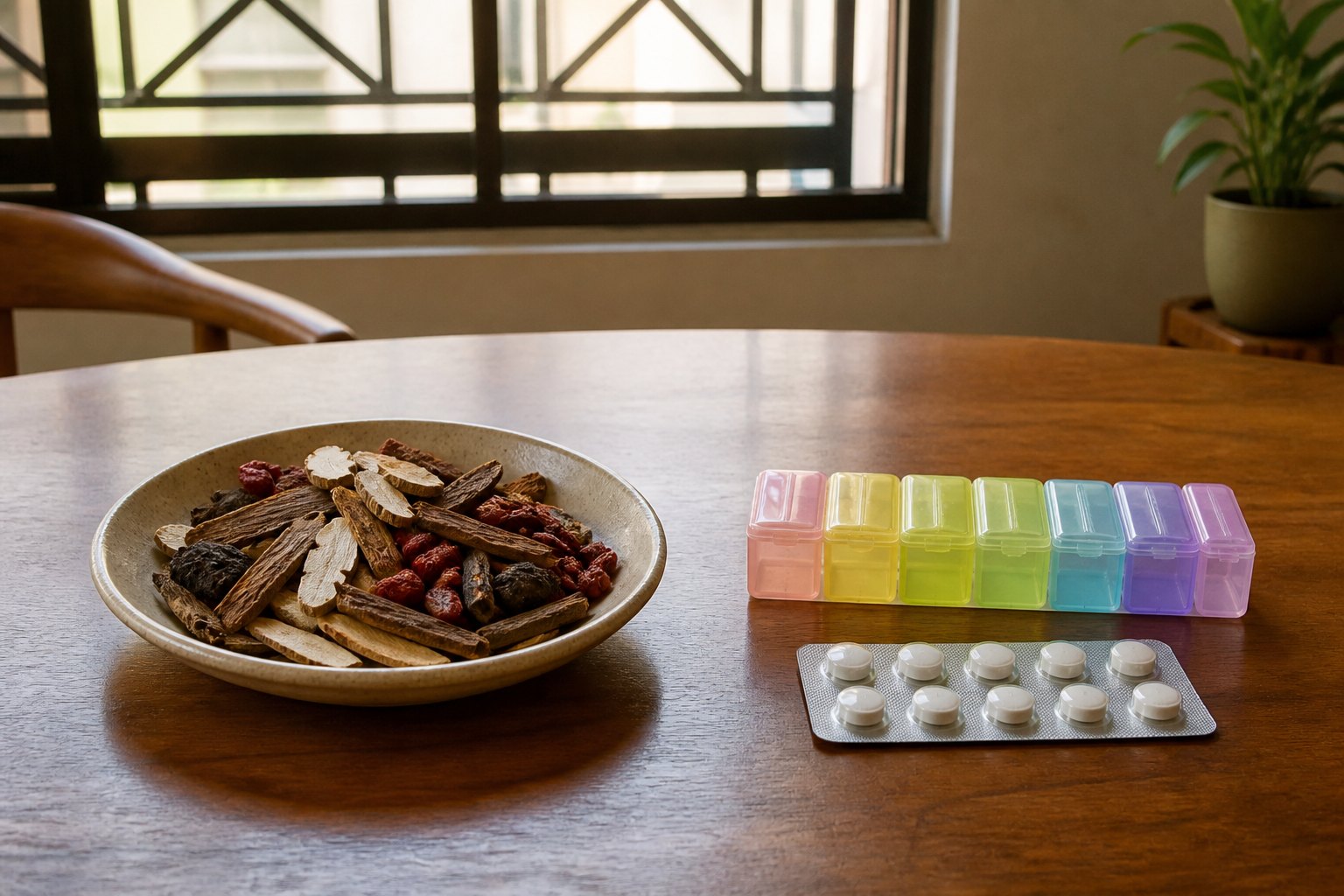
"I'm on blood-pressure medication. How long do I wait before taking the herbs you prescribed?" A question that comes up often is this one, from someone already on Western medication, curious about TCM, and worried the two will clash.
The answer first. Hong Kong's Hospital Authority, through its Chinese medicine pharmacist team, holds that used properly, most Chinese and Western medicines are generally safe to take together, and that the usual practice is to space them at least one to two hours apart. [HA-2024] HansMed's condition is: both practitioners know.
"Used properly" has conditions. These six things are the conditions.
I. Herbs are medicine, which is exactly why they can interact
"Herbs are natural, so they're gentle and harmless" is a common misunderstanding. Herbal medicines contain biologically active constituents, and anything with an effect can affect other things with effects. That is not a flaw of Chinese herbs; Western medications interact with each other for the same reason.
The Hospital Authority divides interactions into pharmacodynamic and pharmacokinetic. [HA-2024] Put simply, the first is two medicines adding to or cancelling each other's effect on the body; the second is one medicine changing how the other is absorbed, metabolised or cleared. Section II opens that split into six routes.
- Supplements, vitamins, herbal teas and tonics you drink regularly all sit inside the same consideration.
- Patent medicines, concentrated granule powders and herbal decoctions follow the same rule. None of them "counts less".
💡 Remember: it is medicine, so someone qualified arranges how it is used. Neither "natural, so anything goes" nor "risky, so never".
II. How it actually happens: six routes
A medicine entering the body passes four stations: absorption in the gut, entry into the blood and distribution through the body, metabolism in the liver, excretion by the kidneys. [HA-SP]
The Hong Kong Hospital Authority's pharmacist and Chinese medicine pharmacist team sort Chinese–Western interactions into six routes: the first four happen at those four stations, the last two are the effects themselves adding up or cancelling out. [HA-SP] Each one below is illustrated with the Hospital Authority's own example.
① Absorption: the reaction happens in the gut. Acidic herbs (山楂 hawthorn, 五味子 schisandra, 乌梅 dark plum) meeting alkaline Western drugs (such as antacids) can react as acid and base. [HA-SP]
Alkaline herbs (瓦楞子 ark shell, 牡蛎 oyster shell, 海螵蛸 cuttlebone) meeting acidic ones (such as aspirin, penicillin) do the same. [HA-SP]
Tannin-containing herbs such as 大黄 rhubarb root, 虎杖 and 地榆 form insoluble complexes with tetracycline, erythromycin, vitamin B, digestive enzymes, and metal-ion drugs such as calcium, iron and antacids. [HA-SP]
Mineral herbs such as 石膏 gypsum, 自然铜 and 赭石 also form insoluble complexes with tetracycline and erythromycin. [HA-SP] The Hospital Authority adds that some foods are also high in tannin. [HA-SP]
Both reactions happen before the medicine is absorbed, which makes this station the one a one-to-two-hour gap mainly reaches.
② Distribution: in the blood. Once absorbed, a medicine enters the blood and is distributed through the body. [HA-SP]
The active constituents of 黄连 (coptis) and 黄柏 (phellodendron bark) bind strongly to blood proteins; taken with the anticoagulant warfarin, the tendency to bleed increases. [HA-SP]
③ Metabolism: the liver station slowed down or sped up. Some herbs inhibit metabolism, so the Western drug's level in the body rises.
姜黄 (turmeric) and 五味子 with tacrolimus may increase its side effects, such as constipation and headache. [HA-SP]
黄连 and 黄柏 with cyclosporine work the same way, inhibiting metabolism and raising the level, and may increase its side effects, such as raised blood pressure. [HA-SP]
Other herbs speed metabolism up, so the level falls: 甘草 (liquorice) with midazolam, and the drug's effect is reduced. [HA-SP] Notice that the same 黄连 appears under distribution in ② and under metabolism in ③: one herb can travel more than one route.
④ Excretion: the kidney station depends on acid and base. An acidic herb with an alkaline drug (or the reverse) neutralises, raises the drug's solubility in water, speeds excretion and lowers the effect. [HA-SP]
Acid with acid, or alkaline with alkaline, lowers solubility, hinders excretion and increases the drug's action, especially its side effects on the kidneys. [HA-SP]
The Hospital Authority's teaching example: some sulfonamide antibacterials reach high concentrations in the urine as they are excreted, which suits them to treating urinary tract infection, but when the urine becomes more acidic their solubility falls, crystals form easily, and blood in the urine and reduced urine follow. [HA-SP]
A patient with a urinary tract infection is prescribed sulfamethoxazole and trimethoprim; for indigestion the patient takes 山楂丸 hawthorn pills on their own (a digestive, acidic), and crystals and blood appear in the urine. [HA-SP]
⑤ Additive: both sides push the same way. The Hospital Authority's teaching example: a patient has fever, chills, a runny nose, aching head and body, and a wheezing cough without sweating; the TCM diagnosis is wind-cold common cold, the treatment principle is to induce sweating and release the exterior, and the prescription is 麻黄汤 (Ephedra Decoction). [HA-SP]
The patient adds paracetamol on their own, sweats far too much and develops 虚脱 (collapse). [HA-SP] Two sweat-inducing actions stacked, and it went too far. That is "additive".
⑥ Antagonistic: the two sides push opposite ways. Constituents of 甘草 (liquorice) have a steroid-hormone-like action; taken long-term in larger doses, liquorice can reduce urine output, so water is retained in the body, blood pressure rises, and the effect of blood-pressure medication is weakened. [HA-SP]
The Hospital Authority labels liquorice "tonifies the spleen and qi, harmonises the other herbs" [HA-SP]. It is common in prescriptions; dose and duration are the practitioner's to manage, which presumes the practitioner knows you take blood-pressure medication.
These are the Hospital Authority's examples, not a list where anything unlisted is safe. One herb can appear under several routes (黄连, 甘草 and 山楂 all do), which is why the judgement is made on your whole medication list.
Do not stop or reduce any Western medication named in this section because you read this; take the list and the question to the prescribing doctor.
A note: this section is general information only. For conditions like these, follow your doctor's diagnosis and treatment, and seek medical attention when you need it.
III. How far apart: usually at least one to two hours — but spacing is not safety
This is a question many people search for, and the answer has two layers.
First layer, the number. As a general rule, Chinese and Western medicines are taken at least one to two hours apart. [HA-2024] China Medical University's Institute of Integrated Chinese and Western Medicine says the same: a one-to-two-hour gap may reduce some of the absorption interference caused by both being in the gut at once. [CMU]
Second layer, the limit of the number. In the same paragraph the Hospital Authority continues: this only avoids interactions caused by direct contact in the stomach, and cannot avoid potential interactions once the medicines have been absorbed. [HA-2024] Spacing solves "swallowed together", not "in the body together".
The Hospital Authority's Smart Patient lecture material says the same: the gap of at least one to two hours is there to avoid interactions caused by direct contact in the gut. [HA-SP] Set against section II: spacing addresses station ① absorption; ② to ⑥ happen after the medicine is in the body, where spacing does not reach.
- The simplest arrangement: keep your Western medication at its usual time and place the herbs at least one to two hours away from it. For example, Western medication with breakfast, herbs two hours after that.
- If both are taken several times a day, write the day's timetable down and show it at the consultation.
- If your practitioner gives a different gap for a specific prescription, follow the written instruction. It fits your situation more closely than the general rule.
⚠️ A safety note: spacing is one tool, not a guarantee. The real safeguard is both practitioners knowing what you take.
IV. Which Western drug classes need extra care
Section II covered the routes; this section is organised by Western drug class, because a class is easier to match against your own medication list than a single herb.
The Hospital Authority says to take particular care with drugs that have a narrow therapeutic window, such as warfarin and digoxin [HA-SP], so those two head the table.
"Narrow therapeutic window" means the gap between the amount that works and the amount that causes trouble is small. Push the level up or down a little with a herb, and the consequence shows more readily than with other drugs.
| Drug class | Why it needs attention | What you do |
|---|---|---|
| Anticoagulant: warfarin | Narrow therapeutic window [HA-SP]. The Hospital Authority sorts its herb examples into four groups by cause. Raise its concentration in the blood: 黄连 and 黄柏. Antiplatelet action that adds to its anticoagulant effect: 丹参 (danshen), 益母草 (motherwort), 当归 (dang gui), 黄芪 (astragalus), 党参 (codonopsis), 葛根 (kudzu root) and 姜黄 (turmeric). Inhibit its metabolism: 枸杞子 (goji berry). All three groups may strengthen its effect and increase the risk of bleeding. Speed its metabolism: 人参 (ginseng) and 西洋参 (American ginseng), which may weaken its effect and increase the risk of blood clotting inside the vessels. [HA-SP] Set against section II, the four groups travel routes ② distribution, ⑤ additive, ③ metabolism slowed and ③ metabolism sped up. In an animal study, interaction was still observed at a two-hour gap. [CMU] | Say so at the start of the consultation; whether blood-test monitoring changes is the prescribing doctor's call; never stop on your own |
| Heart-failure medication: digoxin | Narrow therapeutic window [HA-SP]. 麻黄 (ephedra), 枳实, 枳壳 (bitter orange), 附子 (processed aconite), 川乌 and 葶苈子 contain constituents that strengthen heart-muscle contraction, adding to digoxin's action, which may worsen its side effects on the heart and lead to irregular heartbeat; 甘草 (liquorice) may cause low blood potassium, which makes digoxin's side effects on the heart more likely. [HA-SP] | Say so at the start of the consultation; never stop on your own; if you notice an irregular heartbeat or feel unwell, seek medical attention promptly |
| Blood-pressure medication | The ephedrine in 麻黄 (ephedra) may raise heart rate and blood pressure, and taken together may cancel out the antihypertensive's effect; 葛根 (kudzu root) has a blood-pressure-lowering action of its own, strengthening the drop and easily causing a low-blood-pressure reaction; the glycyrrhizin in 甘草 (liquorice) may cause water retention, which taken together may reduce the drug's effect; 枳壳 and 枳实 can inhibit drug metabolism in the liver, and taken with felodipine may increase the risk of low blood pressure. [HA-SP] Liquorice with the diuretic frusemide may add to the risk of low potassium and so trigger an irregular heart rhythm. [HA-SP] | Do not change your Western medication schedule; space the herbs at least one to two hours away, and tell both sides; never stop on your own |
| Blood-glucose medication | 人参 (ginseng), 西洋参 (American ginseng), 葛根 (kudzu root), 桑叶 (mulberry leaf), 黄连 and 肉桂 (cinnamon bark) have a glucose-lowering action that adds to the medication's effect, so low blood glucose comes easily; 麻黄 (ephedra) and 甘草 (liquorice) have a glucose-raising action that cancels against it. [HA-SP] | Tell both sides; keep taking your glucose readings as usual and bring them to your follow-up; never stop or reduce on your own |
| Cholesterol medication: statins | 红曲 red yeast rice contains lovastatin; taken together, it may increase lovastatin's side effects, such as stomach upset, headache, muscle pain and abnormal liver function. [HA-SP] The red yeast rice story is below the table. | If a supplement label says 红曲, "red yeast rice" or "Monascus", tell both sides; never stop on your own |
| Anti-epileptics (e.g. valproic acid) | Studies record herbs markedly lowering its blood level [CMU] | Add no herb or supplement before discussing with the prescribing doctor |
| Bronchodilators (e.g. aminophylline) | Studies record an effect on its pharmacokinetics even at a one-hour gap [CMU] | Do not change your Western medication schedule; space the herbs at least one to two hours away, and tell both sides |
| Surgery and anaesthesia | Some herbal or proprietary Chinese medicines may interact with anaesthetics and other medicines used during surgery [SG-2025] | Tell the surgical team what you take before the operation; whether and when to stop is their call |
The red yeast rice story. In the 1970s, researchers in Japan, Europe and America screened fungi in large numbers and found statin substances in three of them, confirming a cholesterol-lowering action. [HA-SP]
In 1987 lovastatin was approved in the United States as the first statin drug. [HA-SP]
红曲, also called red yeast rice, is made by fermenting steamed rice inoculated with Monascus fungi, and has been used as food, in brewing and as a Chinese medicine for over a thousand years. [HA-SP] Depending on the strain and the fermentation, Monascus can produce a range of substances, including pigments and lovastatin. [HA-SP]
The lovastatin content of red yeast rice varies widely, which is why the Hospital Authority does not recommend using it as a medicine for high cholesterol, and says it should not be taken together with other statins, to avoid raising the risk of adverse reactions. [HA-SP]
The Hospital Authority also notes that registered proprietary Chinese medicines containing red yeast rice must carry the caution (in translation) "this product should not be used together with statins or products containing red yeast rice, or consult a healthcare professional before use". [HA-SP]
In one line: red yeast rice and a statin are the same kind of substance; the difference is that the tablet's dose is controlled and the rice's content is not.
These are the Hospital Authority's examples, not a list where anything unlisted is safe. The same goes for the classes in the table: a class not listed here is not thereby cleared.
If you take several Western medications, have a chronic condition under regular review, are pregnant or breastfeeding, are a child or an older adult, or have a liver or kidney condition, give the full medication picture at the consultation.
Never stop or reduce any medicine in the table on your own.
A note: this section is general information only. For conditions like these, follow your doctor's diagnosis and treatment, and seek medical attention when you need it.
V. Never stop your Western medication on your own
If you remember one thing from this article, make it this one.
Do not stop, reduce, or adjust any prescribed Western medication because you have started seeing a TCM practitioner.
Whether the reasoning is "the herbs should be enough now" or worry about the two clashing, changes to a prescription are decided by the doctor who wrote it. Stopping on your own carries its own risk; some medications must not be stopped abruptly.
If reducing or stopping is on your mind, raise it at your next Western medical appointment and let the prescribing doctor judge.
TCM is complementary care, not a replacement. A responsible TCM practitioner will not advise you to stop a Western prescription. If someone does, that in itself is a warning sign.
⚠️ A safety note: TCM and Western medicine complement each other. It is not a choice between them.
VI. What actually happens at the consultation

With the five points above in place, the last thing is how the question is handled inside a consultation.
- The medication list comes before the prescription. The practitioner looks at every Western medication, supplement and herbal tea you take before deciding what to prescribe. The easiest way is to photograph the boxes and show them.
- The prescription is written with your list in view. If an ingredient raises a concern against one of your drug classes, the practitioner takes a different direction, or asks you to confirm with the prescribing doctor before starting.
- The spacing is written down. When to take it and how far from your Western medication go in the prescription notes. You do not apply a rule of thumb yourself.
- Both sides are told. At your next Western appointment, mention the herbs. If a doctor ever needs to work out where a reaction came from, that sentence can matter.
- Why the examples in this article are not a "clash list". The examples in section II, and every herb named in the section IV table, come from the Hong Kong Hospital Authority's teaching material; the other three rows carry their own source tags. All of them are there to show how an interaction happens. A list gets read as a safe-list, and every pair not on it gets treated as fine. Judging your combination needs your whole medication picture, so it belongs in the consultation, not in an article.
💡 Remember: your job is not to check a list yourself. It is to put the complete medication list in front of both practitioners.
Fitting it into life in Malaysia
- Chronic-disease medication from a Klinik Kesihatan: counts. Photograph it for the practitioner like everything else.
- Over-the-counter medicine and supplements from a pharmacy counter (Guardian, Watsons and the like): count. The pharmacist there is also someone you can ask, especially about the Western side.
- Herbal soup packs from a traditional Chinese medical hall, the tonic soup an elder made, the 凉茶 from the herbal-tea shop, the supplement from a direct-sales friend: all inside the consideration. Describe what is in them.
- Seeing a Western doctor and a TCM practitioner on the same day: photograph the doctor's prescription and show the practitioner, and the other way round.
Frequently asked
Can I take Chinese and Western medicine at the same meal? Generally not advised. At least one to two hours apart is the usual practice [HA-2024]; if your practitioner gives a different instruction, follow it. The Hospital Authority also cautions: even with these measures, Chinese and Western medicines may still interact inside the body; in most cases the effect is mild, but you still need to watch how you feel closely and consult a healthcare professional when needed. [HA-SP]
Do supplements and vitamins need spacing too, and do I mention them? Yes. They have active constituents like herbs do, and they count as "things you take".
Does herbal tea (凉茶) count? I only drink 五花茶. Yes. The Hospital Authority notes that 凉茶 has no clear unified standard, and each herbal-tea shop's recipe may differ. [HA-SP] Its own example is 五花茶, "five-flower tea": among the recipes on the market, some use 鸡蛋花 frangipani, some swap it for 葛花 kudzu flower, and some use 绵茵陈 and 夏枯草 instead. [HA-SP] So say which shop, which tea, and how often.
Will taking Chinese and Western medicine together harm my liver and kidneys? The Hospital Authority's pharmacist team holds that, used properly, most Chinese and Western medicines are generally safe to take together. [HA-2024] In Malaysia, registered medicines, traditional and proprietary Chinese medicines included, carry a registration number beginning with MAL and a Meditag hologram on the packaging [MOH-PSP]; products and remedies of unknown origin, or with no registration number, sit outside that review. The fuller discussion is in "Do Chinese herbs carry risks? 5 things about using them safely" (/chinese-herb-safety/).
Do I stop herbs before surgery? Tell the surgical team what herbs and supplements you take, and let them decide whether and when to stop. [SG-2025] Do not decide alone.
Once I start herbs, can I lower my Western dose? Not on your own. Any reduction or stop is the prescribing doctor's decision; raise it at your next appointment. The blood-glucose row in section IV shows why: some herbs push blood glucose lower, others push it up [HA-SP], and whether and how to adjust is a judgement only the doctor who sees your glucose record and your medication list can make.
I forgot to mention my Western medication at the TCM consultation. What now? Contact the practitioner now and add it. Hold off starting the herbs until the practitioner has seen the list.
A note: this section is general information only. For conditions like these, follow your doctor's diagnosis and treatment, and seek medical attention when you need it.
In closing
✅ Remember these:
- In most cases the two can be used together (Hong Kong Hospital Authority [HA-2024]); HansMed's condition is that both practitioners know.
- Interactions happen by six routes: absorption, distribution, metabolism, excretion, additive, antagonistic (Hong Kong Hospital Authority [HA-SP]).
- At least one to two hours apart as a rule, but spacing only reaches the "together in the gut" part, not "in the body together".
- Narrow-window drugs like warfarin and digoxin come first; the other classes in the section IV table, and anything before surgery, all need stating clearly.
- The prescription is written with your medication list in view and the spacing is written down. No rule of thumb needed.
- Supplements, vitamins, herbal teas and tonics all count.
❌ Don't do this:
- Don't stop, reduce or adjust any Western medication because you have started TCM.
- Don't treat "two hours apart" as a safety guarantee.
- Don't read the examples and classes in this article as a safe-list. Not listed is not cleared.
- Don't combine a red yeast rice product with a statin on your own; the Hospital Authority's position is that they should not be taken together. [HA-SP]
👉 If you are on Western medication and want to know how Chinese herbs should be arranged around it, you are welcome to book an online consultation with HansMed, where a practitioner registered under the T&CM Act 2016 assesses it with your medication list in view. Make sure your doctor knows about the arrangement too; safety rests on both sides having the full picture.
Reviewed by Ms. Koo Shuang, a TCM practitioner registered with Malaysia's Traditional and Complementary Medicine Council under the T&CM Act 2016. Areas of practice: Gastroenterology, Respiratory and Dermatology.
Sit with a licensed TCM practitioner from wherever you are.
HansMed Modern TCM
For general wellness education only — not medical advice. Consult a registered TCM practitioner for personal guidance.


