"Doctor, is it true that thicker needles work better? My friend said acupuncture must produce a sore, numb, or heavy sensation for it to be effective—is that right?"
This kind of question is very common in Malaysia. Many people encounter acupuncture for the first time through stories from friends or family, and the principles behind it, the choice of needle, and the sensations involved are often reduced to the simple idea that "the more it hurts, the better it works."
This article addresses the five most common misunderstandings about acupuncture: needle thickness, intensity of sensation, safety considerations, frequency of treatment, and the relationship between acupuncture and Western medicine. We will clearly separate the theoretical framework from practical considerations, so you can have a clear picture before considering acupuncture.
I. The Most Basic Layer—What Acupuncture Actually Is
Acupuncture is an external treatment method within the theoretical framework of Traditional Chinese Medicine (TCM). In this framework, the body has a system of "meridians" through which qi and blood circulate. Acupuncture involves inserting very thin needles into specific points on the body (acupoints) to influence the state of qi and blood flow.
It must be emphasised here: meridians and acupoints are a theoretical framework within TCM. They are not equivalent to anatomical structures like nerves or blood vessels. These are two different systems of explanation, each with its own language and logic.
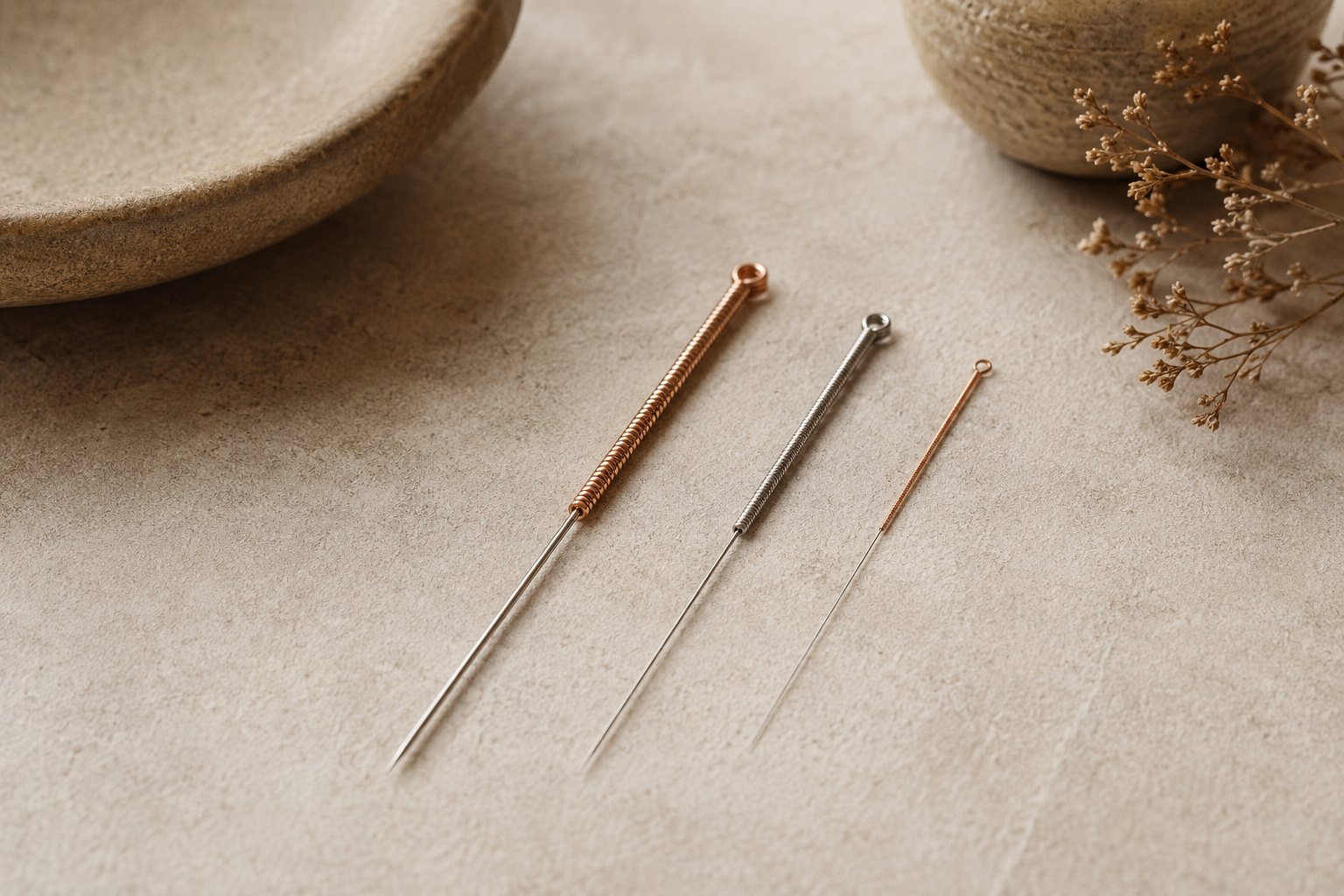
The needles used in acupuncture—general acupuncture needles have a diameter of approximately 0.12–0.25 mm. This gives you a concrete idea: acupuncture needles are far thinner than ordinary injection needles.
Standard clinical practice is single-use sterile needles, discarded after use, to prevent the risk of cross-infection.
💡 Remember: the thickness of an acupuncture needle is measured in fractions of a millimetre—0.12–0.25 mm is far finer than you might imagine.
II. What Gets Confused With It—"Pain" Does Not Equal "Effective"
"More pain means more effective" is probably the most widespread myth about acupuncture. This claim needs to be examined carefully.
When a needle penetrates the skin, there is a light pricking sensation—that is a physical fact. As for the sensation after insertion, different people describe it differently—it is often described as "sore," "heavy," or "slightly swollen." The intensity of these sensations varies with individual constitution, the area being needled, and the practitioner's technique. It varies from person to person.
In TCM theory, there is a concept called "deqi" (得气), which refers to a specific sensation at the needle site, commonly described as soreness, numbness, heaviness, or distension. But "deqi" is a clinical judgment standard—based on the practitioner's feel of the needle—and it does not mean "the more pain, the better."
"Pain" is a signal that needs to be distinguished. If a sharp, intense, unbearable pain occurs during needling, that is not proof of effectiveness—it is a signal to inform the practitioner immediately. If ongoing discomfort occurs during a session, tell the practitioner immediately so the approach can be adjusted or the needles removed early.
💡 Remember: "deqi" is not "pain." Soreness, numbness, heaviness, and distension may be described as common needling sensations, but sharp pain is a signal to tell your practitioner immediately.
III. At a Glance—Acupuncture vs. "Getting an Injection"
Many people associate "needles" with injections, but the two are entirely different—from theory to practice.
| Comparison | Acupuncture | Injection |
|---|---|---|
| Needle thickness | Approximately 0.12–0.25 mm | Ordinary injection needles are far thicker |
| Theoretical framework | TCM meridian theory | Modern pharmacology |
| Depth of insertion | Depends on the point and location | Depends on purpose (subcutaneous, intramuscular, intravenous, etc.) |
| Practitioner | Registered TCM practitioner | Doctor or trained healthcare professional |
| Purpose | To influence the state of qi and blood | To deliver medication into the body |
This table deliberately does not state "how often" or "how many sessions until effective." These vary from person to person and should be explained by the practitioner who assesses you.
💡 Remember: acupuncture and injections are two different things—different theoretical frameworks, different purposes, different needle specifications.
IV. When Extra Caution Is Needed—Safety and Contraindications
Acupuncture is an external treatment method within TCM, and there are still important precautions. Items generally listed in TCM literature include:
- People with blood clotting disorders: If you bruise easily, bleed readily, or are taking anticoagulant medication, you must inform the practitioner before receiving acupuncture, and never stop prescribed medication on your own.
- Pregnancy: In TCM theory, certain acupoints are considered best avoided during pregnancy. If you are pregnant or planning to conceive, be sure to state this clearly before the session.
- Skin conditions: If the skin at the needling site has an infection, wound, rash, or other condition, those areas are generally avoided.
- People with pacemakers: Certain electro-acupuncture devices may interfere with pacemakers. If you have a pacemaker, please inform your practitioner before the session.
- Extreme fatigue or an empty stomach: Receiving acupuncture while extremely fatigued, on an empty stomach, or shortly after drinking alcohol is generally not advisable. If you feel dizzy, clammy, or nauseated during the session, tell the practitioner immediately.
A note: this section is general information only. For conditions like these, follow your doctor's diagnosis and treatment, and seek medical attention when you need it.
⚠️ Safety reminder: If severe pain, difficulty breathing, palpitations, or other abnormal symptoms occur during needling, tell the practitioner on site immediately. If discomfort or unusual reactions persist after leaving the clinic, contact your practitioner. For difficulty breathing, chest tightness or feeling faint, call 999 now — or go to the nearest emergency department.
V. Making It Work in Malaysia—Practical Thoughts Around an Acupuncture Session
In Malaysia, the practical arrangements around an acupuncture session are simpler than you might think, but a few details are worth noting.
Choose your time. How you feel after acupuncture varies from person to person — it is often described as feeling relaxed or wanting to rest, and sometimes as nothing in particular. If you are concerned about needing rest afterwards, consider scheduling the session on a non-working day or in the evening, rather than rushing to the next appointment.
Food and drink. A general suggestion is not to come on an extremely empty stomach. If your appointment is before lunch, having a light snack—like a piece of toast or a cup of kopi—is a reasonable idea. But arriving overly full is also not ideal.
Communication matters. Before needling begins, the practitioner will ask about your health. Please be as complete as possible: medications you are currently taking (both Western and Chinese medicine), past medical history, any current health concerns, and your sensitivity to pain. This information helps the practitioner decide on the approach.
Life after acupuncture is normal. After the session, you can go for teh tarik at a mamak, drive home, or return to work—there is generally no special restriction. The needled areas simply need reasonable care—keep them clean and dry. If discomfort persists or unusual reactions occur, contact your practitioner.
About "treatment courses." Some people expect a single session to resolve everything; others worry that once they start, they will need it for life. In reality, the frequency and number of sessions "vary from person to person"—depending on your situation, constitution, and the assessment. These questions should be asked directly of your practitioner during the consultation, rather than based on a friend's experience.
Misunderstanding 5: "Can acupuncture replace Western medical treatment?" No. TCM and Western medicine complement each other — this is not a choice between the two. If you are under a doctor's care or taking prescribed medication, tell your practitioner, let your doctor know you are having acupuncture, and never stop prescribed medication on your own.
Conclusion
✅ Remember these points:
- Acupuncture needles are very fine—approximately 0.12–0.25 mm in diameter—and completely different from injection needles.
- "Deqi" is a description of needling sensation in TCM theory; it is not the same as "the more pain, the better."
- Sharp, intense pain should be reported to the practitioner immediately—not endured.
- Before acupuncture, be sure to tell your practitioner your full health picture, including medications, pregnancy, skin conditions, and more.
- The frequency and number of sessions vary from person to person and should be explained by the practitioner who assesses you.
❌ What not to do:
- Do not endure severe pain without telling the practitioner just because "you heard the more pain, the more effective."
- Do not go for acupuncture on an extremely empty stomach, after alcohol, or in a state of extreme fatigue.
- Do not self-diagnose "I must have a certain constitution so I should..."—pattern differentiation is the practitioner's job, not a self-labelling exercise for readers.
👉 If you are unsure — "in my situation, is acupuncture actually suitable for me?" — feel free to reach out to HansMed for an online consultation, where you will be assessed by a practitioner registered under the T&CM Act 2016.
Sit with a licensed TCM practitioner from wherever you are.
HansMed Modern TCM
For general wellness education only — not medical advice. Consult a registered TCM practitioner for personal guidance.


