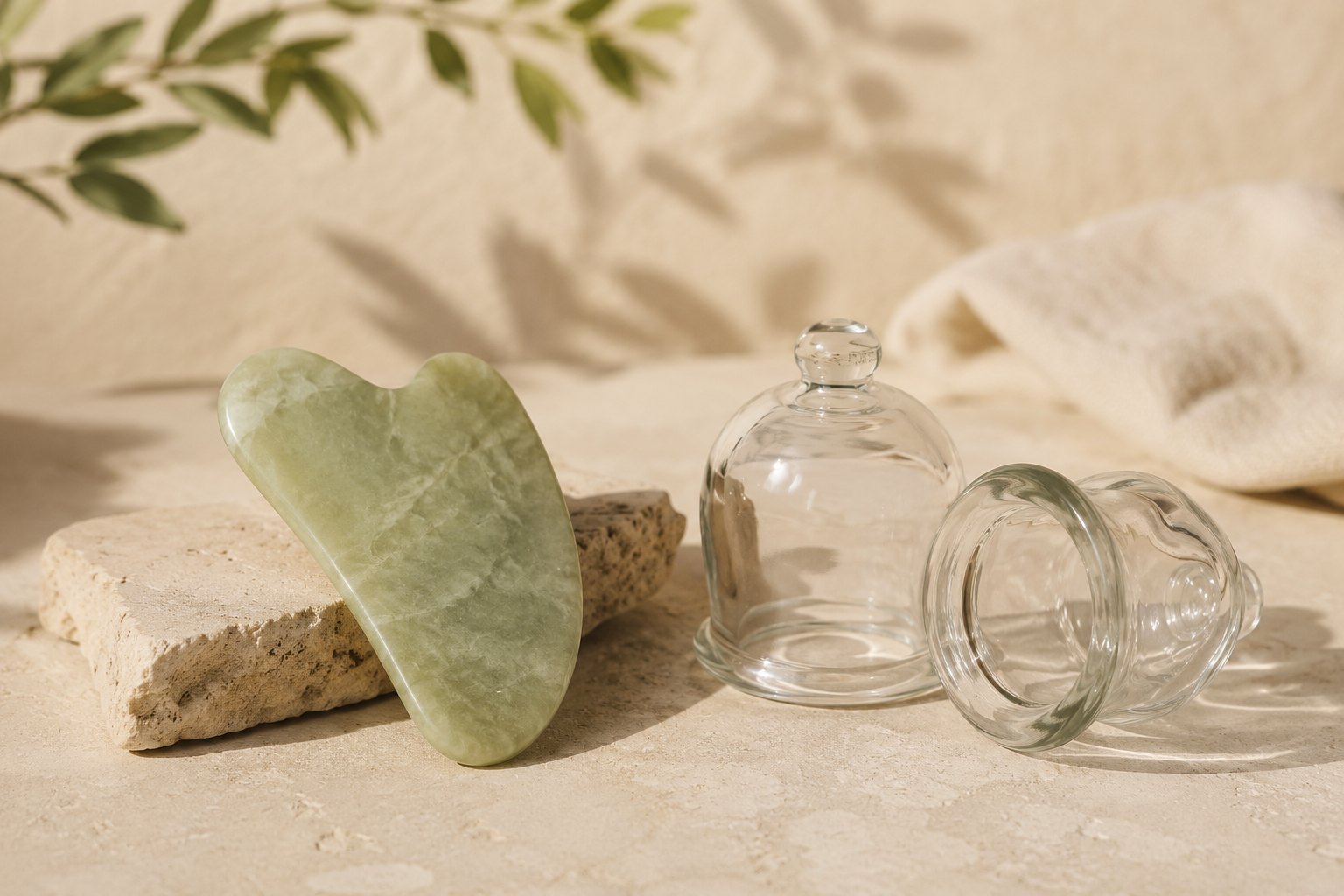
"Doctor, the marks from my last gua sha were very dark — my friend said that means a lot of toxins came out. Is that true?" Questions like this come up often over kopi and teh tarik in Malaysia. Almost everyone has their own interpretation of the colour left behind by gua sha and cupping, but many of these ideas have been passed down without a reliable basis.
This article looks at the 5 most common mistaken ideas about gua sha and cupping — from how dark the marks should be, how fast they fade, to the idea that "more pain means better results." We will explain the difference between popular claims and the TCM theoretical framework, and also cover situations where you should see a medical doctor first.
I. What Gua Sha Marks and Cupping Marks Actually Are
Gua sha and cupping are both traditional external therapies in TCM. Gua sha uses a scraper moving repeatedly over the skin; cupping uses cups that adhere to the skin. Both can leave colour on the skin surface. In TCM theory, these colours are often referred to as "sha" (痧) or cupping marks.
In the TCM theoretical framework, sha and cupping marks are understood as a visible response on the body surface related to the movement of qi and blood. Within TCM theory, the purpose of gua sha and cupping is understood as applying stimulation to specific surface areas to help qi and blood return to balance — a statement inside the theoretical framework, not a promise of results. Terms like "qi" and "meridians" belong to the TCM theoretical framework — they are not equivalent to anatomical structures.
💡 Remember: Sha and cupping marks are common skin responses after treatment — they are not a disease, nor are they a guarantee of effectiveness.
The physical operation itself is observable — the scraper moves across the skin, and the cup creates suction on the skin surface. These are visible facts. As for what this means in TCM theory, that belongs to the framework of meridians and qi, which is not the same as a modern physiology explanation.
II. The Common Confusion — "Darker Means Better"
The most common claim is: "The darker the sha, the more toxins you have released." This claim has no basis in TCM theory. TCM literature generally attributes the colour of sha and cupping marks to multiple factors during the procedure, rather than equating colour depth with how many "toxins" are in the body.
Colour depth is influenced by several neutral factors: skin thickness, the pressure applied during scraping, the strength of suction, and how long the procedure lasts. Skin that is thinner may look redder. Different areas of the same person's body may produce different colours — but this does not indicate whether the body is in a "better" or "worse" state.
Another common claim is: "No colour means it didn't work." This also lacks a reliable basis. Whether visible colour appears after the procedure depends on individual skin response differences — it cannot be used to judge whether the procedure was "successful."
💡 Remember: Depth of colour is not an indicator of effectiveness. Treating colour as a "report card" is an interpretation without reliable support.
If colour after the procedure does not fade for a long time, contact your practitioner. How quickly it fades varies from person to person — there is no benefit in comparing with others.
III. A Table for Quick Comparison: Gua Sha, Cupping and Massage
| Item | Gua Sha | Cupping | Malay Urut or Foot Reflexology |
|---|---|---|---|
| How it is done | A scraper is moved over the skin | Cups adhere to the skin with suction | Manual pressure and kneading of muscles and acupoints |
| Main characteristic | Covers a broader surface area | Concentrated at specific locations | Uses hands only; no instruments needed |
| Common skin response | Colour may appear on scraped areas | Cupping marks or colour change on the skin | Usually no significant colour change |
| Understanding in TCM theory | Acts on the skin layer; belongs to the meridian framework | Acts on the skin layer and acupoints; belongs to the meridian framework | Falls under tuina and massage; focuses on muscles and sinews |
| Who performs it | Usually a registered TCM practitioner or trained provider | Usually a registered TCM practitioner or trained provider | Massage therapist or therapist |
This table deliberately does not state "how often" or "how many sessions." These vary from person to person and should be explained by the practitioner assessing you. Also, these three are not about "which is better" — the question is which one suits what you need right now.
💡 Remember: Gua sha, cupping and massage are different types of services — they suit different needs and should not replace one another.
IV. Situations That Need Extra Caution
Before considering gua sha or cupping, it is advisable to inform your practitioner about the following:
- Skin conditions: If the area has wounds, inflammation, eczema or skin disease, gua sha and cupping are generally not recommended.
- Chronic diseases: Those living with diabetes, heart failure, cancer or other chronic conditions should have a practitioner assess suitability first.
- Pregnancy: During pregnancy, TCM literature generally lists certain acupoints and areas that should be avoided. Always inform your practitioner.
- Taking medication: If you are on blood-thinning medication or other drugs, tell your practitioner first, so suitability can be assessed (do not stop any medication on your own — discuss it with your doctor first).
- Weakened state or fever: When the body is unwell, TCM generally advises postponing the procedure and addressing the current discomfort first.
A note: this section is general information only. For conditions like these, follow your doctor's diagnosis and treatment, and seek medical attention when you need it.
⚠️ Safety reminder: If you experience unbearable pain, dizziness, nausea or any discomfort during the procedure, tell the practitioner immediately. For seizures, loss of consciousness or high fever, seek emergency care without delay — go to the nearest emergency department or call 999.
TCM literature generally lists the above cautions, but this is not exhaustive. Everyone's situation differs — assessment before a procedure should be done by a registered TCM practitioner.
V. How to Arrange This in Malaysian Life
In Malaysia, there are many options for gua sha and cupping. Beyond TCM clinics, many foot reflexology centres and spas offer similar services, with prices ranging from tens to hundreds of ringgit. Over a drink at the mamak stall, friends often recommend "that shop that scrapes really hard."
With so many choices, it becomes more important to distinguish the background of the service provider. If you are looking for relaxation, a massage centre may be sufficient. But if you want gua sha or cupping for a persistent discomfort, or if you have a chronic condition or are on medication, having an assessment by a registered TCM practitioner is a more prudent path.
A practical scenario: after the Chinese New Year spring cleaning, or a few days into the festive season with heavier meals, some people choose to do a gua sha or cupping session to "loosen up." There is nothing wrong with such arrangements in themselves — the key is the provider's qualification. If the person performing the procedure cannot explain what they are doing and why, or promises that "a few sessions will fix it," that itself is a signal to be cautious.
A question that comes up often is: "Is gua sha or cupping suitable for my situation?" Online consultation allows you to explain your situation first — a practitioner can then assess whether it is appropriate before you proceed to arrange an in-person session.
This clinic currently offers online consultations only; in-person services are not yet available. Procedures described above are general descriptions of common TCM clinic workflow, not a description of this clinic's on-site operations.
Conclusion
✅ Keep these in mind:
- The depth of sha or cupping marks is influenced by skin thickness, suction strength and procedure duration — it cannot be used to judge the state of your body.
- "Darker means better" has no basis in TCM theory — it is a claim without a reliable source.
- Fading time varies from person to person — there is no benefit in comparing; contact your practitioner if marks persist.
- The qualification of the practitioner matters more than the colour — choosing a registered TCM practitioner or trained provider is a basic prerequisite.
- If you have a chronic condition, are pregnant, or are on medication, consult your practitioner before any procedure.
❌ Do not do this:
- Do not use mark depth to conclude how many "toxins" you have or how healthy you are.
- Do not ask the practitioner to "scrape harder" in pursuit of darker marks.
- Do not proceed with gua sha or cupping without an assessment when you are unsure whether you are suitable.
👉 If you are unsure whether gua sha or cupping is suitable for your situation, you are welcome to reach out to HansMed for an online consultation with a practitioner registered under the T&CM Act 2016.
Sit with a licensed TCM practitioner from wherever you are.
HansMed Modern TCM
For general wellness education only — not medical advice. Consult a registered TCM practitioner for personal guidance.


