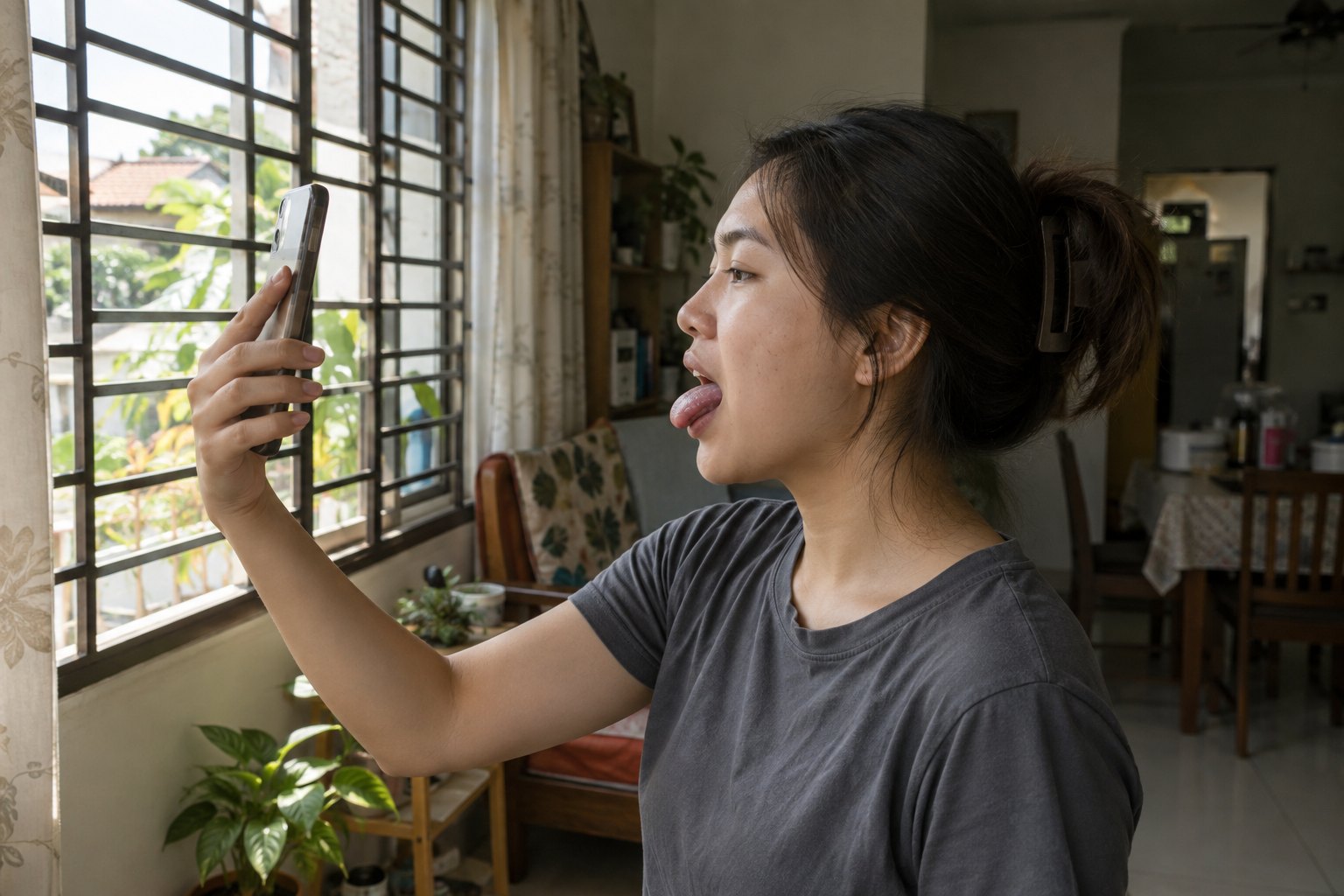
With online consultations becoming more common, in an online consultation with HansMed Modern TCM the system guides you through taking a tongue photo. The appearance of the tongue is one of the references used in TCM pattern differentiation, and a clear photo helps the practitioner read it accurately. But many people take the photo casually — poor lighting, wrong angle, or a cup of coffee just before — and the photo ends up looking quite different from the actual state of the tongue.
This article does not discuss what the tongue appearance means about your health. That is the practitioner's assessment, not something a reader should conclude on their own. We only cover one thing: how to take a tongue photo that is actually useful.
Why Lighting Matters Most
Lighting is the most common problem in tongue photos. Natural light is the best option. Stand near a window, with light coming from the front or side of your face. Avoid backlight, and do not let direct sunlight hit the tongue — strong light distorts colour.
Indoor lighting often has a colour cast. Incandescent bulbs cast yellow, fluorescent tubes cast greenish light, and the resulting photo will not match the tongue's actual colour. If you must shoot indoors, use the phone's default camera app, turn off beauty filters, and keep the image as close to reality as possible.
When to Take the Photo
The morning, right after waking up and before eating, is a more suitable time for a tongue photo. Eating, drinking, brushing, and rinsing all change the surface of the tongue. If you have already eaten, rinse your mouth and wait a while before taking the photo.
Coffee, tea, curry, blueberries, and other strongly coloured foods or drinks can temporarily stain the tongue. Photos taken right after these are of limited reference value. Wait for the staining to fade, or take the photo the next morning.
How to Shoot: Angle and Distance
Hold the phone about one forearm's length from your face, point the lens at your mouth, and stick out your tongue gently. Do not push it out forcefully — a tense tongue looks different from a relaxed one. Open your mouth slightly so the tongue is fully visible.
Take one front-facing photo and one side-angle photo. This gives the practitioner more to work with. Tap on the tongue on the screen to focus, and make sure the image is sharp. If your phone has a macro mode, you can also take a close-up of the tongue surface.
5 Common Mistakes
First, taking the photo right after eating coloured food. Coffee, tea, curry, blueberries, and dragon fruit all temporarily change the tongue's colour. The photo will not reflect the usual state.
Second, using lighting with a colour cast. Yellow light, blue light, or mixed light sources distort the image. Natural light is best; otherwise, use the phone's fill light or a white light source.
Third, sticking the tongue out too forcefully. A tense tongue looks different from a relaxed one. Stick it out gently.
Fourth, wearing makeup or lipstick. Lipstick, lip gloss, and lip tints affect the colour of the area around the tongue. Remove lip makeup before taking the photo.
Fifth, taking the photo right after brushing the tongue. Brushing or scraping the tongue changes its surface. If you brush in the morning, take the photo first, or wait a while after brushing.
What to Do Before the Photo
Do not drink coffee, tea, or dark-coloured drinks before the photo. Do not eat sweets or chew gum. Do not scrape your tongue on purpose. Keep the tongue in its natural state.
If there is food residue on the tongue, rinse gently with water. Do not scrape.
After You Have a Good Photo
A tongue photo is only one reference in an online consultation. The practitioner will also consider other information, such as symptom descriptions, lifestyle habits, and medical history. A clear photo helps the practitioner read more accurately, but the tongue appearance alone is not a diagnosis.
HansMed Modern TCM currently operates through online consultations; in-person services are not yet available. If you need to send a tongue photo to a practitioner, follow the method above and note the time it was taken, for example, "taken in the morning, before breakfast."
Frequently Asked Questions
Q: Can I use a beauty camera app? Not recommended. Beauty apps smooth the skin and alter details, which reduces the photo's reference value. Use the default camera app.
Q: Can I take the photo at night? Yes, but pay attention to lighting. Indoor light at night often has a colour cast. Try to shoot in natural light, or use a white light source.
Q: The photo looks different from what I see in the mirror. Why? This is usually due to lighting or screen display. Different screens have different colour temperatures, so the photo may look different. Shoot in natural light and turn off features like "True Tone" or "Night Shift."
Q: Should I scrape my tongue before taking the photo? No. The coating is part of the tongue's appearance. Scraping it removes information the practitioner needs. Keep it natural.
Q: I took several photos but none look right. What should I do? Take a few more and choose the clearest one with colours closest to reality. If you still cannot get a good photo, let the practitioner know — the tongue can be observed directly during the video consultation.
Q: Can a tongue photo be used to diagnose disease? No. The tongue appearance is only one reference in TCM pattern differentiation. It cannot be used alone as a basis for diagnosis. For any health concern, follow the diagnosis and treatment of Western medicine as primary, and seek medical attention when needed.
A note: this section is general information only. For conditions like these, follow your doctor's diagnosis and treatment, and seek medical attention when you need it.
👉 If you are unsure whether the tongue photo you have taken is actually usable, you are welcome to book an online consultation with HansMed, where a practitioner registered under the T&CM Act 2016 can assess it with you.
Sit with a licensed TCM practitioner from wherever you are.
HansMed Modern TCM
For general wellness education only — not medical advice. Consult a registered TCM practitioner for personal guidance.


