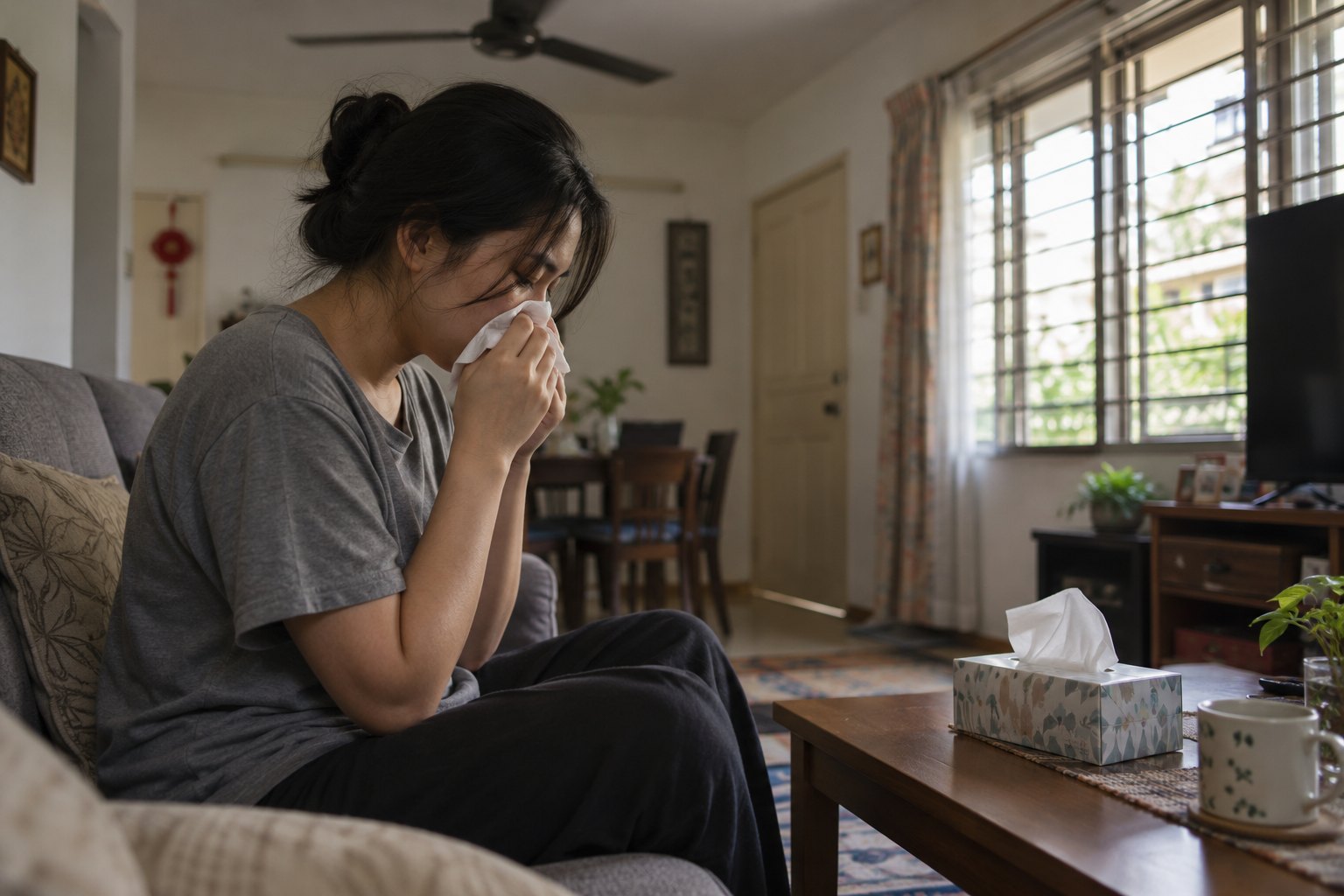
"My nose is like this every year — I wake up and sneeze non-stop." A question that comes up often is this one. Malaysia has no four seasons, but air-conditioning, haze and the rainy months are all still here, so the nose is a year-round topic.
The answer first. TCM theory treats the nose as the lung's gateway: the World Health Organization's TCM terminology standard says "The nose is the opening of the lung", and "The lung dislikes cold" — "Lung qi is easily damaged by exogenous pathogenic cold". [WHO-2022]
So the theory's direction is three things: no cold draught on the nose and mouth, a warm drink first thing in the morning, and sleep at a fixed time (all the theory's direction).
As for "how do I wash the bedding?", "which mask for haze?" and "is this rhinitis or a cold?", Western patient-information pages and Malaysia's Ministry of Health give a yardstick to hold it against. This article puts the two side by side, in 6 points.
I. How TCM theory sees the "nose"
In TCM theory, the "lung" is not quite the anatomical organ; it is the name of a set of functions. The World Health Organization's TCM terminology standard defines the entries that touch the nose this way:
- Lung system: "A functional system composed of the lung, large intestine, skin, body hair, nose and lung meridian." [WHO-2022]
- The lung opens into the nose: "The nose is the opening of the lung." [WHO-2022]
- The fluid of the lung is nasal discharge: "Nasal discharge is associated with the lung." [WHO-2022]
- The lung dislikes cold: "The lung is intolerant of cold and connected with the skin and body hair. Lung qi is easily damaged by exogenous pathogenic cold." [WHO-2022]
The theory adds one more line: wind "is the spearhead of exogenous pathogenic factors and liable to associate itself with cold, dampness, dryness and heat". [WHO-2022] That is why TCM tends to describe recurring sneezing and clear discharge in the language of "wind-cold" — the theory's language, not a diagnosis of you.
In daily life, the theory's direction is a handful of habit-level things:
① No cold draught straight at the nose and mouth — the aircon vent, the fan, the wind on a motorbike.
② A warm drink first thing in the morning, before heading out.
③ Warm the nose and neck on waking — a thin scarf is the theory's direction.
④ Sleep at a fixed time, avoid late nights, and keep the bedroom clean. The Hong Kong Department of Health's Chinese Medicine Regulatory Office lists sleeping at fixed times and avoiding late nights and lying in, and attending to the hygiene of living quarters, among its principles. [CMRO-养生]
These are directions, not a prescription; which of them matters for you is a question for after the consultation.
💡 Remember: the TCM "lung" is the name of a set of functions, and the nose is that set's "opening". It is not an allergy test and not a disease name.
II. A yardstick first: what Western pages say about allergic rhinitis
Theory gives direction; Western patient-information pages give definitions and practice. The following is taken from the UK National Health Service (NHS) and Singapore's MOH HealthHub public pages.
① What allergic rhinitis is. Allergic rhinitis is a Western medical diagnosis. The NHS says it "is where your nose gets irritated by something you're allergic to, such as pollen, causing sneezing and other symptoms"; common allergies include pollen, house dust mites, animal dander and mould. [NHS-鼻敏感]
The NHS also states that allergic rhinitis "is different from non-allergic rhinitis, which is caused by things like having a cold, very hot or cold temperatures and humidity". [NHS-鼻敏感] So "it blocks the moment I walk into an air-conditioned room" has a place in Western medicine too.
② Rhinitis or a cold. The NHS says the symptoms of allergic rhinitis "are similar to a cold" but usually happen "within minutes of coming into contact with something you're allergic to" [NHS-鼻敏感]; cold symptoms "come on gradually over 2 to 3 days" and "You should begin to feel better in about 1 to 2 weeks". [NHS-感冒]
HealthHub adds three points: in allergic rhinitis the mucus and tears "will be clear", while for colds "mucus may be thicker, and appear greenish or yellowish"; "Allergic rhinitis does not cause fever or muscle ache"; and it "rarely causes sore throat". [SG-鼻敏感]
③ Reducing allergens at home. The NHS advice is: "use synthetic bedding and covers, and wash bedding regularly at 60C and above"; "dust with a damp cloth and use a vacuum with a HEPA filter". [NHS-鼻敏感]
The same page says: "keep your home dry and well-ventilated, and deal with any damp and condensation"; "do not allow pets in bedrooms". [NHS-鼻敏感]
HealthHub's list is more specific: "Encase mattresses, pillows and bolsters with House Dust Mite (HDM)-proof covers"; "Wash bedding with hot water (55-60 °C) frequently"; "Remove rugs or carpets, and minimise items on the bed (e.g. stuffed toys, cushions)". [SG-鼻敏感]
④ How to rinse the nose. The NHS method: "Boil a pint of water, then leave it to cool"; "Mix 1 teaspoon of salt and 1 teaspoon of bicarbonate of soda into the water"; wash your hands. [NHS-鼻敏感]
Then, over a sink, pour a small amount into a cupped palm and "Sniff the water into 1 nostril at a time", breathing through your mouth and letting the water run back into the sink; "up to 3 times a day (making a new solution each time)". [NHS-鼻敏感] A pint is around 570ml. [NHS-鼻窦炎]
⑤ Pharmacy medicines, and who asks a pharmacist first. The NHS says "You can often treat allergic rhinitis without seeing a GP"; a pharmacist can advise on antihistamines, decongestant nasal sprays or drops, steroid nasal sprays, and salt water sprays or solutions. [NHS-鼻敏感]
Two class-level cautions. Decongestant nasal sprays "should not be used for longer than 5 days as this can make a blocked nose worse" [NHS-鼻敏感]; HealthHub calls this "a rebound blocked nose". [SG-鼻敏感] Why the cap exists is in section III.
For the type of antihistamine that makes you feel sleepy, the NHS says "do not drive or use machinery after taking these antihistamines". [NHS-抗组织胺]
If you use a spray or medication your doctor prescribed, say so, and never stop your medication on your own. For Chinese herbs alongside Western medication, see Can Chinese herbs be taken with Western medicine.
⚠️ A note: this yardstick is for describing, not for self-diagnosis. The diagnosis of allergic rhinitis belongs to a doctor; if you do not have one yet, see a doctor first.
III. How it happens: two accounts
Section II gave the yardstick. This section answers a different question: why the nose does this, and which step each of the three pharmacy classes, and each of the things you do at home, is aimed at.
The Western account and the TCM theory's account sit side by side, each with its source, and neither is a translation of the other.
① The Western account: an allergic reaction and histamine. The NHS allergic rhinitis page says only this much: allergic rhinitis "is caused by an allergic reaction". [NHS-鼻敏感] HealthHub says a little more: it "results from an over reaction of the immune system to particles which they are allergic to". [SG-鼻敏感]
The histamine step is on the NHS antihistamines page. The NHS says: "Histamine is normally released when your body detects something harmful, such as an infection. It causes blood vessels to expand and the skin to swell, which helps protect the body." [NHS-抗组织胺]
The same page goes on: "in people with allergies, the body mistakes something harmless – such as pollen, animal hair or house dust – for a threat and produces histamine. The histamine causes an allergic reaction with unpleasant symptoms including itchy, watering eyes, a running or blocked nose, sneezing and skin rashes." [NHS-抗组织胺]
That is where the NHS page stops; it does not spell out every step after histamine, and this article stops there too.
② Three classes, three steps. Put the three classes from section II back on that chain and it is clear why they are not the same thing:
- Antihistamines: the NHS says they "block the effects of a substance called histamine"; that is why the NHS writes that taken before contact with the allergen they "help stop this happening", and taken afterwards they "can reduce the severity of symptoms". [NHS-抗组织胺] How to use them is a question for the pharmacist.
- Decongestant nasal sprays: the NHS says they "work by reducing the swelling of the blood vessels in your nose, which helps to open the airways" [NHS-减充血剂] — aimed at the "blocked" step, not at the allergic reaction itself.
- Steroid nasal sprays: HealthHub says they "help to relieve inflammation and swelling in the nose caused by the allergens". [SG-鼻敏感]
③ Why decongestant sprays have a 5-day cap. The NHS decongestants page states: nasal sprays and drops "should not be used for more than 5 days at a time because using them for too long can make your stuffiness worse". [NHS-减充血剂]
HealthHub calls this "a rebound blocked nose" — "constant blocked nose caused by an overuse of nasal decongestants". [SG-鼻敏感]
The NHS non-allergic rhinitis page goes further and lists "using decongestant nasal sprays for longer than it says on the packet" itself among the causes of non-allergic rhinitis. [NHS-非过敏性鼻炎]
On the NHS's own wording, a spray used to unblock the nose can become, past its limit, a source of another kind of blocked nose.
As for why the rebound happens, none of these pages says, and this article does not fill that in. The same NHS page also says: "Do not use more than one medicine to treat a blocked nose at the same time", including "using nasal sprays together or combining them with tablets or capsules for congestion". [NHS-减充血剂]
A spray or medicine your doctor prescribed is used as the doctor directed — never stop your medication on your own.
④ Why bedding at 60C. The NHS gives the temperature and no reason: synthetic bedding, washed regularly "at 60C and above". [NHS-鼻敏感]
HealthHub gives the purpose: "Wash bedding with hot water (55-60 °C) frequently to remove dust mites"; encase mattresses, pillows and bolsters in dust-mite-proof covers. [SG-鼻敏感]
Remove rugs or carpets and minimise items on the bed because they "may collect dust"; vacuum and mop frequently "to get rid of the dust mites and insect droppings". [SG-鼻敏感]
So these measures all aim at the same step — less contact with the allergen, the start of the chain in ①. As for why the number is 60, neither page explains; this article follows the pages and gives only the temperature and the purpose.
⑤ The TCM theory's account: a "surface". The theory has no histamine layer; it uses a different model — the body has a "surface", and the lung is in charge of it. The World Health Organization's standard defines the relevant entries this way:
- The lung governs the skin and body hair: "The lung warms and nourishes the skin and body hair, regulates the opening and closing of the sweat pores and safeguards the surface of the body." [WHO-2022]
- The lung governs upward and outward diffusion: "the upward and outward diffusion of lung qi". [WHO-2022]
- Wei-defensive qi: "Opposite to the Ying-nutrient qi. It travels outside the vessels and is transformed from the nutrients of water and food." [WHO-2022] A second entry, Wei-defence circulates outside the vessels: "Wei-defence is yang and resolute in nature. It travels outside the vessels." [WHO-2022]
- Wind floats and ascends: "Wind is characterized by upward flowing. It easily affects the head, face, surface of the body and yang meridians." [WHO-2022] Wind opens and disperses: "Wind loosens the interspace between skin/muscle fibers and opens the skin pores, resulting in sweating and aversion to wind." [WHO-2022]
- Pathogenic factors attacking orifices: "Pathological states caused by pathogenic factors invading the mouth, nose, ears and eyes." [WHO-2022]
Read together with section I's "The lung opens into the nose" and "The lung dislikes cold", this is the theory's barrier model.
The lung diffuses qi outward to the surface, the surface is kept by the "Wei", and the nose is an opening in that surface; wind-cold coming in through the surface and the nose meets this layer first.
That last paragraph is this article's reading of the definitions above, not the standard's own sentence — the standard defines each entry separately and has no single line that joins them.
The two accounts describe the same kind of experience, and neither is a translation of the other: the NHS speaks of an immune reaction, histamine and blood vessels; the theory speaks of qi, the surface and the orifices.
"Wei-defensive qi" is not another name for the immune system, and histamine is not the laboratory version of "wind-cold".
How either account applies to you is a question for after the consultation, not for this section.
💡 Remember: three classes, three steps — antihistamines block histamine, decongestant sprays shrink swollen blood vessels, steroid sprays act on inflammation; bedding at 60C is aimed at the start: less contact with the allergen. On the theory's side there is a "surface". Side by side, never translated into each other.
IV. One table: five situations, what the theory says, the usual practice, when to see a doctor first
| Situation | What TCM theory says | Usual practice | When to see a doctor first |
|---|---|---|---|
| Sneezing and clear discharge the moment you wake | The lung opens into the nose; the lung dislikes cold [WHO-2022]; the theory holds that the early morning is cool and wind-cold enters easily through the nose | Warm the nose and neck on waking, a warm drink (the theory's direction); wash bedding at 60C and above [NHS-鼻敏感], which HealthHub says is to remove dust mites [SG-鼻敏感]; dust-mite-proof covers [SG-鼻敏感] | Symptoms getting worse, affecting sleep and everyday life, or pharmacy treatments not working: see a doctor [NHS-鼻敏感] |
| Blocked the moment you enter an air-conditioned room | The lung dislikes cold [WHO-2022]; the theory holds that a cold draught on the nose and mouth chills lung qi first | Point the vent away from your face, keep a thin jacket handy (the theory's direction); the NHS lists very hot or cold temperatures and humidity among causes of non-allergic rhinitis [NHS-鼻敏感]; a decongestant spray works by reducing the swelling of the blood vessels in the nose, and no more than 5 days at a time [NHS-减充血剂] | Not sure what is causing it: see a doctor [NHS-鼻敏感] |
| Dry, itchy nose and more sneezing in haze weeks | The lung opens into the nose [WHO-2022]; the theory holds that unclean air enters the lung through the nose first | Check the API reading on APIMS [DOE-API]; at API 101 to 200 the high-risk group wears a mask outdoors, at 201 to 300 everyone does [MOH-烟霾]; the MOH states a surgical mask will not prevent inhaling the small airborne particles, so it recommends a respirator such as an N95 [MOH-口罩] | At API 201 to 300, people with health problems see a doctor [MOH-烟霾]; difficulty breathing or wheezing means call 999 now, or go to the nearest hospital emergency department |
| Constant clear discharge, itchy eyes | The fluid of the lung is nasal discharge [WHO-2022]; the theory holds that when the lung takes wind-cold, the discharge runs clear and copious | Avoid your allergens as far as you can [NHS-鼻敏感]; rinse the nose [NHS-鼻敏感]; no pets in the bedroom [NHS-鼻敏感]; remove rugs or carpets [SG-鼻敏感]; an antihistamine blocks the effects of histamine [NHS-抗组织胺] | Blood-streaked discharge: see a doctor first; sense of smell not back in a few weeks: see a doctor [NHS-嗅觉]; a high temperature for more than 3 days: see a doctor [NHS-感冒] |
| One-sided blockage, repeated nosebleeds | This row has no theory line: a Western doctor establishes the cause first | For a nosebleed, sit and lean forward, pinch the nose just above the nostrils for 10 to 15 minutes, breathe through your mouth [NHS-鼻血] | Regular nosebleeds: see a doctor [NHS-鼻血]; sinusitis symptoms on one side of the face only: the NHS says a GP may refer you to an ENT specialist [NHS-鼻窦炎]; a nosebleed lasting longer than 10 to 15 minutes or bleeding that seems excessive means call 999 now, or go to the nearest hospital emergency department [NHS-鼻血] |
In the table, "see a doctor" means a Klinik Kesihatan or clinic visit; the "call 999 now" situations do not wait for a clinic.
The "what TCM theory says" column is how the theory explains it, not a judgement about you.
💡 Remember: the fourth column lists situations that get mixed up with "allergic rhinitis" and should be ruled out by a Western doctor first. Rule out first, then adjust.
V. See a doctor first in these situations
- You have asthma, or have been diagnosed with it. Asthma needs medical diagnosis and treatment, with a clear medication and emergency plan. Follow your doctor's treatment, and never stop an inhaler or controller medication on your own. — Asthma getting worse too is on the NHS list of reasons to see a GP [NHS-鼻敏感]
- Difficulty breathing, wheezing, speaking in short phrases, or blue lips. Call 999 now, or go to the nearest emergency department.
- Persistent one-sided blockage, or repeated nosebleeds. These need medical investigation. — Regular nosebleeds: see a doctor [NHS-鼻血]; sinusitis symptoms on one side of the face only: the NHS says a GP may refer you to an ENT specialist [NHS-鼻窦炎]
- Blood-streaked discharge, facial pain, a marked loss of smell, or persistent fever alongside it. See a doctor first. — Facial pain and swelling with feeling very unwell, or painkillers not helping: seek care the same day [NHS-鼻窦炎]; sense of smell not back in a few weeks [NHS-嗅觉], or a high temperature for more than 3 days [NHS-感冒]: see a doctor
- Recurrence that disrupts sleep, school or work. Worth a proper medical assessment rather than managing it yourself indefinitely. — The NHS lists symptoms affecting your sleep and everyday life as a reason to see a GP [NHS-鼻敏感]
- No firm diagnosis yet. Establish what it is first, then talk about TCM care. — Not being sure what is causing your symptoms is on the NHS list too [NHS-鼻敏感]
"Seek care the same day" means a same-day visit to a Klinik Kesihatan or clinic.
⚠️ A safety note: TCM and Western medicine complement each other; it is not a choice between them. If you are under medical treatment, TCM care is a layer added on top — not a layer swapped in. A nosebleed lasting longer than 10 to 15 minutes or bleeding that seems excessive [NHS-鼻血] means call 999 now, or go to the nearest hospital emergency department.
A note: this section is general information only. For conditions like these, follow your doctor's diagnosis and treatment, and seek medical attention when you need it.
VI. What an online consultation does, and what needs an in-person visit or a doctor
With the theory and the yardstick covered, the last thing is how "my kind of nose" is handled inside a consultation.
① The five directions a practitioner asks about. The pattern — time of day, time of year, which places; what it does — sneezing, clear discharge, blockage, itching in the nose or eyes, and which troubles you most.
What sets it off — air-conditioning, dust, haze, pets; whether cough, skin problems or disturbed sleep come with it; and the sprays, medicines and supplements you already use.
The practitioner also asks whether you have seen a doctor, whether you have had allergy testing, and which sprays you have used. What has already been ruled out is information too.
② Why the tongue. The World Health Organization's terminology standard defines tongue diagnosis as "A diagnostic method to inspect the patient's tongue body and tongue coating". [WHO-2022] An online consultation works from the tongue photo you take. Lighting, timing, angle and the common mistakes are in how to take a useful tongue photo.
③ What cannot be done online, the practitioner will say. Looking inside the nasal passages and listening with a stethoscope cannot be done online; investigations — allergy testing, nasal endoscopy — are a doctor's. If the practitioner thinks a Western medical check should come first, they say so.
④ Three possible directions: acupuncture, Chinese herbs, and lifestyle adjustments. The herbs may be concentrated granule powder or a decoction; the lifestyle side means the kind of habits in sections I and IV.
The goal is to manage a recurring condition, not to "root it out" — there is no promise of a cure here. Which, and whether, is decided after the consultation, and the practitioner's written instructions take precedence.
⑤ Reminders by situation, not by constitution:
- On long-term medication: tell the practitioner everything you take; if you already take other medicines, the NHS says speak to a pharmacist or GP before taking antihistamines [NHS-抗组织胺]; a nosebleed while taking a medicine that helps prevent blood clots is on the NHS list of reasons to see a GP. [NHS-鼻血] Never stop your medication on your own.
- Pregnant, trying, or breastfeeding: for antihistamines in pregnancy or while breastfeeding, the NHS says speak to a pharmacist or GP first [NHS-抗组织胺]; the MOH states "N95 mask is not suitable for pregnant women and children". [MOH-口罩] Whether herbs or acupuncture suit you, ask the practitioner first.
- Under 12: the NHS states "decongestants should not be used by children under 6" [NHS-鼻敏感], and that "Children aged 6 to 11 should take them for no longer than 5 days" — ask a pharmacist first [NHS-减充血剂]; for an antihistamine for a young child, speak to a pharmacist or GP first [NHS-抗组织胺]; an N95 mask is not suitable for children. [MOH-口罩] For a child's nose, see a paediatrician first.
- Older adults: the NHS says older people should speak to a pharmacist or GP before taking antihistamines [NHS-抗组织胺]; the MOH counts older people among the high-risk group in haze. [MOH-烟霾]
- Before surgery, or a chronic condition under regular review: tell your doctor the herbs, herbal teas and supplements you take, and let the doctor judge.
What to prepare beforehand is in what to prepare before an online consultation.
Fitting it into life in Malaysia
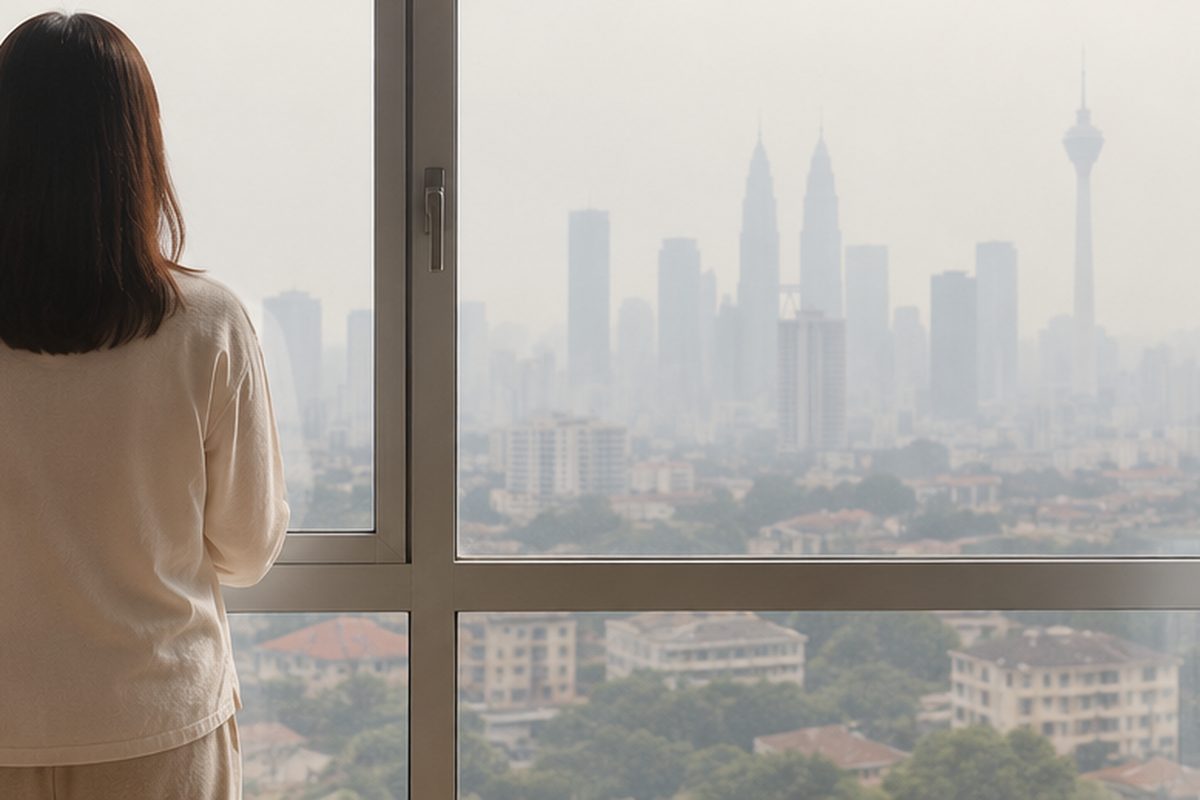
- Air-conditioning at the office and in the car: the theory's direction is the vent away from your face and a thin jacket within reach; the NHS lists very hot or cold temperatures and humidity among causes of non-allergic rhinitis. [NHS-鼻敏感] Driving in haze, the MOH's advice is aircon on recirculation and windows closed. [MOH-烟霾]
- Haze season, check APIMS first: the DOE's five bands are 0 to 50 Good, 51 to 100 Moderate, 101 to 200 Unhealthy, 201 to 300 Very Unhealthy, Above 300 Hazardous; the reading is a 24-hour running average. [DOE-API]
- Masks on haze days: the MOH's practice is that at 101 to 200 the high-risk group wears a mask outdoors, at 201 to 300 everyone does, and people with health problems see a doctor; drink plenty of water and wash your face often. [MOH-烟霾] For the mask, a respirator such as an N95; "The use of the surgical mask will not prevent one from inhaling the small airborne particles". [MOH-口罩]
- Commuting by motorbike: wind straight at the nose and mouth is a thing the theory minds — visor down and neck covered is the theory's direction. If you have taken the type of antihistamine that makes you feel sleepy, do not ride or drive. [NHS-抗组织胺]
- Fabric sofas, carpets, soft toys: HealthHub's advice is "Remove rugs or carpets, and minimise items on the bed". [SG-鼻敏感] No need to throw everything out; start with the bedroom.
- Sunning the bedding: there is sun every day here and sunning is a habit; the sourced measure is the wash temperature — the NHS says 60C and above [NHS-鼻敏感], HealthHub says 55-60 °C. [SG-鼻敏感] The theory's "hygiene of living quarters" lands here. [CMRO-养生]
- Changes after moving or going back to your hometown: whether a different environment made a difference is often a useful single sentence at the consultation.
- Sprays and antihistamines from the pharmacy (Guardian, Watsons): the NHS says allergic rhinitis can often be handled by asking a pharmacist first; decongestant sprays no longer than 5 days. [NHS-鼻敏感] Say what you bought and for how long you used it.
- Herbal-tea-shop teas, direct-sales supplements: mention them all at the consultation; the practitioner looks at them together.
- Overtime season, exam season: late nights are an early thing the theory asks about — sleeping at a fixed time and avoiding late nights is the wording of that set of principles. [CMRO-养生]
- Keep two weeks of notes: which day, what time, where you were. Two weeks of notes beats recall — see what to prepare before an online consultation.
Frequently asked
Why do I sneeze the moment I wake up? TCM theory holds that the nose is the opening of the lung and the lung dislikes cold [WHO-2022]; the early morning is cool, and wind-cold enters easily through the nose — the theory's language, not a diagnosis of you. On the Western side, the NHS lists house dust mites among common allergies, with symptoms usually "within minutes" of contact [NHS-鼻敏感]; the first item on HealthHub's list is dust-mite-proof covers for mattresses and pillows, and washing bedding "with hot water (55-60 °C)". [SG-鼻敏感] Symptoms getting worse or affecting your sleep: see a doctor. [NHS-鼻敏感]
What about air-conditioned rooms? The theory's direction is the vent away from your face, a thin jacket, a warm drink on the desk; the entry behind it is "The lung dislikes cold" [WHO-2022] — the theory holds that a cold draught on the nose and mouth chills lung qi first. On the Western side, the NHS states that very hot or cold temperatures and humidity can cause non-allergic rhinitis, which is a different thing from allergic rhinitis [NHS-鼻敏感]; telling the two apart is the doctor's job. Not sure what is causing it: see a doctor. [NHS-鼻敏感]
Which mask on a haze day? The MOH's position: "The use of the surgical mask will not prevent one from inhaling the small airborne particles. Therefore the recommended protection is the use of the respirator"; "The N95 respirator may be used as protection during the haze"; it "is effective only if used correctly", and "is not suitable for pregnant women and children". [MOH-口罩] When to wear one goes by the API: at 101 to 200 the high-risk group wears a mask outdoors, at 201 to 300 everyone does, and people with health problems see a doctor. [MOH-烟霾] Difficulty breathing or wheezing means call 999 now, or go to the nearest hospital emergency department.
Does rinsing the nose help? The NHS lists "salt water nasal sprays or solutions to rinse out the inside of your nose" among what a pharmacist can advise, and gives the method: "Boil a pint of water, then leave it to cool", add 1 teaspoon of salt and 1 teaspoon of bicarbonate of soda, sniff into 1 nostril at a time, "up to 3 times a day (making a new solution each time)". [NHS-鼻敏感] The point is "boiled, cooled, fresh each time" — never tap water as it comes. It is a general measure, not a substitute for a diagnosis; if treatments from a pharmacist are not working, see a doctor. [NHS-鼻敏感]
How do I tell allergic rhinitis from a cold? The NHS says the symptoms are similar, but allergic rhinitis usually happens "within minutes of coming into contact with something you're allergic to" [NHS-鼻敏感]; cold symptoms "come on gradually over 2 to 3 days" and you "should begin to feel better in about 1 to 2 weeks". [NHS-感冒] HealthHub's three points: in allergic rhinitis the mucus is clear, while a cold's "may be thicker, and appear greenish or yellowish"; "Allergic rhinitis does not cause fever or muscle ache"; it "rarely causes sore throat". [SG-鼻敏感] A high temperature for more than 3 days: see a doctor. [NHS-感冒]
What does TCM look at for allergic rhinitis? The whole picture around the recurrence: when it happens, what it tracks with, how the rest of the body is, plus tongue diagnosis — "A diagnostic method to inspect the patient's tongue body and tongue coating" [WHO-2022], done online from your photo. The practitioner uses the theory's language — lung, wind-cold, nasal discharge — and does not make the Western diagnosis of "allergic rhinitis" or replace it. The goal is to manage the recurrence, not to "root it out"; whether acupuncture, herbs or lifestyle adjustments is decided after the consultation.
In closing
✅ Worth remembering:
- TCM theory treats the nose as the lung's opening: "The nose is the opening of the lung"; "The lung dislikes cold". [WHO-2022]
- The theory's direction is no cold draught on the nose and mouth, a warm drink in the morning, warm the nose and neck, and sleep at a fixed time.
- The Western account: an allergic reaction produces histamine [NHS-抗组织胺]; antihistamines block histamine [NHS-抗组织胺], decongestant sprays shrink swollen blood vessels and, overused, can make the blocked nose worse [NHS-减充血剂]. The theory's account is a "surface": the lung governs the skin and body hair, Wei-defensive qi [WHO-2022]. Neither translates the other.
- The Western yardstick: wash bedding at 60C and above [NHS-鼻敏感], dust-mite-proof covers [SG-鼻敏感]; over-the-counter decongestant sprays no longer than 5 days. [NHS-鼻敏感]
- Haze: at API 201 to 300 everyone wears a mask outdoors [MOH-烟霾], and the MOH states that respirators work better than surgical masks [MOH-口罩]. One-sided blockage, repeated nosebleeds, blood-streaked discharge, loss of smell: see a doctor first. A nosebleed lasting longer than 10 to 15 minutes or bleeding that seems excessive [NHS-鼻血], or difficulty breathing: call 999 now, or go to the nearest hospital emergency department.
- An online consultation asks five directions and looks at your tongue photo; allergy testing and nasal endoscopy are a doctor's.
❌ Do not:
- Go looking for remedies before there is a firm diagnosis.
- Stop a prescribed spray or medication because you have started TCM care — never stop your medication on your own.
- Weigh up TCM options during difficulty breathing or wheezing — call 999 now, or go to the nearest hospital emergency department.
👉 If you are not sure where to even start describing a nose problem that keeps coming back, you are welcome to book an online consultation with HansMed, where a practitioner registered under the T&CM Act 2016 can assess it with you.
Reviewed by Ms. Koo Shuang, a TCM practitioner registered with Malaysia's Traditional and Complementary Medicine Council under the T&CM Act 2016, practising in gastroenterology, dermatology, respiratory and women's health.
Sit with a licensed TCM practitioner from wherever you are.
HansMed Modern TCM
For general wellness education only — not medical advice. Consult a registered TCM practitioner for personal guidance.


