
"I'm in my fifties and my shoulder hurts so much I can't lift it — is this frozen shoulder?" It is a self-diagnosis readers often arrive with, and it is what people searching "frozen shoulder" usually want answered.
The answer first: not necessarily. Frozen shoulder is a medical diagnosis; its formal name is adhesive capsulitis. The American Academy of Orthopaedic Surgeons (AAOS) patient page describes its hallmark as severe pain and being unable to move the shoulder — either on your own or with someone else's help [AAOS-FS].
It develops in three stages, the whole course may take up to 3 years [AAOS-FS], and it is most common between 40 and 60 [AAOS-FS].
Shoulder pain has other common sources, and a doctor is weighing more than one direction. These six things set out what frozen shoulder is, how it actually happens, what else it could be, how TCM theory sees it, and when to see a doctor first.
I. What frozen shoulder is: a medical diagnosis with three stages
Frozen shoulder — formally adhesive capsulitis — is confirmed by a doctor on clinical examination and, where needed, imaging [AAOS-FS]. It is not an age.
AAOS describes it this way: the shoulder capsule thickens and becomes stiff and tight, and it develops in three stages [AAOS-FS].
- ① Freezing: pain slowly increases, and as it worsens the shoulder loses range of motion; this typically lasts anywhere from 6 weeks to 9 months [AAOS-FS].
- ② Frozen: pain may actually improve, but the stiffness remains; during the 4 to 6 months of this stage, daily activities may be very difficult [AAOS-FS].
- ③ Thawing: motion slowly improves; a complete return to normal or close-to-normal strength and motion typically takes anywhere from 6 months to 2 years [AAOS-FS].
Singapore's MOH HealthHub uses the same three-stage picture: freezing with significant pain but acceptable movement, frozen with more stiffness but less pain, thawing with a gradual return of movement [HH-2021]. The NHS puts it more simply: frozen shoulder can take months or years to get better, but the pain and stiffness will usually go away eventually [NHS-FS].
Who tends to get it. It most commonly affects people between the ages of 40 and 60, and occurs in women more often than men [AAOS-FS]. People with diabetes and thyroid conditions are at increased risk, but it can happen to anyone at any time, sometimes after an injury or surgery [AAOS-FS]. The NHS adds that it is often not clear why people get it [NHS-FS].
So the conclusion of this section: being fifty does not mean frozen shoulder, and being unable to lift the arm does not either. Age is a common range, not a basis for diagnosis.
A note: this section is general information only. For conditions like these, follow your doctor's diagnosis and treatment, and seek medical attention when you need it.
II. How it actually happens: the capsule thickens and tightens
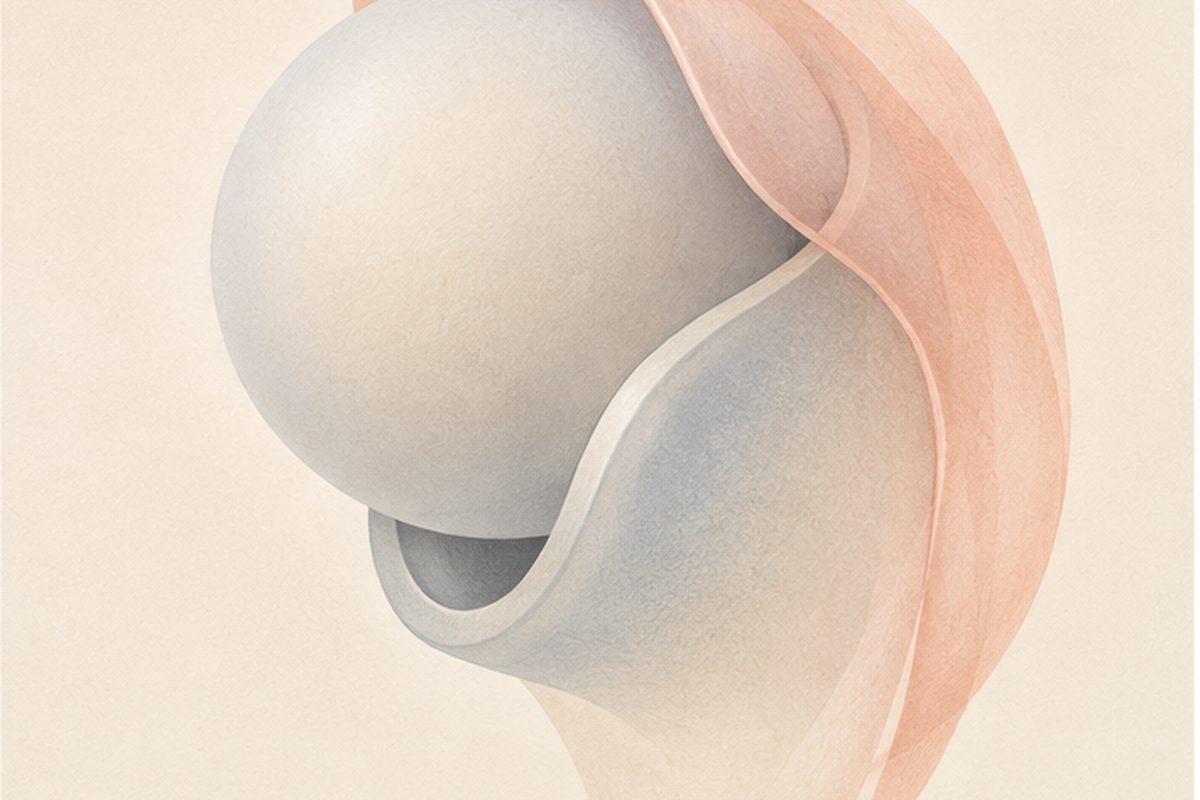
Start with how the shoulder is built. AAOS explains: the shoulder is a ball-and-socket joint made up of three bones — the humerus (upper arm bone), the scapula (shoulder blade) and the clavicle (collarbone); the head of the upper arm bone fits into a shallow socket in the shoulder blade [AAOS-FS].
Surrounding the joint is strong connective tissue called the shoulder capsule; synovial fluid lubricates the capsule and the joint so the shoulder moves more easily [AAOS-FS].
In frozen shoulder, it is this capsule that goes wrong. In AAOS's words: the shoulder capsule thickens and becomes stiff and tight; thick bands of tissue called adhesions develop; in many cases there is less synovial fluid in the joint [AAOS-FS].
The same page puts it another way: the smooth tissues of the shoulder capsule become thick, stiff and inflamed [AAOS-FS].
In plain terms: what jams the shoulder is the capsule around the joint itself drawing tight.
That is also why section I says "unable to move it, on your own or with help" — once the capsule is tight, it makes no difference who lifts. (The link in this paragraph is this article's reading, not AAOS's wording.)
What the pain is like. AAOS records frozen-shoulder pain as usually dull or aching; typically worse early in the course and when you move your arm; usually located over the outer shoulder and sometimes the upper arm [AAOS-FS].
Why it happens — and where the explanation stops. AAOS is direct: the causes of frozen shoulder are not fully understood; there is no clear connection to arm dominance or occupation [AAOS-FS]. A few factors may put you more at risk [AAOS-FS]:
- ① Diabetes: frozen shoulder occurs much more often in people with diabetes, and the reason is not known [AAOS-FS]. The NHS says the same: it is unclear why [NHS-FS]. This is an association, not "diabetes causes frozen shoulder"; neither page goes further on the reason.
- ② Immobilisation: frozen shoulder can develop after a shoulder has been held in one position for a period of time because of surgery, a fracture or another injury; AAOS notes that having patients move their shoulders soon after injury or surgery is one measure doctors prescribe to prevent it [AAOS-FS]. When and how to move is decided by the doctor managing that injury or surgery.
The thyroid conditions mentioned in section I are listed on the AAOS page among the other diseases associated with frozen shoulder [AAOS-FS].
A note: this section is general information only. For conditions like these, follow your doctor's diagnosis and treatment, and seek medical attention when you need it.
III. What else shoulder pain could be: what a doctor's hands are testing, and the directions being distinguished
The capsule is not the only source of shoulder pain. The NHS shoulder-pain page is direct: do not self-diagnose; see a doctor if you are worried [NHS-SP]. The table below is not a self-test. It shows what a doctor may be distinguishing and what public patient pages record as common presentations, so you can describe your shoulder more precisely at the visit.
What a doctor's hands are testing. Across its patient pages, AAOS breaks the shoulder examination into a few questions:
- ① Range of motion, measured two ways: the doctor moves your shoulder carefully in all directions to see whether movement is limited and whether pain occurs with the motion; the range when someone else moves your shoulder is called "passive range of motion" [AAOS-FS]. The doctor compares this to the range you show when you move it yourself ("active range of motion"); people with frozen shoulder have limited range of motion both actively and passively [AAOS-FS]. So the answer to "does it go up if someone else lifts it?" changes which direction the doctor looks in.
- ② Strength: the doctor tests your arm strength in different positions and with different motions [AAOS-RC]; "weakness when lifting or rotating your arm" is one of the symptoms AAOS lists under rotator cuff tears [AAOS-RC].
- ③ The neck: the doctor may also examine your neck to make sure the pain is not coming from a pinched nerve, and to rule out other conditions such as arthritis [AAOS-RC].
Each of these three questions maps to one or more rows of the table.
| Situation | What the doctor may be distinguishing | Common presentation recorded in public sources | When to see a doctor first |
|---|---|---|---|
| Frozen shoulder (adhesive capsulitis) | The capsule itself has thickened and tightened, adhesions have formed, and there is often less synovial fluid [AAOS-FS] | Pain plus stiffness; pain usually dull or aching, mostly over the outer shoulder [AAOS-FS]; lifting the arm, reaching behind the back or behind the head especially limited [HH-2021]; limited whether you move it or someone else does [AAOS-FS] | Pain and stiffness that does not go away, or pain so bad it is hard to move the arm [NHS-FS] |
| Rotator cuff tear | Whether a tendon has become partially or completely detached from the head of the humerus; most tears are slow wear of the tendon with age, and a fall or lifting something too heavy with a jerk can also tear it [AAOS-RC] | Pain at rest and at night, especially lying on the affected shoulder; pain when lifting, lowering or rotating the arm, with weakness [AAOS-RC] | Sudden intense pain after a fall, with immediate weakness [AAOS-RC] — get urgent help (see section V) |
| Subacromial impingement / rotator cuff tendinitis | The space between tendon and acromion narrowing when the arm is raised, so they rub [AAOS-IMP] | Pain and tenderness at the front or side of the shoulder, pain reaching for things overhead, typically worst at night [AAOS-IMP]; often worse with use [NHS-SP] | If it has not improved after two weeks, see a doctor [NHS-SP] |
| Referred pain from the neck (cervical radiculopathy) | A nerve in the neck compressed or irritated where it branches away from the spinal cord, with pain radiating into the shoulder and arm in the area served by that nerve [AAOS-CR] | Pain starting at the neck and travelling down the arm, usually described as burning or sharp; turning or extending the neck may increase it; tingling in the fingers, weakness [AAOS-CR] | Persistent numbness or weakness in the arm or fingers (see section V — get urgent help) |
| Calcific tendinitis | Calcium deposits within the rotator cuff tendons [AAOS-CT] | Pain and tenderness at the front or side of the shoulder, which may be severe and may occur without trauma or movement; adults between 30 and 60 at increased risk [AAOS-CT] | Sudden very bad pain, cannot move the arm [NHS-SP] — get urgent help |
These five directions have a public patient-information page behind them; the list is not complete. The table records presentations, not "this presentation means this condition".
The same presentation can appear in more than one situation. Telling them apart is done by a doctor's hands, with imaging where needed [AAOS-FS].
Three that get mixed up, and where they differ. Frozen shoulder, a rotator cuff tear and impingement all hurt when you lift the arm, but the three AAOS pages locate the problem in different places:
- Frozen shoulder is in the capsule: it thickens and tightens, so both kinds of range of motion are limited [AAOS-FS].
- A tear is at the tendon's attachment to bone: the tendon becomes partially or completely detached from the head of the humerus [AAOS-RC]; among the symptoms AAOS lists is "weakness when lifting or rotating your arm" [AAOS-RC].
- Impingement is about space: when the arm is raised, the space between the acromion and the tendon becomes smaller and they rub, which is why AAOS writes of pain when reaching for things overhead, typically worst at night [AAOS-IMP].
This is not for you to decide which one it is. What it changes is what you say at the visit: stuck or weak, does it go up when someone else lifts it, at which height it hurts most, and whether it hurts at night.
💡 Remember: the table exists so that you can describe your shoulder precisely at the visit, not so that you can match yourself to a row.
IV. How TCM sees it: wind-cold-damp and under-nourished sinews
In the classical TCM texts this kind of shoulder pain is filed under the name 漏肩风 (lòu jiān fēng), first recorded in the Qing-dynasty text 《绛囊撮要》 [CUHK-2017]; TCM calls it 五十肩 ("fifty shoulder") or 冷凝肩 ("cold-congealed shoulder") [HKU-2025]; everyday speech uses the same names, and locally 肩周炎 ("periarthritis of the shoulder") is common too.
A registered practitioner at the Chinese University of Hong Kong's School of Chinese Medicine summarises the theory this way: wind, cold and damp enter the sinews, bones and joints directly, qi and blood are obstructed by them, the channels stop flowing freely, and pain results [CUHK-2017].
The same article continues: it is more common in people over 50 because, in the theory, liver and kidney are depleted and the sinews are under-nourished, so a small exposure to wind and cold, or long-term strain, blocks qi and blood and sets it off [CUHK-2017].
In plain terms, TCM theory looks at two things: "wind-cold-damp" coming in from outside, and "liver-kidney depletion and under-nourished sinews" from inside (the sinews not receiving enough supply). That is why a consultation asks about air-conditioning, getting chilled, long hours without moving, and long-term strain.
What "wind-cold-damp" is in the terminology standard. The WHO's 2022 international standard terminologies on TCM files this family under "bi-impediment disorders": a group of disorders characterised by joint pain, numbness and impaired movement due to wind, cold and dampness or heat attacking the meridians [WHO-2022].
Within it, "wind-cold-dampness impediment" is described as migratory muscle or joint soreness, heaviness and pain, which often occurs when wind, cold and dampness affect the joints and muscles and cause qi and blood to stagnate [WHO-2022].
The standard divides further. "Painful impediment" (also called cold impediment): joint pain in a fixed position that is exacerbated by cold and alleviated by warmth, often occurring when cold affects the joints [WHO-2022]. "Fixed impediment" (also called dampness impediment): joint or muscle soreness and pain in a fixed position, sometimes with joint swelling, often occurring when dampness affects the joints [WHO-2022].
That is where "keep it warm" comes from in the theory: the cold type of impediment is defined as worse with cold and eased by warmth. Whether it is an impediment pattern at all, and which one, is the practitioner's judgement after seeing you, not something for a reader to match themselves to.
Why "liver and kidney". The same standard states: the liver governs the sinew/tendon and the kidney governs the bones [WHO-2022]; the liver stores blood, and the blood nourishes the tendons/sinew [WHO-2022]; the kidney essence generates marrow to nourish bones [WHO-2022].
Read together, "liver-kidney depletion and under-nourished sinews" becomes clear: in the theory, the sinews are supplied by way of liver blood and the bones by way of kidney essence; when the supply falls short, the sinews are "under-nourished". (The linking in this paragraph is this article's reading, not the standard's wording.)
The everyday directions the theory attaches, listed in the same article [CUHK-2017]:
- ① Keep the shoulder warm and out of the cold: in Malaysian life, a common form of "cold on the shoulder" is an office vent or car air-conditioning blowing straight onto it.
- ② Move the shoulder joint in moderation so qi and blood flow more freely: this lines up with the NHS, which says to move your shoulder because keeping it still will make the pain worse [NHS-FS]. The NHS adds: avoid movements that cause you pain, and only move the shoulder gently [NHS-FS]; specific movements should come from a professional who has examined you.
- ③ Avoid raw, cold, and greasy food: in TCM theory these injure the spleen and generate damp, and damp lodged in the channels worsens pain [CUHK-2017].
- ④ Mind your posture when lifting heavy things, to reduce the chance of injuring the muscles around the shoulder [CUHK-2017].
Where the two accounts overlap, and where they do not. They overlap on not moving: AAOS says frozen shoulder can develop after a shoulder has been immobilised for a period of time [AAOS-FS], the NHS says keeping it still will make the pain worse [NHS-FS], and TCM theory says moderate movement lets qi and blood flow more freely [CUHK-2017].
They do not overlap on cold: exposure to cold is one of the core causes in TCM theory [CUHK-2017], and neither the AAOS nor the NHS page lists cold as a cause.
In the other direction, the thickened capsule and reduced synovial fluid described in section II [AAOS-FS] are a layer the TCM sources cited in this article do not have. Each account stands on its own; this article does not splice them into one.
What a TCM practitioner typically considers: acupuncture, tuina and topical herbal applications [HKU-2025]; internal herbal medicine is another option a practitioner may consider. Which of these, whether at all, and when, is the practitioner's judgement after seeing you. This article predicts no outcome.
💡 Remember: the above is the direction the TCM framework gives, explaining how that framework understands shoulder pain. It is not a diagnosis of you, and it does not replace the medical diagnosis in section I.
V. See a doctor first in these situations
- Persistent numbness or loss of feeling in the arm or fingers, or marked weakness. Get urgent help — do not wait.
- After a fall, blow or clear injury, especially with sudden severe pain, being unable to move the arm, or a change in shape. Get urgent help — the nearest hospital emergency department or clinic.
- Left shoulder pain with chest tightness, chest pain, breathlessness or a cold sweat. Call 999 immediately, or go to the nearest hospital emergency department — cardiac symptoms sometimes present as shoulder discomfort. This is an emergency, not a consultation booking.
- Redness, swelling or heat in the shoulder, or persistent fever. Get urgent help.
- Night pain that wakes you and keeps worsening, or unexplained weight loss. See a doctor first.
- Pain that has not improved after two weeks, is getting worse, or makes it very difficult to move the arm. The NHS advice is to see a doctor [NHS-SP].
- Already diagnosed and under treatment. Follow your doctor's diagnosis and treatment, and never stop a prescription on your own.
In Malaysia, call 999 in an emergency, or go to the nearest hospital emergency department.
A note: this section is general information only. For conditions like these, follow your doctor's diagnosis and treatment, and seek medical attention when you need it.
VI. What an online consultation can and cannot do for a shoulder

Shoulder pain is the classic case of "start online, finish in person". Both sides, plainly.
What an online consultation can do:
- ① Ask the right questions: pain, or genuinely stuck; which direction is limited (forward, to the side, reaching behind the back); if you cannot lift it yourself, does it go up when someone else lifts it; does it wake you at night, which side is worse to lie on, how long the morning stiffness lasts; any numbness or weakness travelling into the arm or fingers.
- ② Triage: if anything in section V applies, the practitioner sends you to a doctor first rather than arranging TCM care.
- ③ Explain the direction: how TCM theory understands what you describe, what a practitioner typically considers, and where to go next.
What it cannot do:
- ① Examine with hands: "does it go up if someone lifts it?" is answered by a doctor moving your shoulder carefully in every direction and comparing passive with active range of motion [AAOS-FS]. That needs someone in the room.
- ② Order imaging: X-rays, MRI and ultrasound are tests a doctor uses to rule out other causes [AAOS-FS]; they are decided and arranged by a doctor, and a TCM practitioner does not order them.
- ③ Make the diagnosis of frozen shoulder: diagnosis belongs to the doctor. What a TCM consultation does is understand the shoulder as a whole — how it hurts, which movements are limited, how long, and what it tracks with.
In-person consultations are coming soon. Until then, the online consultation's role is to understand, to triage, and to organise the clues you can observe yourself.
⚠️ A safety note: TCM and Western medicine complement each other; it is not a choice between them. With a shoulder especially, leave the diagnosis step to the doctor.
Fitting it into life in Malaysia
- Air-conditioned rooms: an office vent aimed at your shoulder, or car air-conditioning on full and blowing straight at it, is a common Malaysian form of what TCM theory calls "cold on the shoulder". Keep a light jacket at the desk, or redirect the vent.
- Motorbikes and long drives: grip and steering positions, plus vibration, are worth describing at the consultation.
- Badminton and swimming: overhead sports — AAOS lists swimming and volleyball among the overhead activities that put the rotator cuff at risk [AAOS-IMP]. How often, and whether that has recently increased, is information.
- Phones and tablets in overtime season: holding an arm in one position for long stretches is part of what gets asked.
- Pharmacy counters (Guardian, Watsons and the like): heat packs can be bought there [NHS-FS], and the pharmacist is someone you can ask about choosing a painkiller [NHS-SP].
- Klinik Kesihatan or a government hospital: for the non-emergency situations in section V, and for the "see a doctor to confirm the diagnosis" step, the nearest government clinic is the entry point; the chest-symptoms line is still 999.
- Don't "walk the wall" on your own: self-stretching routines circulating online may not suit your situation. Any movement aimed at the shoulder joint should be guided by a doctor, physiotherapist or TCM practitioner who has examined you. The NHS says it plainly: do not make up your own strenuous exercises [NHS-FS].
On the overall order of a pain consultation: how TCM approaches pain.
Frequently asked
Does frozen shoulder get better on its own? The public sources say "usually, but slowly". NHS: frozen shoulder can take months or years to get better, but the pain and stiffness will usually go away eventually [NHS-FS]. AAOS: it generally gets better over time without surgery, although it may take up to 3 years [AAOS-FS]. So "gets better on its own" is not "no need to be seen" — the NHS advice is to see a doctor if the pain and stiffness do not go away, or the pain makes it hard to move the arm [NHS-FS].
Do I need an MRI? That is the doctor's decision. AAOS explains that MRI and ultrasound are not required to diagnose frozen shoulder, but may help identify other soft-tissue injuries such as a rotator cuff tear [AAOS-FS]; X-rays show bone clearly and may also show other problems in the shoulder, such as arthritis [AAOS-FS]. A TCM practitioner does not order imaging; if you already have a report, bring it to the consultation.
Can I have acupuncture? It can be discussed. The HKU School of Chinese Medicine column names acupuncture, tuina and topical herbal applications as the TCM methods [HKU-2025]; whether and how any is used is the judgement of the practitioner who has seen you. Acupuncture is an in-person procedure, and HansMed Modern TCM's in-person consultations are coming soon; an online consultation can assess whether it fits and what a session involves. If you are on Western medication, how herbs and medication are arranged is covered in "Can You Take Chinese Herbs With Western Medication?" (/chinese-herbs-with-western-medicine/). On what a first session feels like: "Does acupuncture hurt the first time?" (/does-acupuncture-hurt-first-time/).
Can I use heat? The NHS frozen-shoulder page lists it under things you can do yourself: a heat pack or hot water bottle wrapped in a tea towel on the shoulder, for up to 20 minutes at a time [NHS-FS]. The NHS shoulder-pain page says either heat or cold packs can be tried [NHS-SP]. Two conditions: redness, swelling, heat or fever belong to section V — get urgent help rather than applying heat; and if your doctor or practitioner has given a different instruction, follow theirs.
Which side should I sleep on? There is no one answer for everyone, but the sources record two things: AAOS lists "pain at rest and at night, especially if you are lying on the affected shoulder" among the symptoms of a rotator cuff tear [AAOS-RC]; the NHS says frozen-shoulder pain can be worse at night and disturb sleep [NHS-FS]. A common-sense approach is to avoid the side that wakes you. More useful still: note which side wakes you and say so at the consultation — it is an important clue for telling the directions apart.
How long is too long before seeing a doctor? The NHS standard is clear: if the pain has not started to ease within two weeks, is getting worse, or makes it very difficult to move the arm, see a doctor [NHS-SP]. Sudden or very bad pain, being unable to move the arm, a change in shape or bad swelling, pins and needles that do not go away, pain that started after an injury, or feeling feverish are reasons to seek urgent help [NHS-SP]. Section V follows the same logic.
In closing
✅ Worth remembering:
- Frozen shoulder is a medical diagnosis, not an age: three stages, possibly up to 3 years, most common between 40 and 60 [AAOS-FS].
- It is in the capsule: it thickens and tightens and there is often less synovial fluid, so movement is limited whether you move the arm or someone else does [AAOS-FS]; the causes are not fully understood [AAOS-FS].
- Shoulder pain can also be rotator cuff, impingement, referred pain from the neck, or calcific tendinitis; telling them apart takes a doctor's hands (both kinds of range of motion, strength, the neck), with imaging where needed.
- TCM theory sees it as wind-cold-damp and liver-kidney depletion with under-nourished sinews, so warmth and moderate movement are the directions the theory gives [CUHK-2017]; in Malaysia that means staying out of direct air-conditioning, avoiding movements that cause pain, and moving the shoulder only gently [NHS-FS].
- Numbness or weakness, or injury — get urgent help. Left shoulder pain with chest tightness — call 999 now. Not improving after two weeks — see a doctor [NHS-SP].
- An online consultation can ask, triage and explain the direction; hands-on examination and imaging need an in-person visit and a doctor.
❌ Better not to:
- Conclude it is frozen shoulder because you are over fifty and your shoulder hurts.
- Follow an online video and force the shoulder through a stretch.
- Stop prescribed medication on your own because you have started TCM care.
👉 If you are not sure "where my shoulder should go next", you are welcome to bring it to an online consultation with HansMed, where a practitioner registered under the T&CM Act 2016 can assess it; if you do not yet have a firm diagnosis, or if any of section V applies, see a doctor first. In-person consultations are coming soon.
Reviewed by Ms. Bavithaa Sufina, a TCM practitioner registered with Malaysia's Traditional and Complementary Medicine Council under the T&CM Act 2016, practising in pain management, internal medicine, acupuncture and women's health.
Sit with a licensed TCM practitioner from wherever you are.
HansMed Modern TCM
For general wellness education only — not medical advice. Consult a registered TCM practitioner for personal guidance.


