
"I know it's from sitting too long, but the job is the job — what am I supposed to do?" It is a sentence that comes up often, and behind it is usually a kind of resignation: the posture cannot change, so the aching has to be endured.
The answer first: there is a fair amount you can do, and there is a public standard to check it against. Malaysia's Department of Occupational Safety and Health (DOSH) puts it plainly in its 2024 Seating at Work guidelines: sitting for long periods can lead to discomfort and may result in long-term health problems, so it is important that employees have the opportunity to change position, stand up and move around [DOSH-SEAT].
The problem is not "sitting"; it is "for how long" and "without moving". The six things below start with why sitting still aches, then set out DOSH's standards for the screen, the elbows and the feet, how often to get up, how TCM theory sees long sitting and air-conditioning, and when to see a doctor first.
I. First: the problem is not "sitting", it is "for how long" and "without moving"
Prolonged sitting is not a diagnosis. DOSH's Seating at Work guidelines apply to all seated work, but their emphasis is on seated work with minimal movement for more than 30 minutes continuously [DOSH-SEAT]. The same department's Display Screen Equipment guidelines draw the line at using a screen for more than 1 hour continuously, or more than 4 hours cumulatively in a day without frequent breaks [DOSH-DSE].
The Display Screen Equipment guidelines give concrete examples of "static posture": keeping the head still while looking at the monitor, continuously holding a phone or tablet, and sitting without making any movements for long periods [DOSH-DSE]. The NHS neck-pain page likewise lists "bad posture — for example, when sitting at a desk for a long time" among the common causes of neck pain [NHS-NP].
So what a practitioner usually cares about is not whether your posture is textbook, but three things:
- How long one position is held unchanged — a stretch with no change of position at all is a different situation from one where you got up in between.
- How much accumulates in a day — eight hours at work, two commuting, plus the phone in the evening.
- Whether there is any movement in the opposite direction — after a day of leaning forward, is there any stretch of time that is not leaning forward?
💡 Remember: the question is often not whether you sit correctly, but how long since you last changed position.
II. Why sitting still aches: DOSH's own explanation
Both DOSH guidelines explain the mechanism, in plain words. Read this section and the numbers in sections III and IV stop being mere rules.
① Sitting is still work. The Seating at Work guidelines begin with something easy to overlook: a seated person is pulled downward by gravity all the time, and the body parts that are not resting on the chair or desk — including muscles, tendons and ligaments — exert an upward counterforce to balance it [DOSH-SEAT]. So "sitting still" is not the same as "the muscles are resting".
② The longer one posture is held, the greater the load. The guidelines define a "static and sustained posture" as the same posture or position held with minimal, restricted or no movement for a prolonged period of time [DOSH-SEAT]. The exertions sustained during prolonged sitting put an increased load or force on the muscles and tendons, which contributes to fatigue [DOSH-SEAT]. The Display Screen Equipment guidelines put it this way: the muscles hold the body in a single position for a long period, which can result in circulation problems and cause muscle tension [DOSH-DSE].
③ No movement, slower blood supply. A static working position restricts blood flow to certain parts of the body, particularly the vessels supplying the muscles; this can accelerate fatigue and make the muscles prone to injury [DOSH-SEAT]. At the same time, the sedentary nature of sitting (limited mobility) creates less demand on the circulatory system, so heart activity is lower and blood flow slows, indirectly compounding the problem [DOSH-SEAT]. The guidelines add one more sentence: being static impedes not only the blood flow that brings nutrients to the muscles, but also the transport of metabolic waste products away to be processed and eliminated [DOSH-SEAT].
④ Why the neck and shoulders. The Seating at Work risk table lists "lack of movement over a prolonged period in a sitting posture" as an item of its own, and the potential symptoms for that group include neck pain, shoulder pain, upper back pain and low back pain [DOSH-SEAT]. The Display Screen Equipment guidelines state that prolonged work with display screens has been associated with musculoskeletal conditions, especially around the neck and shoulder [DOSH-DSE]. "Associated" is the guideline's word — not "will certainly".
⑤ And the air-conditioning. DOSH counts the environment too: cold temperature leads to reduced sensory feedback and tensed-up muscle, with less dexterity and flexibility, as the body constricts blood vessels to prevent heat loss [DOSH-SEAT]. Section V sets this sentence beside TCM theory's "cold".
Joining the first four steps (the linking here is this article's own): seated muscles keep working → the longer one posture, the greater the load → stillness slows the blood supply and leaves waste uncleared → fatigue and aching. So what DOSH gives is not only the workstation standard (section III) but also "change position, stand up and move around" (section IV) [DOSH-SEAT] — both are needed.
💡 Remember: in DOSH's explanation, the ache comes from stillness slowing the blood supply while the load keeps accumulating, not from "sitting" itself.
III. DOSH's workstation standards: screen, elbows, feet
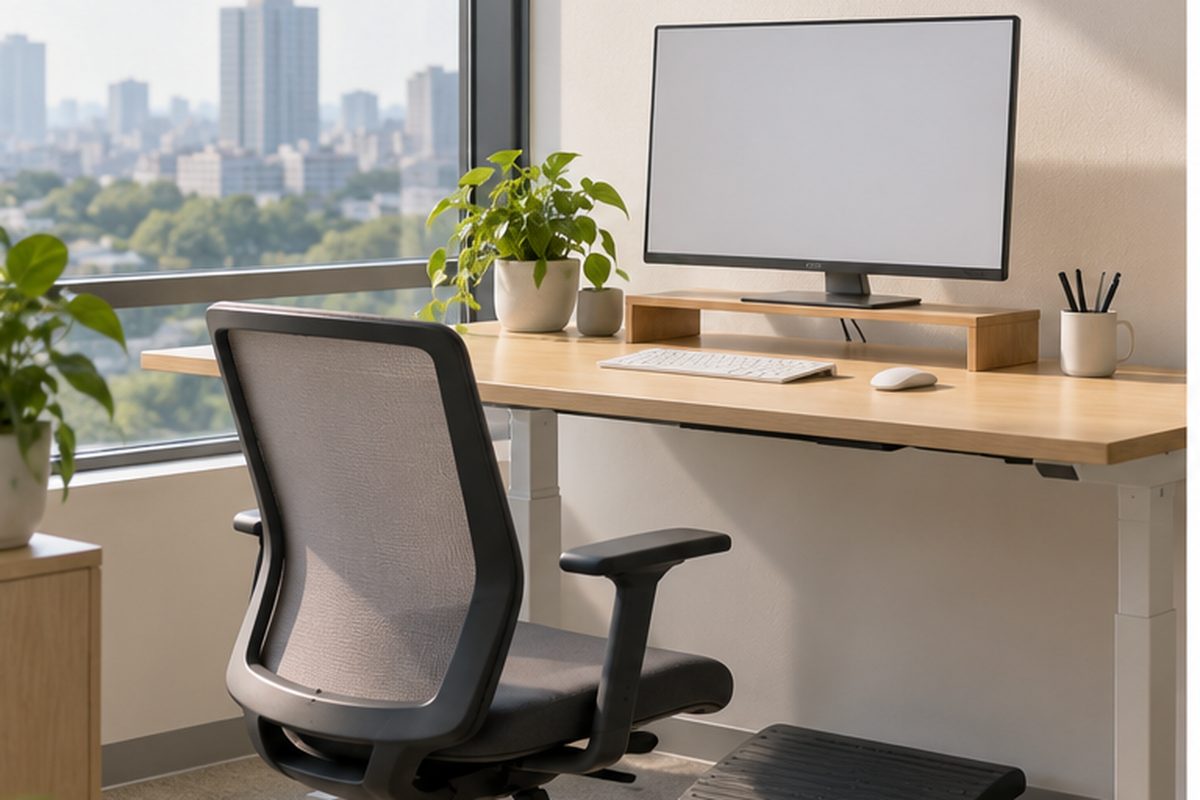
This section states the occupational-safety guideline's standards, not treatment advice. Its use is to let you check your own desk against them.
- Screen: DOSH's steps are to place the monitor directly in front of you, at arm's length (45 cm to 70 cm), with the top usable line of the monitor at a height where the neck is straight [DOSH-DSE]. Place the monitor at eye height if you wear single-prescription glasses or contacts, and below eye height if you wear bifocal, trifocal or progressive lenses [DOSH-DSE].
- Laptops: DOSH notes that a laptop's built-in screen is typically lower than eye level [DOSH-SEAT]; for prolonged use, an external keyboard, mouse and monitor should be provided [DOSH-DSE].
- Elbows and desk: a seated worker normally prefers to work with both hands at roughly elbow level or slightly lower [DOSH-SEAT]. For typing, the work surface should be about 30 to 50 mm below sitting elbow height, so the fingers type at around elbow height with the shoulders relaxed, not hunched or shrugged [DOSH-SEAT]. In DOSH's own case illustration, the improved position has the hand at a 90-degree angle and the shoulder relaxed [DOSH-SEAT].
- Feet: adjust the chair so the thighs are parallel to the ground with both feet flat on the floor [DOSH-SEAT]. A chair set too high presses on the thighs; a footrest is the last resort, for when the chair cannot be lowered [DOSH-SEAT].
- What a screen set too high or too low does: DOSH's risk table files it under "awkward posture", and the potential symptoms listed for that group include neck pain and shoulder pain [DOSH-SEAT].
💡 Remember: these numbers are DOSH's standards for employers and employees. Wherever your desk does not match, that is information worth giving at the consultation.
IV. How often to get up: one table

DOSH's guidelines, in their case studies (call-centre and display-screen work), recommend a one-minute standing break after 30 minutes of sitting [DOSH-SEAT]. A registered practitioner at the Chinese University of Hong Kong's School of Chinese Medicine recommends changing position at least every 45 minutes [CUHK-2016]. The two numbers are close.
| Situation | What the public guidance says | Usual practice | When to see a doctor first |
|---|---|---|---|
| Sitting continuously | DOSH: a static posture restricts blood flow to the vessels supplying the muscles and accelerates fatigue [DOSH-SEAT]; its case studies recommend a one-minute standing break after 30 minutes of sitting [DOSH-SEAT]; CUHK's School of Chinese Medicine recommends changing position at least every 45 minutes [CUHK-2016] | Stand to take calls, walk to the pantry for water | Shoulder pain not improving after two weeks [NHS-SP], neck pain not going away after a few weeks [NHS-NP]: see a doctor |
| Staring at the screen | DOSH lists "keeping the head still while looking at the monitor" as an example of a static posture [DOSH-DSE]; its 20/20/20: every 20 minutes, look at something at least 20 feet away, for at least 20 seconds [DOSH-DSE]; the guideline states the purpose: to change the focus of the eyes, allowing the muscles in the eyes to rest from the otherwise constant focus [DOSH-DSE] | Look away, to the window or the end of the corridor | Pins and needles that do not go away, or no feeling in the arm or shoulder: get urgent help (see section VI) [NHS-SP] |
| Working on a laptop | Its screen is typically lower than eye level [DOSH-SEAT], and a monitor too high or too low sits under "awkward posture" in DOSH's risk table, with neck pain and shoulder pain among the potential symptoms [DOSH-SEAT]; for prolonged use, an external keyboard, mouse and monitor [DOSH-DSE]; minimise use on public transport and in vehicles [DOSH-DSE] | DOSH's own case-study fix: raise the screen a little on a ream of paper [DOSH-SEAT], and plug in a keyboard | As above |
| Air-conditioning blowing on the neck and shoulders | The terminology standard's "cold causes contraction": pathogenic cold constricts qi, blocks the skin pores, and causes contractions [WHO-2022]; TCM theory (the CUHK column, writing on 漏肩风): wind, cold and damp obstruct qi and blood, the channels stop flowing freely, and pain results [CUHK-2017]; keep warm and keep the shoulder out of the cold [CUHK-2017]; DOSH's account: cold temperature tenses up muscle as blood vessels constrict to prevent heat loss [DOSH-SEAT] | A light jacket, or redirect the vent | Shoulder badly swollen or hot to touch, or fever: get urgent help [NHS-SP] |
| After work: phone on the sofa, laptop in bed | NHS: do not keep your neck in the same position for a long time [NHS-NP]; DOSH lists continuously holding a phone or tablet as a static posture [DOSH-DSE] — muscles holding the body in a single position for a long period can result in circulation problems and tension [DOSH-DSE] | Change seat and position at the end of each episode | Night pain that wakes you and keeps worsening: see a doctor first (see section VI) |
"Moving" here means a habit, not an exercise. DOSH calls things like answering the telephone or a discussion "productive rest", because they change the posture and rest the muscles [DOSH-DSE]; its case studies also recommend focusing the eyes on distant objects [DOSH-SEAT]. As for movements aimed at the neck or lower back, do not follow online videos on your own; the NHS shoulder-pain page says it plainly: do not make up your own strenuous exercises [NHS-SP].
💡 Remember: DOSH wrote "change position, stand up and move around" into the guideline [DOSH-SEAT]. Exercise instruction comes from a professional who has examined you.
V. How TCM sees it: sitting injures the flesh, looking injures the blood, and cold from the air-conditioning
TCM theory has an old line about the word "long". The Suwen chapter 宣明五气 (Xuan Ming Wu Qi) says: "The five overstrains injure thus: prolonged looking injures the blood, prolonged lying injures qi, prolonged sitting injures the flesh, prolonged standing injures the bones, prolonged walking injures the sinews — these are the injuries of the five overstrains" [BUCM-2012]. The Beijing University of Chinese Medicine article files this passage under "overuse of exertion and rest" — doing anything to excess becomes a cause of illness [BUCM-2012].
In plain terms, TCM theory holds that qi and blood are driven by the body's movement. Hold one posture too long and their circulation slows, the muscles (the "flesh") are under-nourished, and that is "prolonged sitting injures the flesh"; eyes fixed on one spot for hours is "prolonged looking injures the blood". A day at a desk does both.
What the terminology standard says. The plain-language paragraph above is a common teaching in the theory; the terminology standard puts it this way. The WHO's 2022 international standard terminologies on TCM carries the same entry, the "five exhaustions": long-time observation damages blood; long-time lying damages qi; long-time sitting damages muscles; long-time standing damages bones; long-time walking damages sinews [WHO-2022] — the standard's English renders 肉 as "muscles" [WHO-2022]. The standard also carries an entry "work-rest imbalance": a collective term for over-exertion and physical inactivity [WHO-2022]. The same chapter's "physical inactivity" entry states: physical inactivity leads to imbalances in the flow of qi and blood, weak tendons and bones, and stagnant qi of the spleen and stomach [WHO-2022]. So in the theory, "prolonged sitting injures the flesh" is not an old saying urging people to move; it is a defined entry among the causes of illness.
A registered practitioner at the Chinese University of Hong Kong's School of Chinese Medicine makes the same point from another angle: holding one posture for a long time also has an adverse effect on the joints of the cervical spine [CUHK-2016]; when the body stays still for long, the muscles and ligaments of the neck and shoulders must work harder to hold the posture, and their blood supply is also restricted by the lack of movement [CUHK-2016]. Hence the column's recommendation to change position at least every 45 minutes [CUHK-2016].
The two accounts side by side. DOSH and TCM theory start from the same observation: a body kept still for a long time. From there they part. DOSH speaks of muscles kept working, blood supply slowing, nutrients not arriving and waste not being cleared [DOSH-SEAT] — all things that can be measured. The theory speaks of "prolonged sitting injures the flesh" [BUCM-2012] and "imbalances in the flow of qi and blood" [WHO-2022] — and "qi and blood" is the theory's own category, not the blood in the vessels. The two agree on one sentence only: stillness is the problem and changing position is the answer — DOSH writes "change position, stand up and move around" [DOSH-SEAT], the CUHK column's recommendation is to change position at least every 45 minutes [CUHK-2016]. Where they differ is the language each uses for "why"; this article does not merge the two languages into one sentence.
Cold from the air-conditioning. The other line in TCM theory is external pathogens. Another registered practitioner at the same school summarises the cause of 漏肩风 (lou jian feng, a classical TCM disease name for one kind of shoulder pain) this way: wind, cold and damp enter the sinews, bones and joints directly, qi and blood are obstructed by them, the channels stop flowing freely, and pain results [CUHK-2017]; so daily life should emphasise keeping warm and keeping the shoulder out of the cold [CUHK-2017].
The terminology standard writes this line out entry by entry. "Pathogenic wind": a pathogenic factor characterised by opening the skin pores, high mobility and upward and outward movement [WHO-2022]; wind flows upward and easily affects the head, the face, the surface of the body and the yang meridians [WHO-2022]; wind is the spearhead of the exogenous pathogenic factors and liable to associate itself with cold, dampness, dryness and heat [WHO-2022] — which is why the theory so often says "wind" and "cold" in one breath. "Pathogenic cold": a pathogenic factor characterised by coldness, stagnation, congealing and contraction [WHO-2022]. "Cold congeals and stagnates": pathogenic cold causes qi and blood to stagnate, blocks the meridians, and causes pain [WHO-2022]. "Cold causes contraction": pathogenic cold constricts qi, blocks the skin pores, and causes contractions [WHO-2022].
Joining these entries (the linking here is this article's own): wind opens the pores first and cold follows; cold stops qi and blood from moving and tightens the area; when the channels do not flow freely, there is pain. That is the entry-by-entry counterpart, in the standard, of the CUHK column's sentence "qi and blood are obstructed by them, the channels stop flowing freely, and pain results" [CUHK-2017], and the theory behind its direction "keep warm and keep the shoulder out of the cold" [CUHK-2017].
DOSH also speaks of cold, in a different language: cold temperature leads to reduced sensory feedback and tensed-up muscle, with less dexterity and flexibility, as the body constricts blood vessels to prevent heat loss [DOSH-SEAT]. Both accounts use a word for "contracting" — DOSH of muscle and blood vessels, the standard of qi and pores — but they are two models, and this article does not present them as one and the same thing.
In Malaysia, the common form of "cold on the shoulder" is not winter but an office vent aimed at the neck and shoulders, or the car air-conditioning on full. The practice is simple: if your seat is under the vent, add a light jacket or redirect it.
How the two accounts would read the day. Below, both models are laid over an ordinary office day. It describes how the models read these situations, not any particular reader, and it is not a diagnosis.
- 9 a.m., laptop flat on the desk, straight to work. DOSH: a laptop's screen is typically lower than eye level [DOSH-SEAT], and a monitor too low sits under "awkward posture" in the risk table, with neck pain and shoulder pain among the potential symptoms [DOSH-SEAT]. Theory: the "long-time observation" and "long-time sitting" of the five exhaustions [WHO-2022] begin accumulating from this moment.
- 9 to 11, one email after another, head never moved. DOSH: this is exactly its example of a static posture — keeping the head still while looking at the monitor [DOSH-DSE]; muscles holding the body in a single position for a long period can result in circulation problems and tension [DOSH-DSE]. Theory: "physical inactivity" — inactivity leads to imbalances in the flow of qi and blood [WHO-2022].
- 11 a.m., the air-conditioning vent aimed at the back of the neck. DOSH: cold temperature tenses up muscle as the body constricts blood vessels to prevent heat loss [DOSH-SEAT]. Theory: wind opens the skin pores and associates itself with cold [WHO-2022]; cold causes qi and blood to stagnate and blocks the meridians [WHO-2022], and causes contractions [WHO-2022] — this is what "keep the shoulder out of the cold" [CUHK-2017] refers to.
- 2 to 6 p.m., a report to finish, not once out of the chair. DOSH: a static posture restricts blood flow to the vessels supplying the muscles and accelerates fatigue; limited mobility lowers circulatory demand and slows blood flow [DOSH-SEAT]; metabolic waste is not carried away either [DOSH-SEAT]. Theory: still "prolonged sitting injures the flesh" [WHO-2022]; what the theory counts is how long it has accumulated.
- 10 p.m., an hour on the phone on the sofa. DOSH: continuously holding a phone or tablet is a static posture [DOSH-DSE]. Theory: "long-time observation" continues after work.
- The two accounts' overall reading. DOSH reads a load that accumulates all day and a blood supply that slows again and again — so what it wrote into the guideline is "change position, stand up and move around" [DOSH-SEAT]. The theory reads two lines, "long" and "cold", stacked on the same day — so the CUHK columns' directions are to change position [CUHK-2016] and keep warm [CUHK-2017]. The two sets of advice land close together; the language of the reasons differs.
This passage describes models, not a diagnosis. The same day landing on different people can turn out completely differently; how long the ache has lasted, and whether anything in section VI applies, is what to say at the consultation.
What a TCM practitioner typically considers: acupuncture, tuina, herbal medicine, and the everyday directions above. Which of these, whether at all, and when, is the practitioner's judgement after seeing you; this article predicts no outcome. On the overall order of a pain consultation: how TCM approaches pain.
💡 Remember: the above is the direction the TCM framework gives. It is not a diagnosis of you, and it does not replace the medical judgement in section VI.
VI. See a doctor first in these situations
Posture-related aching is very common, but the following do not belong to that category:
- Persistent numbness or weakness in the arm or fingers, or a marked drop in grip strength. Get urgent help — the NHS lists "pins and needles that do not go away" and "no feeling in your arm or shoulder" among the reasons to get urgent help [NHS-SP].
- Numbness or weakness in the leg, or unsteadiness walking. Get urgent help.
- Loss of bladder or bowel control (such as difficulty peeing), or loss of feeling around the genitals or anus. Call 999 now, or go to the nearest hospital emergency department — the NHS back-pain page lists these, with back pain, among the reasons to call 999 [NHS-背痛].
- Pain after a clear injury, fall or road accident. Get urgent help [NHS-SP].
- Night pain that wakes you and keeps worsening, or unexplained weight loss. See a doctor first.
- Pain with persistent fever. Get urgent help [NHS-SP].
- Chest pain that feels tight or squeezing, or chest pain spreading to your arms, neck or jaw. Call 999 now, or go to the nearest hospital emergency department — the NHS heart-attack page lists this among the reasons to call 999 [NHS-HA]. This is an emergency, not a consultation booking.
- Slurred speech, one-sided weakness or a severe headache. Call 999 now, or go to the nearest hospital emergency department.
- Shoulder pain that has not improved after two weeks, is getting worse, or makes it very difficult to move the arm. The NHS advice is to see a doctor [NHS-SP]; neck pain or stiffness that does not go away after a few weeks, or that painkillers have not helped, is also a reason to see a doctor [NHS-NP].
- Taking medication prescribed by a doctor. Never stop a prescription on your own; discuss any change with the doctor who prescribed it.
In Malaysia, call 999 in an emergency, or go to the nearest hospital emergency department.
A note: this section is general information only. For conditions like these, follow your doctor's diagnosis and treatment, and seek medical attention when you need it.
Fitting it into life in Malaysia
- Working from home at the dining table. Dining-table height is fixed and cannot be adjusted. DOSH's approach to a fixed-height table is a keyboard tray, or raising the chair; if your feet then leave the floor, add a footrest [DOSH-SEAT].
- Sitting under the office air-conditioning vent. The common Malaysian form of section V's "cold on the shoulder". Keep a light jacket on the chair, or redirect the vent.
- Commuting by motorbike. A long held position in traffic plus vibration is a separate load from the office chair — describe them separately.
- Standing on the LRT, laptop in the car. DOSH advises minimising laptop use on public transport and in vehicles [DOSH-DSE].
- Napping face-down on the desk at lunch. Common, and worth a mention at the consultation.
- Catching up on exercise at weekends. Nothing all week and a heavy weekend is itself information.
- Pharmacy counters (Guardian, Watsons and the like). Heat and cold packs can be bought there [NHS-NP], and the pharmacist is someone you can ask about choosing a painkiller [NHS-SP].
- Klinik Kesihatan or a government hospital. For the non-emergency situations in section VI, and for the "see a doctor to confirm" step, the nearest government clinic is the entry point; chest pain spreading to the arm, slurred speech and loss of bladder or bowel control are still 999.
- Don't follow videos for neck movements. Routines circulating online may not suit your situation. Any movement aimed at the neck or lower back should be guided by a doctor, physiotherapist or TCM practitioner who has examined you.
If you are unsure where your situation should go: when an online consultation is not the right choice. On the neck and shoulders specifically: stiff, aching neck and shoulders.
⚠️ A safety note: TCM and Western medicine complement each other; it is not a choice between them. Separating "the ache I always have" from "numbness or weakness that is new" matters — the second is not a posture problem.
Frequently asked
How high should my pillow be? The NHS neck-pain page gives no number of centimetres, only a direction: use a low, firm pillow [NHS-NP]; when sleeping, make sure your head is the same height as the rest of your body [NHS-NP]; do not sleep on your front, and do not twist your neck in bed [NHS-NP]. So the answer to "how high" goes only as far as the guideline does: low and firm, head level with the body. If the ache is still there a few weeks after changing the pillow, bring that to the consultation.
What does air-conditioning blowing on my neck and shoulders do? TCM theory's account is in section V; the CUHK column on 漏肩风 puts it this way: wind, cold and damp obstruct qi and blood, the channels stop flowing freely, and pain results [CUHK-2017], so the direction the theory gives is to keep warm and keep the shoulder out of the cold [CUHK-2017]. That is the framework's explanation, not a diagnosis of you. In practice: a jacket, and redirect the vent; if your neck and shoulders already ache, the side the air-conditioning hits is worth mentioning at the consultation.
Is a standing desk useful? DOSH's position is not "standing beats sitting" but "change". The Seating at Work guidelines: sitting for long periods can lead to discomfort, so employees need the opportunity to change position, stand up and move around [DOSH-SEAT]; the short breaks it describes include switching from seated work to standing work [DOSH-SEAT]. The Standing at Work guidelines say: standing is a natural human posture and by itself poses no particular health hazard, but prolonged standing at work can lead to ergonomic risk factors that affect health [DOSH-STAND]. Where a standing desk fits is a matter of those two sentences.
Can I use heat? The NHS neck-pain page lists heat or cold packs among the things you can do yourself: a hot water bottle wrapped in a tea towel on the neck for 20 minutes, 2 to 3 times a day [NHS-NP]; the shoulder-pain page says either heat or cold can be tried, for up to 20 minutes at a time [NHS-SP]. Two conditions: pain with fever belongs to section VI — get urgent help, and a shoulder that is badly swollen or hot to touch is on the NHS urgent list too [NHS-SP] — do not apply heat first in any of these; and if your doctor or practitioner has given a different instruction, follow theirs.
What is the difference between a massage parlour and seeing a TCM practitioner? It is not a question of which is better, but of which one you need right now. A massage parlour offers relaxation; TCM tuina is manual therapy after a practitioner's assessment — there is a consultation before it, a judgement, and situations where it is not done. The detail is in "Tui Na or Massage?" (/tuina-vs-massage/). For the situations listed in section VI, neither is the first step — see a doctor.
How long is too long before seeing a doctor? The NHS standard: if shoulder pain has not started to ease within two weeks, is getting worse, or makes it very difficult to move the arm, see a doctor [NHS-SP]; neck pain or stiffness that does not go away after a few weeks, or that painkillers have not helped, is also a reason to see a doctor [NHS-NP]. Sudden or very bad pain, being unable to move the arm, pins and needles that do not go away, pain that started after an injury, or feeling feverish are reasons to get urgent help [NHS-SP]. Section VI follows the same logic.
In closing
✅ Worth remembering:
- The problem is not "sitting" but "for how long" and "without moving": DOSH's emphasis is on seated work with minimal movement for more than 30 minutes continuously [DOSH-SEAT].
- Why sitting still aches: DOSH's explanation is that a static posture restricts blood flow to the vessels supplying the muscles and accelerates fatigue [DOSH-SEAT]; muscles holding the body in one position for a long period can result in circulation problems and tension [DOSH-DSE].
- DOSH's standards: screen directly in front, an arm's length away, top line at a height where the neck is straight [DOSH-DSE]; typing surface a little below the elbows, shoulders relaxed [DOSH-SEAT]; feet flat [DOSH-SEAT].
- How often to get up: DOSH's case studies recommend a one-minute standing break every 30 minutes [DOSH-SEAT]; CUHK's School of Chinese Medicine recommends changing position at least every 45 minutes [CUHK-2016] — standing to take a call or walking to the pantry counts.
- TCM theory: prolonged sitting injures the flesh, prolonged looking injures the blood [BUCM-2012]; the terminology standard's "physical inactivity": inactivity leads to imbalances in the flow of qi and blood [WHO-2022]; on 漏肩风, the CUHK column's direction is to keep warm and keep the shoulder out of the cold [CUHK-2017]; the standard's "cold causes contraction": pathogenic cold causes contractions [WHO-2022] — in Malaysia, that is a jacket and a redirected vent when the air-conditioning blows on you.
- Persistent numbness, injury, fever — get urgent help [NHS-SP]. Chest pain spreading to the arm — call 999 now [NHS-HA]. Not improving after two weeks — see a doctor [NHS-SP].
❌ Better not to:
- Absorb new numbness or weakness into "the job is just like this".
- Follow online videos for neck or lower-back movements on your own.
- Stop prescribed medication on your own because you have started TCM care; discuss any change with the doctor who prescribed it.
👉 If you are not sure "where this desk-work neck and shoulder ache should go next", you are welcome to bring it to an online consultation with HansMed, where a practitioner registered under the T&CM Act 2016 can assess it; if any of section VI applies, see a doctor first. In-person consultations are coming soon.
Reviewed by Ms. Heather Wong, a TCM practitioner registered with Malaysia's Traditional and Complementary Medicine Council under the T&CM Act 2016, practising in pain management, internal medicine, acupuncture and women's health.
Sit with a licensed TCM practitioner from wherever you are.
HansMed Modern TCM
For general wellness education only — not medical advice. Consult a registered TCM practitioner for personal guidance.


