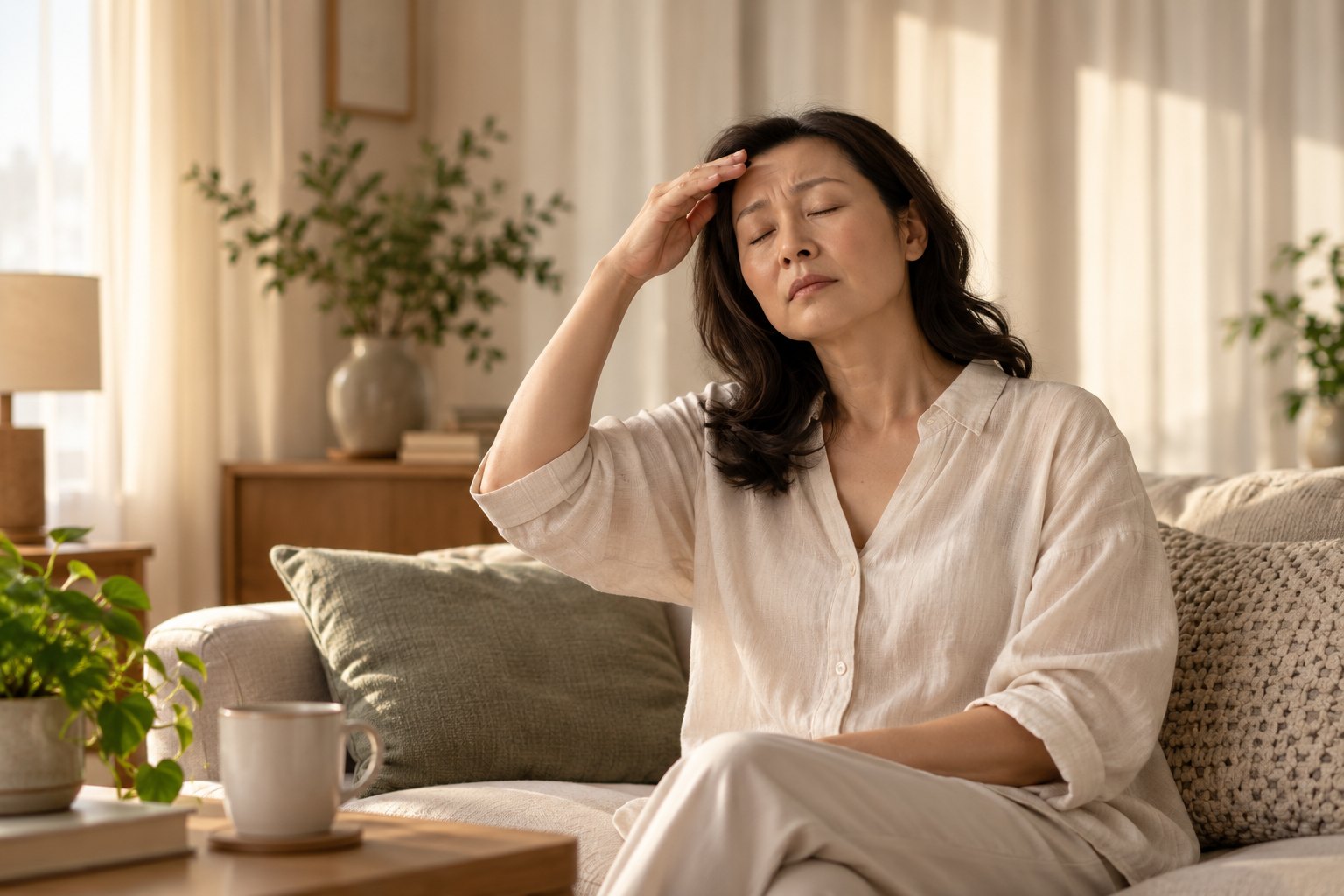
"The last six months I've just been off — hot flushes, poor sleep, shorter temper. Is this menopause?" It is a question that comes up often — asked with a slight hesitation, as though it might not count as a thing worth raising.
The answer first, on two levels. TCM theory reads this stage mainly through the "kidney": the World Health Organization's TCM terminology standard defines perimenopausal disorders as a group of disorders involving irregular menstruation and gradual menopause, often resulting from kidney qi failure and imbalance between yin and yang. [WHO-2022]
Medically, natural menopause is 12 consecutive months without menstruation, and it generally occurs between 45 and 55. [WHO-MENO] The WHO's account of the cause: the loss of ovarian follicular function and a decline in circulating blood oestrogen levels. [WHO-MENO] Symptoms usually last 7 to 9 years, sometimes longer. [NHS-症状]
This article sets out both sides: where those numbers come from, what is falling in the body, how TCM theory understands the transition, how the two accounts each read one hot flush, why hormone therapy is the doctor's decision, and when to see a gynaecologist first — as 6 things.
I. First: menopause is a life stage, not a disease — and it has numbers
Menopause is a natural transition in a life stage, not an illness. The WHO describes it as one point in a continuum of life stages for women, marking the end of the reproductive years. [WHO-MENO] The Malaysian Menopause Society says the same: a natural life stage, not a disease. [MMS-2023]
① The definition. Natural menopause is deemed to have occurred after 12 consecutive months without menstruation for which there is no other obvious physiological or pathological cause and in the absence of clinical intervention. [WHO-MENO] The NHS puts it more plainly: not having a period for 12 months, and you're not using hormonal contraception. [NHS-定义]
② The age. WHO: most women experience menopause between the ages of 45 and 55. [WHO-MENO] The NHS and the Malaysian Menopause Society give the same range. [NHS-定义] [MMS-2023] Before 45, the NHS calls it early menopause or premature ovarian insufficiency. [NHS-定义]
③ How long the transition is. The WHO defines perimenopause as the period from when changes in the menstrual cycle are first observed until one year after the final menstrual period; it can last several years. [WHO-MENO] The Malaysian Menopause Society also states that perimenopause can last for several years. [MMS-2023]
④ How long symptoms last. NHS: symptoms usually last for 7 to 9 years, sometimes longer, and during this time they can change — hot flushes and night sweats may improve for a while and be replaced by other symptoms such as low mood and anxiety. [NHS-症状]
⑤ How it is confirmed. There is no routine test. The NHS states that a doctor may diagnose it based on your age and symptoms. [NHS-定义] The WHO also notes it is not possible to predict when an individual woman will experience menopause. [WHO-MENO] So "has it started?" is a question for a doctor, not for a checklist.
💡 Remember: "it's natural" does not mean "you just put up with it." A natural stage can still be discussed and cared for — the WHO states that symptoms that impact on health and well-being should be discussed with a health-care provider. [WHO-MENO]
II. What is changing in the body: what falls, and what commonly follows
Section I's numbers answer "when". This section answers "what happened" — using only what the WHO and NHS pages state.
① What falls. The WHO's account: menopause is caused by the loss of ovarian follicular function and a decline in circulating blood oestrogen levels; this means that the ovaries stop releasing eggs. [WHO-MENO] The NHS version is shorter: menopause is caused by a fall in hormone levels. [NHS-定义] On its page about hormone therapy, the NHS names two of them: oestrogen and progesterone, which fall to low levels as you approach the menopause. [NHS-HRT]
② What those two hormones did before. NHS: oestrogen and progesterone are an essential part of period cycles, ovulation and pregnancy; they also keep your bones healthy; as you get older, the loss of these hormones can have a big effect on your body. [NHS-HRT] So menopause is not only "periods stopping" — the same hormones had been working elsewhere.
③ What commonly follows. The WHO describes the hormonal changes associated with menopause as able to affect physical, emotional, mental and social well-being, and among the symptoms it lists are hot flushes and night sweats, changes in the regularity and flow of the menstrual cycle culminating in its cessation, difficulty sleeping, and changes in mood. [WHO-MENO] The WHO also states that the range is wide: from few if any symptoms to severe symptoms that affect daily activities and quality of life. [WHO-MENO]
④ Two longer-term changes. The WHO states: women's advantage over men in terms of cardiovascular disease gradually disappears with the significant decline in oestrogen levels after menopause; loss of bone density at menopause is a significant contributor to higher rates of osteoporosis and fractures. [WHO-MENO] Read ② and ④ together: the NHS says these hormones keep your bones healthy [NHS-HRT], and the WHO says bone density is lost at menopause [WHO-MENO] — that is where the "bones" row in section V's table, and the NHS list of weight-bearing exercise and calcium-rich food [NHS-做法], come from.
What the two pages do not say. Both explain what falls and what commonly follows; neither walks through why a fall in hormones sets off a single hot flush. This article does not supply that step — when section IV reads one flush, it uses only the description and the trigger list the two pages state.
A note: this section is general information only. For conditions like these, follow your doctor's diagnosis and treatment, and seek medical attention when you need it.
III. How TCM theory sees this stage
This section has three parts: which concepts the theory uses, the habits the theory attaches, and what a practitioner typically does at this stage.
① The theoretical frame
TCM theory places this stage mainly within the "kidney" functional system. The WHO's TCM terminology standard defines perimenopausal disorders as a group of disorders involving irregular menstruation and gradual menopause, and states that these conditions often result from kidney qi failure and imbalance between yin and yang. [WHO-2022]
The "kidney qi" in that sentence: the standard's description is that it is transformed by kidney essence and is the driving force of the physiological activities of the kidney [WHO-2022]; kidney essence, in turn, is the essence stored in the kidney, inherited from one's parents and nourished by water and food, known as the foundation of the kidney's physiological activities. [WHO-2022] The standard also describes "the kidney governs reproduction" as the function of kidney essence and qi in boosting the maturity of reproductive organs and maintaining reproductive ability. [WHO-2022] So "kidney qi failure", and the Tian Gui and kidney yin below, point to the same system in the theory.
Three terms are worth knowing first:
- Tian Gui (天癸): the standard's description is a material substance transformed and generated by abundant kidney essence, which boosts the maturity of reproductive organs and maintains the reproductive function. [WHO-2022] The classical texts attribute the changes of this stage to Tian Gui gradually running out — the theory's account of why periods stop, a paraphrase rather than a quotation.
- Kidney yin (肾阴): the standard's description is the yin essence of the kidney, which, as opposed to kidney yang, refers to the quiescent and moistening aspect of the kidney's functions. [WHO-2022] The theory reads sudden heat, night sweating and a dry mouth in the direction of this aspect weakening.
- The liver governs the free flow of qi (肝主疏泄): the standard's description is that the liver maintains free flow of qi over the entire body. [WHO-2022] The theory places mood swings and irritability with the "liver" and its free flow of qi — when that flow is disturbed, mood and the sense of ease in the chest and flanks can both be affected; the liver stores blood [WHO-2022], and the liver and kidney share the same source — the liver stores blood and the kidney stores essence, and blood and essence can mutually transform into each other. [WHO-2022]
- The kidney governs the bones (肾主骨): the standard's description is that the kidney essence generates marrow to nourish bones. [WHO-2022] The theory places the state of the bones within the "kidney" system too — which is where the theory cell of the "bones" row in section V's table comes from.
Join these up, and "kidney yin gradually waning" reads as one account. One thing first: joining them up is a reading from within TCM theory, not a sentence from the WHO standard — the standard defines kidney essence, kidney qi, Tian Gui, kidney yin, yin deficiency leading to heat, the shared source of liver and kidney, and the kidney governing the bones entry by entry; stringing them into one line is what the theoretical tradition does, not what the standard says. The theory traces the source of reproductive function to Tian Gui, transformed from kidney essence, and attributes this stage to Tian Gui gradually running out (the theory's account); kidney yin is the quiescent and moistening aspect of the kidney's functions [WHO-2022]; the standard defines "yin deficiency leading to heat" (阴虚则热) as a pathological state in which yin fluid fails to control yang and causes a relative hyperactivity of yang and deficiency heat [WHO-2022] — the entry the theory uses to understand episodic heat and sweating.
Two more links outward: the liver and kidney share the same source, and blood and essence can mutually transform [WHO-2022], so in the theory the changes in mood and free flow are tied to the changes in the kidney; kidney essence generates marrow to nourish bones [WHO-2022], so bone sits in the same system. In one sentence: the theory reads this transition as one root (kidney essence) showing in several directions — kidney qi is transformed by kidney essence [WHO-2022], Tian Gui is transformed and generated by kidney essence [WHO-2022], kidney yin is the quiescent and moistening aspect of the kidney's functions [WHO-2022] — not as several unrelated complaints. So the opening's "kidney qi failure" and this section's "kidney yin gradually waning" point, in the theory, to the same root.
These are the theory's directions, not a judgement about you. The same hot flush can have more than one explanation in the theory; which one applies is the practitioner's judgement after the consultation, the tongue and the pulse — not something a reader assigns to herself. Entries such as Tian Gui and kidney yin describe how the theory accounts for this change; they are not targets to be "tonified" or "regulated" in a consultation, and they are not quantities that can be measured. Whether the change itself needs handling, and how, belongs first to the doctor of sections I and VI.
② The habits the theory attaches — and where the NHS list overlaps
- An evening cooling routine: the theory holds that the hours after dusk belong to yin and the body should settle — a warm rather than hot shower, a cooler room, light nightwear. The NHS hot-flush list runs the same direction: lightweight clothing, keeping your bedroom cool at night, a cool shower or a fan. [NHS-做法]
- Sleep timing: the theory treats the hours around 11 pm (子时) as the body's restorative window — in bed before about eleven. The NHS's first item is keeping to regular sleep routines. [NHS-做法]
- Less spice and alcohol in the evening: the theory classes spicy food and alcohol as warming, and least suited to the evening. The NHS lists spicy food, caffeine, hot drinks, smoking and alcohol as potential triggers of hot flushes, to avoid or reduce. [NHS-做法]
- Gentle movement: tai chi, walking. The NHS list includes yoga, tai chi or meditation. [NHS-做法]
- Cold drinks: the NHS list includes having a cold drink [NHS-做法]; the TCM habit is room-temperature or warm water. Both positions are here; you can ask your practitioner.
③ What a practitioner typically does at this stage
A consultation asks about five things — the list from the live version, still as it was:
- Changes to the cycle — longer or shorter, changes in flow, when the last period was.
- Temperature-related changes — flushes, night sweats, changes in how hot or cold you run, which times of day are worst.
- Sleep — falling asleep, waking at night, getting back to sleep.
- Mood and energy — swings, concentration, how tired you are.
- Existing diagnoses and medication — your doctor's diagnosis, any hormone-related medication, bone density or lipid results, anything else you take.
Then three options: acupuncture, herbs, a direction for daily life. Acupuncture, concentrated herbal granules or a decoction, and adjustments to routine and eating — the practitioner explains which suit this stage. These are options in practice, not a promise of results.
If you take medication your doctor prescribed (including anything hormone-related), keep taking it — never stop it on your own. On taking Chinese herbs alongside Western medication, see Can You Take Chinese Herbs With Western Medication?.
💡 Remember: ① is the theory's concepts, ② is the habits the theory attaches, ③ is what a practitioner does — none of the three is a promise that the flushes will go.
IV. How the two accounts sit side by side

① One transition, two accounts
The WHO and NHS account: loss of ovarian follicular function and a decline in blood oestrogen [WHO-MENO], which the NHS shortens to a fall in hormone levels [NHS-定义]; what commonly follows is hot flushes, changes in sleep and mood, and loss of bone density. [WHO-MENO] TCM theory's account: Tian Gui, transformed from kidney essence, gradually runs out (the theory's account); kidney yin — the quiescent and moistening aspect [WHO-2022] — wanes, and yin failing to control yang gives deficiency heat [WHO-2022]; kidney essence generates marrow to nourish bones [WHO-2022], and the liver and kidney share the same source [WHO-2022], so bone and mood sit on the same line. Each account stands on its own, in its own language, with its own methods of checking. They are not two names for one thing — oestrogen is not a translation of "kidney yin", and Tian Gui is not a hormone. This article does not merge them, and does not use one to prove the other.
② How the two accounts would read one hot flush
Picture one flush: early evening, the face, neck and chest suddenly hot, sweating, gone after a few minutes.
- The medical reading. The WHO describes this scene as a sudden feeling of heat in the face, neck and chest, often with flushing, sweating and palpitations, lasting several minutes [WHO-MENO]; the NHS adds that it can happen during the day or night, and at night it is a night sweat. [NHS-症状] The NHS's list of potential triggers: spicy food, caffeine, hot drinks, smoking and alcohol. [NHS-做法] So the medical side asks: what did you eat and drink before this flush?
- The theory's reading. The standard defines "yin deficiency leading to heat" as a pathological state in which yin fluid fails to control yang and causes a relative hyperactivity of yang and deficiency heat. [WHO-2022] The theory reads a sudden burst of heat followed by sweat in this direction — and asks about the time of day (the theory assigns dusk and night to yin), whether the mouth is dry, how the night's sleep went, and the person's state overall.
The two readings ask different questions and record almost the same things: what time, what was eaten, how much sweat, how the night's sleep went. The "track two weeks first" in section VII serves both. This is how two accounts read one flush, not a judgement about your flush — that belongs to your doctor and your practitioner, each on their own side.
③ Why hormone therapy is an individual decision
The NHS's account: the type of HRT that is best depends on different factors, such as whether you have had a hysterectomy, what stage of menopause you are at, and your personal preferences; if you are considering it, talk to a GP about the options suitable for you. [NHS-HRT类型]
The NHS treatment page also states: if you have symptoms of perimenopause or menopause, talk to a doctor, nurse or pharmacist about HRT and other options available. [NHS-治疗] The WHO points the same way: symptoms that affect health and well-being should be discussed with a health-care provider, with consideration of medical history, values and preferences. [WHO-MENO] That is what "individual decision" means: one term, a different plan for each person. This article says nothing about its benefits or risks; if you are on it, never stop it on your own.
💡 Remember: ① is each account's own ledger, ② is two readings of the same flush, ③ is why hormone therapy is talked through with a doctor — none of the three decides anything for you.
V. One table: common situations, what the theory says, what medicine says, when to see a doctor first
| Situation | What TCM theory says | What medicine says, what is generally done | When to see a doctor first |
|---|---|---|---|
| Hot flushes, night sweats | The standard defines kidney yin as the quiescent and moistening aspect of the kidney's functions [WHO-2022]; the theory reads sudden heat and night sweating in the direction of this aspect weakening | NHS: menopause is caused by a fall in hormone levels [NHS-定义]; the WHO lists hot flushes and night sweats among the symptoms associated with menopause [WHO-MENO]. The WHO describes a hot flush as a sudden feeling of heat in the face, neck and chest, often with flushing, sweating and palpitations, lasting several minutes [WHO-MENO]. NHS measures: lightweight clothing, a cool bedroom, avoiding spicy food, caffeine, hot drinks, smoking and alcohol [NHS-做法]; the theory adds an evening cooling routine | For symptoms like a fast heartbeat (palpitations), the NHS says contact your GP [NHS-症状]; chest pain with breathlessness or a cold sweat — call 999 now, or go to the nearest hospital emergency department |
| Poor sleep | The theory reads difficulty falling asleep and waking easily in the direction of "yin" being insufficient and the "spirit" unsettled | The WHO lists difficulty sleeping among the symptoms associated with menopause [WHO-MENO]. NHS: sleep problems may be worse if you also have night sweats [NHS-症状]; keep to regular sleep routines [NHS-做法]. Theory: in bed before about eleven; less spice and alcohol in the evening | Persistent insomnia that affects your days — tell your doctor first |
| Mood swings, irritability | The standard's description of 肝主疏泄 is that the liver maintains free flow of qi over the entire body [WHO-2022]; the theory places mood swings with the "liver" and its free flow of qi | The WHO lists changes in mood on the same symptom list [WHO-MENO]. NHS: mood swings, low mood and anxiety are common at this stage [NHS-做法], and may feel worse with sleep problems [NHS-症状]; the measures are as much rest as you can, regular exercise, relaxing activities [NHS-做法] | Persistently low mood, anxiety that is hard to control, or loss of interest in things — tell your doctor |
| Periods starting to change | The standard defines Tian Gui as the substance that boosts the maturity of reproductive organs and maintains the reproductive function [WHO-2022]; the theory treats changes in cycle and flow as Tian Gui gradually running out (the theory's account, not a quotation) | WHO: menopause is caused by the loss of ovarian follicular function and a decline in blood oestrogen; the ovaries stop releasing eggs [WHO-MENO]. NHS: one of the first signs of perimenopause is usually a change to your periods — more or less often, heavier or lighter [NHS-症状]. Pregnancy is still possible in perimenopause: the NHS says you still need contraception after your final period — for 1 year if you're 50 or over, 2 years if you're 40 to 49 [NHS-症状] | Still having periods but bleeding more, not less — the NHS says contact your GP [NHS-症状]; periods changing or stopping before 45 — see a doctor first [NHS-定义] |
| Bleeding after menopause | The theory does not handle this item — it goes to a doctor first | None | Always see a doctor first — even if it has only happened once, there is only a small amount, it is only pink or brown discharge, or there are no other symptoms [NHS-症状]. The NHS explains it can be a sign of cancer, which is why it is checked [NHS-绝经后出血] |
| Hormone therapy (HRT / MHT) | The theory does not assess this item — whether to use it, which kind and for how long is the doctor's decision | The NHS reminds: HRT is not contraception [NHS-做法]. If you are on it, never stop it on your own, and tell your doctor about the TCM side at your follow-up | Any question about starting, changing or stopping — ask the doctor who prescribed it |
| Bones and blood vessels | The standard's description of 肾主骨 is that the kidney essence generates marrow to nourish bones [WHO-2022]; the theory files bone within the "kidney" system. For the "kidney" system in general, see What Does "Kidney Deficiency" Actually Mean? | NHS: oestrogen and progesterone also keep your bones healthy [NHS-HRT]. WHO: loss of bone density at menopause is a significant contributor to higher rates of osteoporosis and fractures; cardiovascular risk can also be affected [WHO-MENO]. NHS measures: weight-bearing and resistance exercise, calcium-rich food, some sunlight, stop smoking and cut down on alcohol [NHS-做法]; ask a doctor before supplements | Which screening applies to you and how often — blood pressure, lipids, bone density, breast and cervical — ask your doctor |
| Tonics, herbs, supplements from family | The theory asks first what you are actually taking, then prescribes | NHS: talk to a doctor before taking herbal supplements or complementary medicines [NHS-做法]. Check the packaging for a registration number beginning with MAL and a Meditag label [MOH-PSP] | If you take medication your doctor prescribed, both sides need to know |
This table is "what is generally done", not "what you should do". Which items apply to you is for your doctor and your practitioner to judge, each on their own side.
A note: this section is general information only. For conditions like these, follow your doctor's diagnosis and treatment, and seek medical attention when you need it.
VI. See a gynaecologist or doctor first in these situations
- Any bleeding after menopause — always get this checked; this is the one that cannot wait
- Before menopause: bleeding between periods, after intercourse, or a sudden marked increase in flow
- A lump you can feel in the breast or abdomen
- Chest pain or palpitations with breathlessness or a cold sweat — call 999 now, or go to the nearest emergency department
- Persistently low mood, anxiety that is hard to control, or loss of interest in things — tell your doctor; this needs professional support
- Concerns about fracture risk, or a fracture from a minor fall
- Taking or considering hormone-related treatment — this belongs to your doctor's judgement; follow their advice and never stop or adjust it on your own
⚠️ A safety note: TCM and Western medicine complement each other; it is not a choice between them. The routine checks of this stage — blood pressure, lipids, bone density, breast and cervical screening — are not something a TCM consultation replaces. Follow your doctor's schedule for them.
A note: this section is general information only. For conditions like these, follow your doctor's diagnosis and treatment, and seek medical attention when you need it.
VII. Fitting it into life in Malaysia
- Air-conditioned rooms and flushes. Strong office air-conditioning against the heat outside makes for a large swing across the day. The NHS measure is lightweight clothing [NHS-做法]. In Malaysia, the cardigan every cold office already has does the rest — take it off when a flush comes.
- Mamak and dinner. The NHS lists spicy food, caffeine, hot drinks and alcohol as potential triggers of hot flushes, to avoid or reduce [NHS-做法]. The TCM habit is to keep them out of the evening — kopi or teh tarik in the daytime, dinner lighter on chilli and alcohol — and that is the theory's side; chilli and alcohol are on both lists. Whether and how much to cut back is a question for your doctor.
- Track two weeks first. How many flushes a day, at what times, how often you wake at night, and the date of the last period. "Nothing since March last year" is far more useful than "I think I'm menopausal" — and the record serves your doctor and your practitioner alike.
- Klinik Kesihatan and the gynaecologist. Bleeding after menopause, a marked change in periods, periods stopping before 45 — start at the Klinik Kesihatan or your family doctor, with referral to a gynaecologist when needed. Ask there which screening applies to you and how often.
- Pharmacies (Guardian, Watsons and the like). Over-the-counter medicines, calcium tablets, vitamin D, menopause supplements from the shelf — all of it goes on the list. Ask a doctor or pharmacist before supplements.
- Tonics from family and direct-selling supplements. Plenty gets recommended at this stage. One NHS line applies: talk to a doctor before taking herbal supplements or complementary medicines [NHS-做法]. Check the packaging for a registration number beginning with MAL and a Meditag label [MOH-PSP], and tell your practitioner what you are actually taking.
- What else is happening at home. Caring for elderly parents, children's exam season, the overtime season — several things often stack at this stage. The NHS list has an item for that too: talk to other people going through the same thing — family, friends or colleagues. [NHS-做法]
On preparing: what to prepare before an online consultation. On what the consultation covers: what TCM gynaecology covers.
Frequently asked questions
At what age does menopause start? WHO: most women experience menopause between the ages of 45 and 55 [WHO-MENO]; the NHS and the Malaysian Menopause Society give the same range [NHS-定义] [MMS-2023]. "Menopause" is defined as 12 consecutive months without a period [WHO-MENO]; the years before it, when periods start to change, are perimenopause, which can last several years [WHO-MENO]. If periods stop before 45, see a doctor first [NHS-定义].
How long do hot flushes last? A single flush lasts several minutes [WHO-MENO]. Overall, the NHS states that symptoms usually last for 7 to 9 years, sometimes longer, and that they change — flushes may ease after a while and be replaced by other symptoms [NHS-症状]. The measures are in section V: lightweight clothing, a cool bedroom, avoiding spicy food, caffeine, hot drinks, smoking and alcohol [NHS-做法].
Do I have to take hormones? That is the doctor's decision — whether it suits you, which kind, and for how long, judged against your medical history. The NHS states that the type that is best depends on whether you have had a hysterectomy, what stage you are at, and your personal preferences [NHS-HRT类型] — so the answer sits with your doctor. This article says nothing about the benefits or risks of hormone therapy, because that depends on your situation. If you are on it, never stop it on your own; the TCM side can run alongside, but let both sides know.
How does TCM see menopause? The theory places it with the "kidney": the WHO's TCM terminology standard defines perimenopausal disorders as a group of disorders involving irregular menstruation and gradual menopause, often resulting from kidney qi failure and imbalance between yin and yang [WHO-2022]. The classical texts attribute the changes of this stage to Tian Gui running out (the theory's account, not a quotation); the mood side is usually read through the "liver" and its free flow of qi. Which explanation applies to you is the practitioner's judgement after a consultation — section III has the full account, and section IV sets the two accounts side by side.
What tests are there for osteoporosis? The WHO states that loss of bone density at menopause is a significant contributor to higher rates of osteoporosis and fractures [WHO-MENO]. Whether you need a bone-density test, when, and how often — ask your doctor; this article has no Malaysian Ministry of Health screening schedule to cite. Why bone: the NHS's account is that oestrogen and progesterone also keep your bones healthy [NHS-HRT]; on the theory's side, the standard describes 肾主骨 as the kidney essence generating marrow to nourish bones [WHO-2022] — sections II and III each set this out. For the everyday part, the NHS lists weight-bearing exercise, calcium-rich food, some sunlight, and stopping smoking and cutting down on alcohol [NHS-做法].
Does bleeding after menopause always mean something is wrong? Not always, but it always needs checking. The NHS states that any vaginal bleeding after 12 months or more without a period needs to be checked — even if it has only happened once, there is only a small amount, or it is only pink or brown discharge [NHS-症状]. The reason is that it can be a sign of cancer [NHS-绝经后出血]. This item does not belong to a TCM consultation; see a doctor first.
A note: this section is general information only. For conditions like these, follow your doctor's diagnosis and treatment, and seek medical attention when you need it.
In closing
✅ Worth remembering:
- Menopause is a life stage, not a disease [WHO-MENO] [MMS-2023]; the definition is 12 consecutive months without a period, usually between 45 and 55 [WHO-MENO].
- What falls in the body is ovarian follicular function and oestrogen [WHO-MENO]; the NHS says these hormones had been part of period cycles, ovulation and pregnancy, and keep your bones healthy [NHS-HRT] — so the change is not only in the periods.
- TCM theory places this stage with the "kidney" — perimenopausal disorders often result from kidney qi failure and imbalance between yin and yang [WHO-2022]; the theory reads Tian Gui, kidney yin, the shared source of liver and kidney, and the kidney governing the bones as several directions of one root; the mood side is usually read through the "liver" and its free flow of qi.
- Any bleeding after menopause needs checking, even once, even a small amount [NHS-症状] — that is the one that cannot wait.
- Hot flushes have a list: lightweight clothing, a cool bedroom, avoiding spicy food, caffeine, hot drinks, smoking and alcohol [NHS-做法]; the theory adds an evening cooling routine and bed before eleven.
- Hormone therapy is the doctor's decision; which screening applies to you and how often — ask your doctor; medication you are on, never stop it on your own.
❌ Better not to:
- Treat bleeding after menopause as a sign of renewed youth and leave it uninvestigated.
- Stop hormone medication on your own because you have started TCM care.
- Write off persistent low mood as "everyone's like this at this age" — tell your doctor.
👉 If you are not sure "where to start setting out the changes of this stage for a practitioner", you are welcome to book an online consultation with HansMed, where a practitioner registered under the T&CM Act 2016 can assess it with you; if anything in section VI applies, see a doctor or a gynaecologist first.
Reviewed by Ms. Koo Shuang, a TCM practitioner registered with Malaysia's Traditional and Complementary Medicine Council under the T&CM Act 2016, practising in gastroenterology, dermatology, respiratory and women's health.
Sit with a licensed TCM practitioner from wherever you are.
HansMed Modern TCM
For general wellness education only — not medical advice. Consult a registered TCM practitioner for personal guidance.


