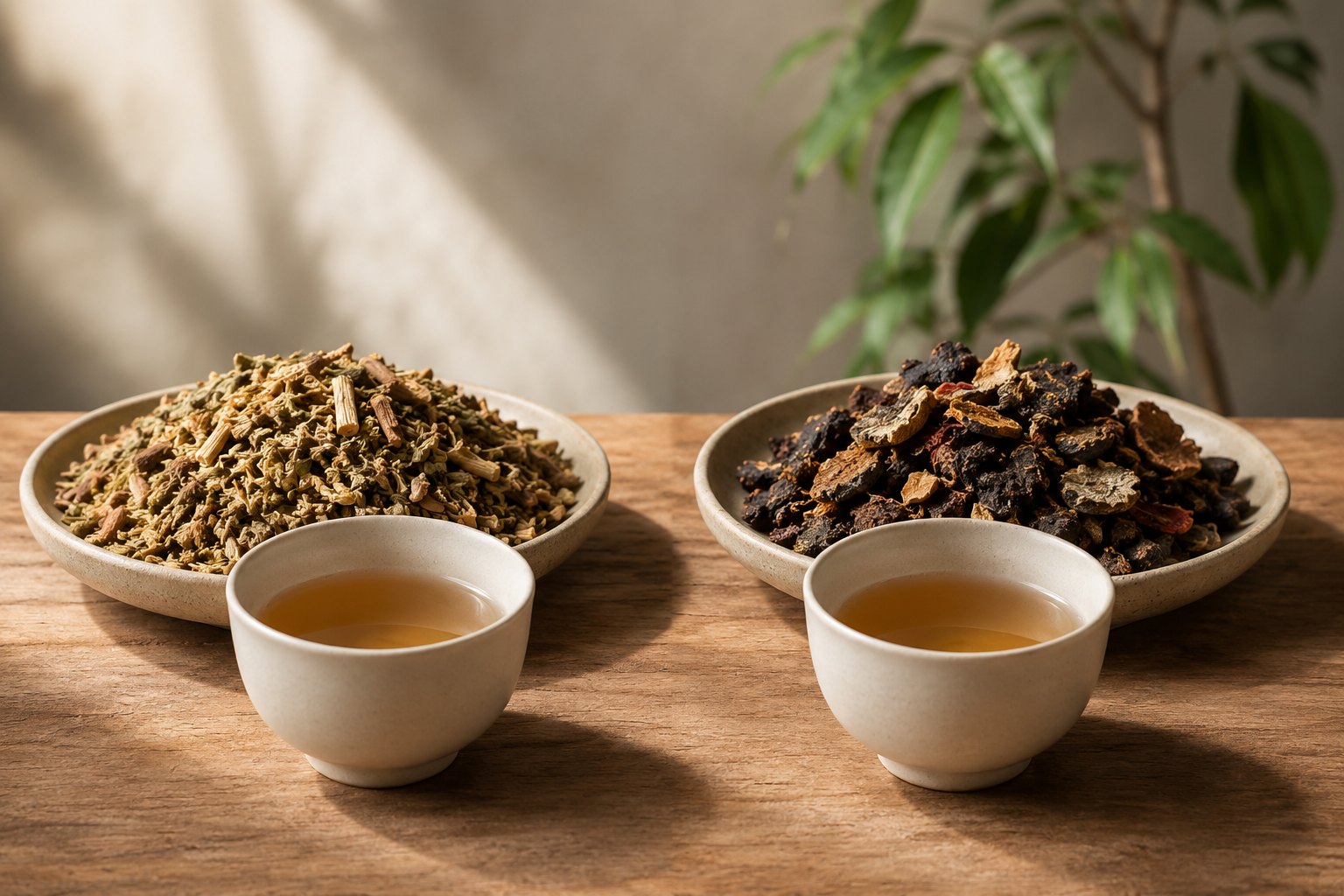
A question many readers have is: "My friend has the same sleep problem as me — why is their prescription completely different from mine?"
The answer is not that the practitioner prescribes randomly. In TCM, the focus is not on "the same disease name" but on "the same person's current overall state." This process of assessment is called pattern differentiation (辨证).
What Is Pattern Differentiation? — Distinguishing "Disease Name" From "Pattern"
Pattern differentiation is the process by which TCM identifies where the problem lies. It does not attach a single label to an illness. Instead, it pieces together clues about your body: sleep, appetite, emotions, sensations of heat or cold, bowel movements, tongue appearance, pulse — and forms a "pattern."
A "pattern" is not the same as a "disease." The disease name may be the same, but the pattern can differ. Two people with the same pattern may even have different disease names.
| Disease diagnosis — the Western method | Pattern differentiation — the TCM method | |
|---|---|---|
| Focus | What the disease is | What is happening with this person now |
| Basis | Tests, scans, biomarkers | Symptoms, tongue, pulse, lifestyle |
| Classification | By cause or pathology | By pattern type, e.g., liver qi stagnation, heart-spleen deficiency |
| Treatment goal | Treat the disease itself | Restore balance to the system |
| Prescription logic | Guided primarily by the disease diagnosis | Same disease, different treatment; different disease, same treatment |
TCM and Western medicine complement each other; it is not a choice between them. So two people with the same sleep problem can receive very different prescriptions — because their patterns are different.
Why Can "Poor Sleep" Have Different Patterns?
In TCM, a sleep problem is not a fixed disease — it is an outcome. Different underlying causes can produce it, and pattern differentiation is the process of identifying which cause is at work.
Taking "poor sleep" as the example: in TCM theory it may correspond to different patterns — for instance heart-spleen deficiency, liver qi stagnation with heat, heart-kidney non-interaction, or phlegm-heat harassing the interior. What separates these patterns is where TCM theory understands the imbalance to lie (which organ system is involved, and the state of qi and blood) — not a checklist of symptoms a reader could match themselves against. The same person's pattern can also change over time and with life circumstances.
A note: this section is general information only. For conditions like these, follow your doctor's diagnosis and treatment, and seek medical attention when you need it.
Please note: Pattern names are classifications within TCM theory, not a judgment about your body. Your pattern can only be determined by a registered TCM practitioner through the four diagnostic methods.
How Is Pattern Differentiation Done? — The Four Diagnostic Methods
Pattern differentiation is not based on a single symptom. It uses the "four diagnostic methods" together:
- Inspection — observing complexion, tongue, and body posture
- Listening and smelling — voice quality and body odour
- Inquiry — asking about symptoms, diet, sleep, bowel movements, emotions, and menstruation (where applicable)
- Palpation — taking the pulse (this requires the practitioner's own hands and cannot be done online; you may be asked to describe your pulse)
Can pattern differentiation be done online? Yes. In a video consultation, the practitioner gathers most information through inquiry, supplemented by a tongue photo taken with the system's guidance — if the photo is not clear enough, the practitioner can observe the tongue directly on the video call. Pulse-taking cannot be performed online, so the practitioner relies primarily on inquiry and tongue observation — and may suggest seeking a face-to-face assessment if the situation is complex.
Pattern differentiation is dynamic. Your state changes with sleep, stress, diet, and other factors — so prescriptions change with it. This is why TCM emphasises regular follow-up visits: not to repeat the same prescription, but to adjust it to your current pattern.
Why Should You Not "Take Your Friend's Prescription"?
Because a prescription matches a "pattern," not a "symptom." Two people may both sleep poorly, but one has heart-spleen deficiency and the other has liver qi stagnation with heat. If the direction is reversed, the prescription may not help — and could make things worse.
Risks of self-medicating with someone else's prescription:
- The pattern may be misjudged, and the treatment direction reversed
- Dosages are individualised; tolerance varies with constitution
- Possible interactions with Western medications you are currently taking
- Underlying issues may be overlooked
If you are taking Western medication, tell your TCM practitioner. They will adjust the prescription accordingly — and will never ask you to stop or reduce your prescribed medication on your own. Do not stop or reduce prescribed medication on your own.
See a doctor first in these situations: sleep problems with chest pain, observed pauses in breathing, or persistently low mood.
If you have thoughts of harming yourself, this is not something to wait on. Call 999, or go to the nearest hospital emergency department. To talk to someone, Befrienders KL is open 24 hours on 03-7627 2929. You can also contact your doctor.
FAQ
Q: Does pattern differentiation require medical tests?
A: TCM pattern differentiation relies mainly on the four diagnostic methods and does not require equipment-based tests. However, if you have Western medical reports, you may share them with your practitioner for a more complete picture.
Q: Is online pattern differentiation as effective as in-person?
A: Online consultations rely on inquiry and tongue observation; pulse-taking cannot be performed. Whether an online assessment is sufficient for your situation is something the practitioner judges during the consultation. If the situation is complex, the practitioner may suggest seeking a face-to-face assessment.
Q: Is one session of pattern differentiation enough?
A: No. Patterns change with your life circumstances. Follow the practitioner's recommended schedule for regular follow-up visits so the prescription stays aligned with your current state.
Q: Can I learn pattern differentiation myself?
A: Pattern differentiation requires systematic TCM training and clinical experience. Self-diagnosis followed by self-medication is not advised. You may learn TCM wellness knowledge, but leave prescribing to a registered practitioner.
Summary
Pattern differentiation is how TCM understands your current state — not how it labels a disease. Two people with the same sleep problem can receive different prescriptions, not because TCM is obscure, but because their bodies are genuinely different.
👉 If you are unsure why the same complaint can lead practitioners in different directions, you are welcome to book an online consultation with HansMed, where a practitioner registered under the T&CM Act 2016 can assess it with you.
Sit with a licensed TCM practitioner from wherever you are.
HansMed Modern TCM
For general wellness education only — not medical advice. Consult a registered TCM practitioner for personal guidance.


