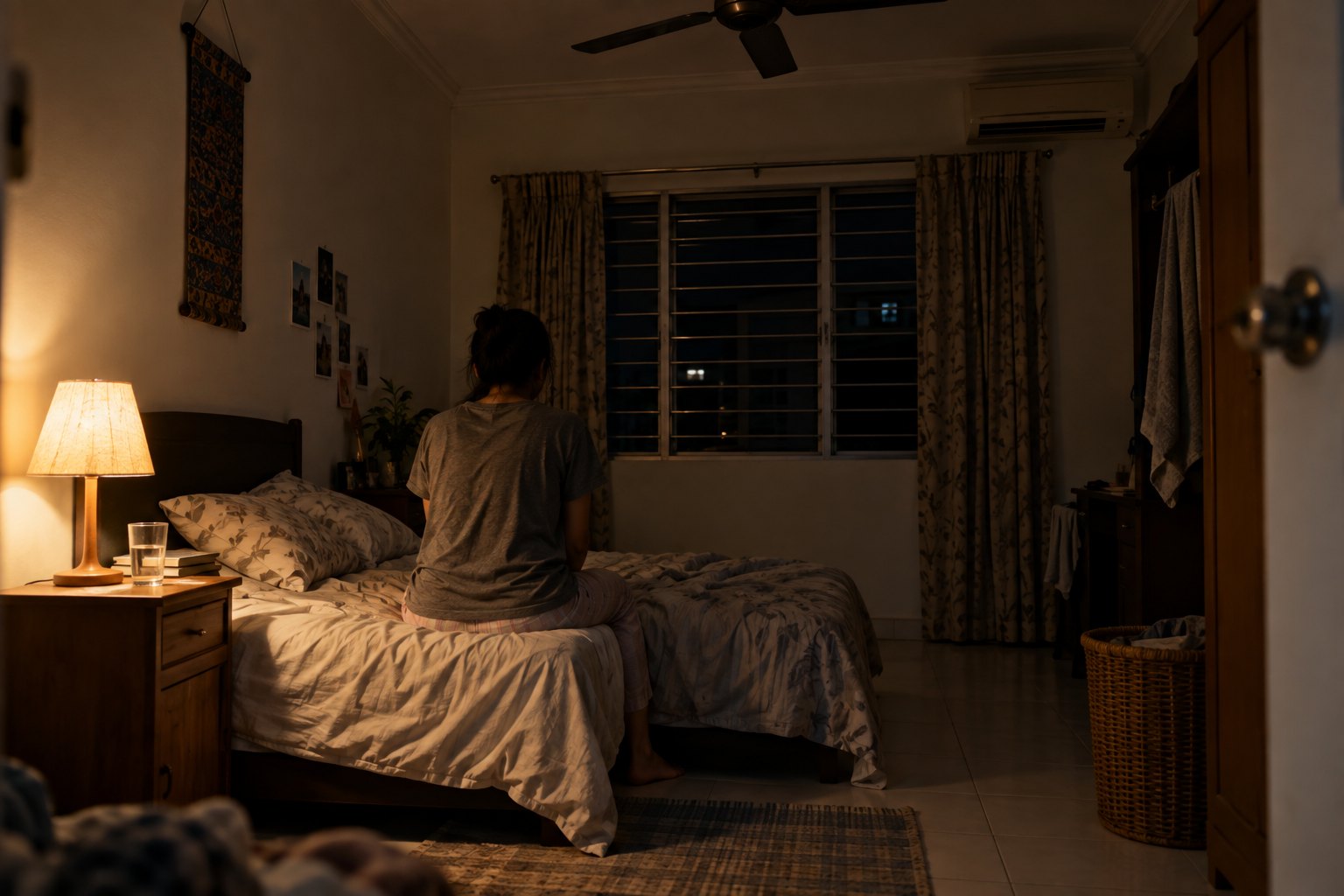
"I haven't slept well for a long time. Can TCM do anything?" This is a question that comes up often at the start of an online consultation. What usually happens next surprises people — the practitioner does not offer an answer. They start asking questions.
This article will not tell you what to take for poor sleep, because that is a judgement a practitioner makes about your situation, not something an article can supply. It is about what the practitioner is actually trying to understand during that stretch of questions — set out as 5 things. Knowing the process tells you what is worth mentioning.
I. First: in TCM theory, "not sleeping well" is not a diagnosis
Within the TCM framework, poor sleep (called 不寐 in the classical literature) is not a single situation — the same phrase covers different directions that need distinguishing, rather than mapping directly onto a course of action.
The same phrase covers difficulty falling asleep, waking repeatedly through the night, waking too early, and sleeping a full night yet still feeling tired. Within TCM theory these are understood as different situations, and each leads somewhere different.
How those distinctions are classified belongs to the theoretical framework of the organ systems and qi. That is a different kind of explanation from modern sleep medicine, and the two should not be conflated.
💡 Remember: the questions are not a delay. "I don't sleep well" is not yet enough to form an assessment on.
II. What a practitioner is asking about
Across a consultation, a practitioner will generally want to understand:
- The shape of the sleep itself — what time you go to bed, how long until you fall asleep, how often you wake, what time you wake, whether you can get back to sleep.
- How the daytime goes — energy, drowsiness, whether concentration has changed.
- Other signals from the body — appetite, digestion, bowel and bladder, palpitations, how warm your hands and feet run.
- Mood and stress — recent changes in life or work, ongoing anxiety or low mood.
- What you are already doing — sleep medication or supplements, whether you have seen a doctor, what tests you have had.
That last point matters most. If you are taking medication your doctor prescribed, say so, and never stop it on your own because you have started TCM care.
💡 Remember: these questions are not there to put a label on you. The practitioner is assembling a whole picture, not matching you against a list.
III. What gets asked, and why
| What the practitioner asks | What they are trying to understand |
|---|---|
| Trouble falling asleep, or waking easily? | These are different situations, and TCM theory treats them differently |
| How is your energy in the daytime? | Hours slept and how restored you feel do not always match |
| How are appetite and digestion? | A TCM consultation looks at the whole state, not sleep alone |
| What has changed in your life recently? | Mood and stress are part of what the consultation covers |
| What medication or supplements are you taking? | It bears on safety, and on what the practitioner can suggest |
This table deliberately does not say which answer means which pattern. TCM is not a self-assessment quiz — distinguishing is what a practitioner does after a consultation, not something a reader applies to themselves from a table.
IV. See a doctor first in these situations
Poor sleep is sometimes the visible part of something else, and that something else needs investigating. See a doctor first if:
- You snore with pauses in breathing, or wake up gasping. This needs medical assessment; TCM care does not replace the investigation.
- Daytime sleepiness is severe enough to affect driving or work safety. See a doctor promptly.
- There is noticeable weight change, palpitations, tremor or heat intolerance alongside it. These can relate to things only tests can confirm.
- Mood is persistently low, anxiety is hard to control, or you have thoughts of harming yourself. This is not something to wait on. Call 999, or go to the nearest hospital emergency department. To talk to someone, Befrienders KL is open 24 hours on 03-7627 2929. You can also contact your doctor.
- You already take prescribed sleep or psychiatric medication. Follow your doctor's treatment, make sure both sides know your full medication list, and never stop or adjust a prescription on your own.
⚠️ A safety note: TCM and Western medicine complement each other; it is not a choice between them. Sleep problems can have causes that only tests or imaging can confirm, and a TCM consultation does not substitute for those.
A note: this section is general information only. For conditions like these, follow your doctor's diagnosis and treatment, and seek medical attention when you need it.
V. Fitting it into life in Malaysia
- Shift work or a long commute. Ordinary here, and worth raising unprompted — your schedule is part of what the practitioner needs to understand.
- The afternoon kopi or teh. No need to give it up before the consultation. Just say honestly how many and at what time. It is information, not something to be corrected on.
- Air-conditioning and the room. Temperature, renovation next door, light in the corridor — environmental factors get skipped, but they are genuinely part of what gets asked.
- The phone before bed. Again, just say it as it is. The practitioner needs the real version, not the ideal one.
- Keep a few days' notes beforehand. Time to bed, time awake, how many times you woke. Those few lines are far more accurate than recalling it on the spot — see what to prepare before an online consultation.
In closing
✅ Worth remembering:
- In TCM theory, poor sleep is a presentation that needs distinguishing, not a label with a fixed answer.
- A practitioner asks across five directions — the sleep itself, the daytime, other bodily signals, mood and stress, and what you already take.
- Distinguishing is the practitioner's job, not something to apply to yourself from a table.
- Snoring with pauses, severe daytime sleepiness, marked weight change, or persistently low mood — see a doctor first.
- If you take prescribed medication, say so, and never stop it on your own.
❌ Do not:
- Judge your own situation from someone else's experience — theirs is not yours.
- Stop medication your doctor prescribed because you have started TCM care.
- Carry thoughts of harming yourself alone — reach out immediately.
👉 If you are not sure "where to even begin describing this kind of poor sleep", you are welcome to book an online consultation with HansMed, where a practitioner registered under the T&CM Act 2016 can assess it with you.
Sit with a licensed TCM practitioner from wherever you are.
HansMed Modern TCM
For general wellness education only — not medical advice. Consult a registered TCM practitioner for personal guidance.


